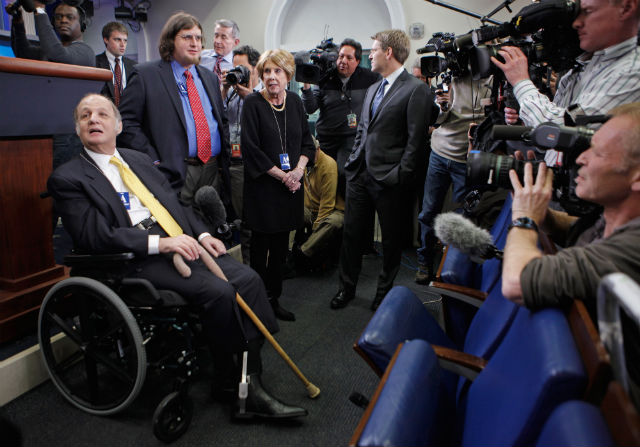
 Former White House Press Secretary James Brady, his son Scott Brady and wife Sarah Brady visit the press briefing room that bears his name in the West Wing of the White House. (Photo by Chip Somodevilla/Getty Images)
Federal prosecutors won’t pursue charges in the death of James Brady, the former aide to President Ronald Reagan who was shot and partially paralyzed during an assassination attempt in the 1980s.
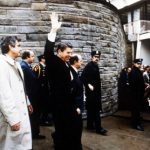
Brady died on August 4, 2014, and his death was ruled a homicide as it was ruled as a consequence of the 1981 shooting by John W. Hinckley, Jr.
The U.S. Attorney for the District of Columbia announced today that Hinckley, who is committed to St. Elizabeth’s Hospital, will not be charged: “The decision was made following a review of applicable law, the history of the case, and the circumstances of Mr. Brady’s death, including recently finalized autopsy findings.”
According to an autopsy report prepared by the chief medical examiner’s office, and finalized on Dec. 4, 2014, the traumatic brain injury sustained by Mr. Brady created difficulty managing oral secretions and food and led to aspiration pneumonia and other chronic diseases. At the time of his death, Mr. Brady was suffering from aspiration pneumonia. The chief medical examiner thus concluded that Mr. Brady’s death was determined to be “gunshot wound of head and consequences thereof.”
At his 1982 trial, the jury found Hinckley not guilty by reason of insanity of the two charges, assault with intent to kill while armed and assault with a dangerous weapon, related to the shooting of Mr. Brady. Because the jury conclusively made this finding, the government would be precluded now from arguing that Hinckley was sane at the time he shot Mr. Brady.
Additionally, before 1987, the District of Columbia courts abided by the “year and a day rule,” by which a homicide prosecution could only be brought if the victim died within a year and day of the injury causing death. At the time that Hinckley made his assassination attempt, the year-and-a-day rule was still in effect.
In summary, any further prosecution of Hinckley premised on his March 1981 shooting of Mr. Brady would be precluded by the doctrine of collateral estoppel, which would prevent the U.S. Attorney’s Office from arguing, or a court or jury from finding, that Hinckley was sane at the time Mr. Brady was shot. Thus, Hinckley would be entitled to a directed verdict that he was not guilty of the murder of Mr. Brady by reason of insanity. Furthermore, a homicide prosecution would be precluded by the common law “year-and-a-day rule,” in effect at the time.
As a result of the head wound he suffered, Brady was no longer able to work as the White House Press Secretary, although he retained the title, and used a wheelchair for the remainder of his life. He became an advocate for gun control, working with what became the Brady Campaign to Prevent Gun Violence.