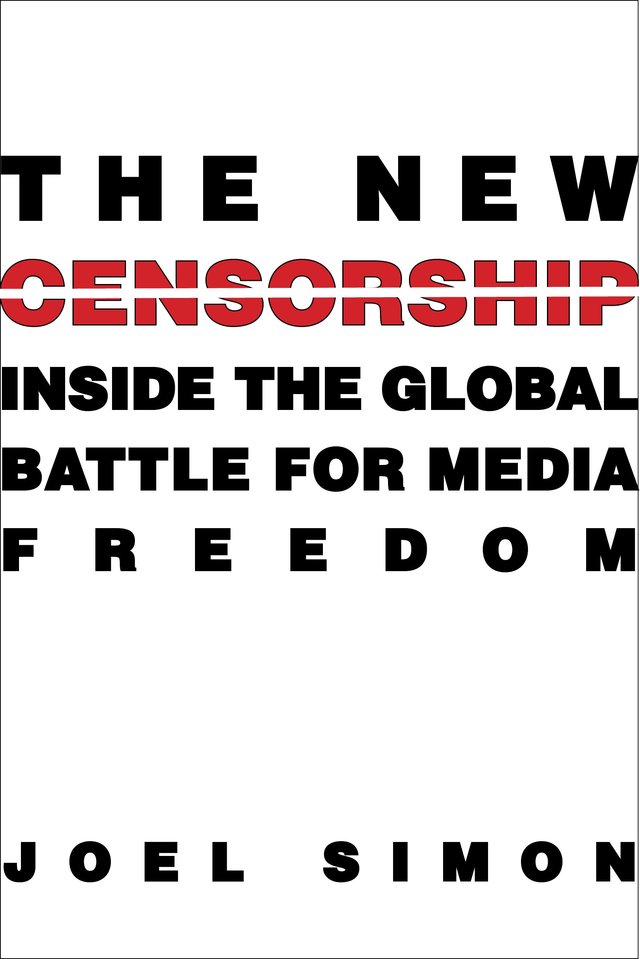
 2014 gave us several reminders about the risks journalists take when covering world events. In turbulent regions that prohibit free expression, members of the media are often under constant threat. Joel Simon, executive director of the Committee to Protect Journalists (CPJ), addresses this issue in The New Censorship: Inside the Global Battle For Media Freedom (Columbia, $28), and will be at Politics and Prose on Monday, January 5th at 7 p.m. to speak about it.
Simon explains the dangers journalists face in certain “hotspots” like Pakistan, Iraq, Syria, Russia, Turkey, and Egypt. He speaks to his personal experience from his time as a journalist in the 1990s and as an advocate with the CPJ; he begins with a story of his 2011 meeting with Pakistan’s President Asif Ali Zardari, which coincided with the week Osama Bin Laden was killed there. Simon also points to the experiences of his friends and colleagues abroad, who have been threatened or forced to leave the country or killed.
But The New Censorship is about much more than individual cases. The 636 journalists killed since 2002, and the many who have been kidnapped or imprisoned, tell stories about democracy and “the complexity and vulnerability of a system of global information” including traditional media, citizen journalism, blogging, and texting.
Though it might seem like the latter contributes positively to the former, Simon argues that the world is trending toward less freedom of the press. He cites four main reasons why: elected leaders who intimidate journalists by denouncing them, jailing them, or isolating them as an “other”; terrorists who have normalized journalist capture and execution; technology that enables armed groups to release their own propaganda and makes journalists less essential to them; and digital surveillance that makes it harder for journalists to protect their sources. These factors have also blurred the role of journalists with that of activists, which drags them into the fight.
How must we respond to horrific murders of journalists? This is the more complicated question, but Simon offers a few suggestions about what citizens, governments, the United Nations, and news organizations can do. He opposes the “news blackouts” sometimes implemented in the case of kidnappings, which are meant to deny publicity and the “value” of the journalist to the kidnappers. This, Simon says, compels news organizations to suppress news and doesn’t really work anyway.
Simon has led CPJ since 2006. He has written extensively on press freedom issues for Slate, Columbia Journalism Review, The New York Review of Books, World Policy Journal, and more. As a reporter, Simon covered the Guatemalan civil war, the Zapatista uprising in Southern Mexico, the debate over NAFTA, and economic turmoil in Cuba. He graduated from Amherst College and Stanford University, and previously authored the book Endangered Mexico: An Environment on the Edge.
The event is free to the public, and Simon will be in conversation with Rebecca MacKinnon of Global Voices Online and the New America Foundation, and former Beijing bureau head for CNN. A Q&A will follow.