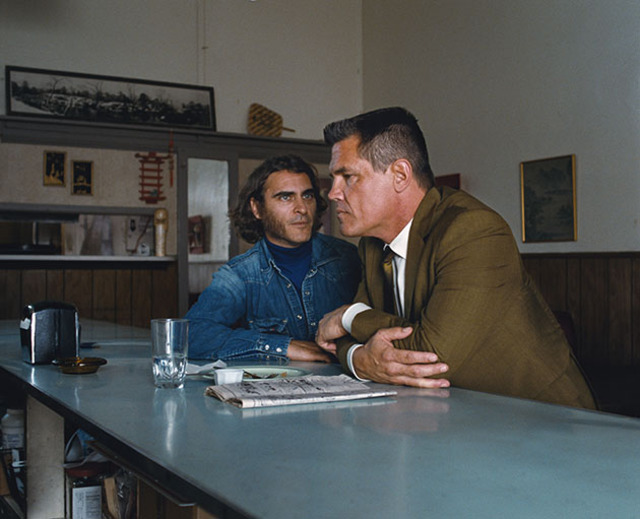
 Joaquin Phoenix and Josh Brolin (Warner Bros. Pictures)
Bigfoot has communication problems. Lt. Det. Christian F. “Bigfoot” Bjornsen (Josh Brolin), that is. Throughout Inherent Vice, director Paul Thomas Anderson’s adaptation of the Thomas Pynchon novel, the square-headed officer miscommunicates with hippie P.I. Larry “Doc” Sportello (Joaquin Phoenix), either deliberately or by poor choice. He tells Doc that his ex-girlfriend Shasta (Katherine Waterston) is gone when he just means she’s disappeared. Doc ironically pleads with Bigfoot to be professional for once, which also isn’t really what he means. This failure to communicate creates the disconnection at the heart of Inherent Vice and its characters’ struggles, but the irony is this communication breakdown leaves its characters in a haze—not necessarily a drug-fueled haze, but just a fog of uncertain motivations that make it hard to ever get purchase on the film and truly engage with it.
The movie opens with Doc being visited by his elusive ex, Shasta, who sends him off on a quest involving real estate mogul Mickey Wolfmann (Eric Roberts) and the Nazis who are guarding his latest development. This leads Doc on a noir picaresque where he moves from one scrape to another involving a disappearing surf-band sax player (Owen Wilson), a dental syndicate led by Martin Short, and a … well the plot doesn’t really matter. I haven’t read all of Pynchon’s novel, but Anderson seems to have adapted it faithfully, trimming a character here and changing chronology there. He takes perhaps the greatest liberty by adding the character Sortilège (Joanna Newsom), who narrates the film sporadically with text (mostly) taken from Pynchon’s own words. As if there wasn’t enough trouble connecting characters, Sortilège seems to be coming from Doc’s own imagination, sitting beside him as he drives his car one moment and then disappearing the next.
This disconnection isn’t limited to a character that may or may not exist. Doc seems disconnected even from his love interest. In the film’s very first scene with Doc and Shasta, the pair’s conversation is mostly covered in separate shots, even though they’re speaking in a small space.
Doc may be an investigator, but despite his professional and personal questioning, he doesn’t seem to connect with anyone, except ironically his sometimes-nemesis Bigfoot. In the novel, Pynchon depicts Bigfoot’s use of hippie slang as pandering, but in Brolin’s characterization, despite his hostility to hippies, he seems to genuinely want to communicate with Doc.
Anderson has been down this road of quirky ensemble before, in great, ambitious films like Boogie Nights and Magnolia, but the sense of loss that pervaded the characters in those films seems missing here, lost in a dense plot that doesn’t hit the notes that resonate so well in Anderson’s best films. Phoenix seems to be in a haze for much of the film, which may be appropriate to the character but makes it hard to follow his picaresque adventures with much interest. Brolin is the standout here, finding some depth in what could have been a cartoon character. And I like Hong Chau’s Jade: A prostitute who could have been another cartoon but seems to be channeling the movie’s noir roots. For Eric Roberts’ Mickey Wolfmann may be one of the actor’s more respectable recent roles. Roberts’ career has seemed desperate, lowered to such dreck as The Hot Flashes and a voice role as a cat in one of David DeCoteau’s talking animal movies; sinking so low as to mimic the sound of a cat drinking in the later.
Raymond Chandler once admitted that even he didn’t know who had committed one of the murders in the movie version of his crime novel The Big Sleep. Chandler created an iconic gumshoe in Philip Marlowe, a flawed hero trying to navigate the deep seeded corruption of Los Angeles crime. But his greatest character may have been Los Angeles itself, a city whose presence he vividly conjured in his work. I wish Inherent Vice had had such a well-formed central character. The movie is a stoner detective story transplanted from L.A.’s film noir era to 1970, the waning end of an era. If Chandler wrote about an L.A. that is long gone, Anderson’s L.A. is conscious of what many urban centers are going through right now: Poor neighborhoods are being taken over by real estate prospectors, urban revitalization putting up massive, hideous structures where once there were empty lots. It is in these details that Inherent Vice works best, and ironically in its most stoic of characters. But the central lead and the convoluted plot are sitting on a fragile foundation.
—
Inherent Vice
Written and directed by Paul Thomas Anderson
Adapted from the novel by Thomas Pynchon
With Joaquin Phoenix, Josh Brolin, Owen Wilson, Katherine Waterston
Rated R for drug use throughout, sexual content, graphic nudity, language and some violence
Running time 148 minutes
Opens today at E Street Landmark Cinema, AMC Georgetown, the AFI Silver, ArcLight Bethesda, Angelika Mosaic, and selected area multiplexes.