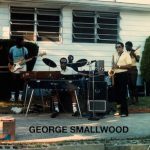
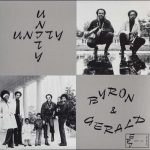
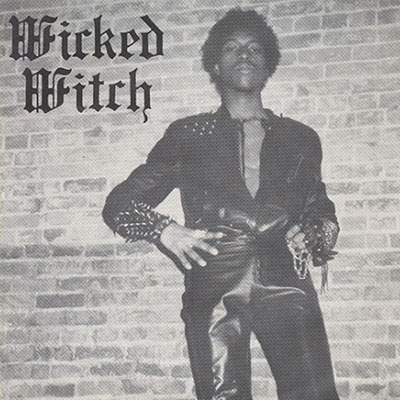
 “Fancy Dancer” 7″ single sleeve art, 1985 (Discogs)
Welcome to this week’s installment of my column on the Washington area’s musical history as seen through private press records; limited editions released by musicians foregoing the major label route. Wicked Witch, aka Rick Simms, released a series of records in the late ‘70s and early ‘80s that were a unique blend of prog rock, hard funk, and jazz. EM Records compiled these recordings in 2008 on the album Chaos 1976-1986. Simms was not available to comment, but I had a long conversation with Pastor Virgil Roberts, who grew up with Simms and played drums in Paradigm, the band Simms formed prior to Wicked Witch. Pastor Roberts was very generous with his time.
DCist: Can you tell me about the kind of music you listened to when you were growing up?
Pastor Roberts: I’m a Washington native. I grew up in Northwest Washington in the Meridian Hill area at 14th and Euclid Streets. So I used to go over to Rock Creek Park, the Tivoli, the Savoy and a lot of different movie theaters. I went to the Kalorama Road Skating Rink and a lot of different venues. When I was there as a young boy, I got into a lot of mischief.
I came back one day from summer camp and saw a young lady who lived in the same brownstone as my family. She asked, “What are you doing here?” I said what was she talking about? “Your mother bought a house in Southeast, you don’t live here anymore!” I was devastated, man! Northwest was like Disneyland! I lamented moving from Northwest to Southeast, but If I hadn’t moved, I probably wouldn’t have embarked on my musical career.
I was doing with what young people do: Playing football, baseball, basketball, whatever we could do in the neighborhood. One year we got together and, not having any musical skill whatsoever, we put a musical group together. One guy on A Street—Clifton Thompson—he played bass. A guy named Andrew [possibly Young?] wanted to play guitar. I said, “I guess I’ll play drums then.” I had my mother get me a drum set, and we started playing together. We started doing cover material and then our own originals, but we weren’t really great musicians.
DCist: What time period was this?
Roberts: This was in the early ’70s, maybe ’71-’72. Then I met Adrian Thomas, and he played guitar. I think he introduced me to Rick, because he lived right around the corner from me. So we started playing together, and we started getting really good with original material. The majority of what we did was original, with maybe 5 percent covers. We used to go to all different kinds of concerts to see rock and roll groups and progressive jazz groups. We must have seen Chick Corea about ten times, The Mahavishnu Orchestra. All different types of artists. Michael Urbaniak. The violin player—I can’t think of this guy’s name. He had his own group, he used to play with Mahavishnu
DCist: Jean-Luc Ponty?
Roberts: Yea, that’s right! We saw Larry Young. We used to go up to the Cellar Door in Georgetown. We went to the Childe Harold [now Darlington House] I think we saw Lifetime with Tony Williams there [ed. note: droool]. We had all different types of influences. So when we got together initially, we started playing originals, rock and roll music. We were called the Wild Dawg Band and we got a few gigs here and there in different little clubs. It was wild! Then we changed the name to Blind Rage. We’d play block parties and stuff like that.
Around the corner from where I lived in Southeast, they’d have these summer block parties every year and we’d always play them. Most of the groups there would play rhythm and blues music; stuff you heard on the radio. But we would just play our original material, rock and roll music, and everybody would go, [laughing] “Where are these guys from?” It was kinda wild, but we pretty much held to our guns and played the music we liked to play. A lot of times we’d play other venues with other rock groups and they would be amazed at our musicianship. We didn’t have the best equipment, but the musicianship was really incredible. People gave us a lot of respect for our musicianship. After Blind Rage, Rick, Adrian Thomas, and myself started Paradigm [spelled Paradiagm [sic] on the recording]. We went to [Pep Sound Box Studio] in Arlington and this engineer named Peplo—we called him Pep for short—recorded us.
So I was riding down the street one day, maybe five to seven years ago. And there was this car riding behind me on East Capitol Street in Southeast—a Mercedes Benz. I pulled off to the side and he pulled off behind me and it was Rick! We hugged each other—I hadn’t seen him in years. We talked and caught up and exchanged numbers and he was telling me what he was up to. he gave me a CD of some of the masters we recorded—he wrote the material. He gave me a CD of masters from Racetrack records that he called Psychedelic Madness.
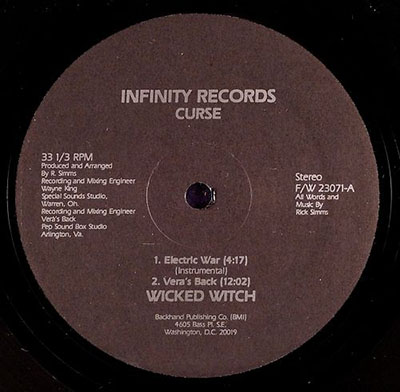 Infinity Records F/W 23071 (Discogs)
DCist Was this ever released?
Roberts: It’s a blur! I gave my life to the Lord in 1981. We played together until around 1980 or so. When I got faith, Rick approached me a year or two later and he said he wanted to start the group back again. At the time I was interested. We made excellent music together. So I asked him what the name of the group was going to be. He said, Godhead. I knew the Lord at that time and didn’t want to be blasphemous. So that completely turned me off, and I turned him down. But I didn’t realize he was still recording stuff in his own studio. And that’s where the Wicked Witch recordings came from. I didn’t know anything about that at the time so when he resurfaced again I saw “Wicked Witch?” That blew my mind. But he was always a prolific composer and performer and an excellent bass guitarist. We complemented each other perfectly.
Then I started doing a little research and I saw this stuff online—writeups about Rick and it was really amusing. And then I saw that his stuff was being sold in Japan. His contention was he wasn’t being paid. They used the material but never paid him.
I downloaded one of our songs, “Vera’s Back.” Rick wrote that song. He produced it at Racetrack Studios. Psychedelic Madness has four songs on it “Morbid Man,” “Realize,” “Illusions Part II” and “Rise.” Adrian Thomas played guitar, I played drums. Louis Oxley keys. Carlos—I don’t remember his last name. Lauren Elliott was on violin. It’s copyrighted 1999 but we recorded this music in 1978 but we didn’t release it at the time. At the time we were a fledgling group. We played different venues here and there. What happened was we were going through being “rock stars” and Rick was shopping the music around to different companies and got a lot of rejections. So he finally got in contact with [name redacted]. So he heard the music and liked what he heard, and told Rick that they could work together and do some recording. But he told him the music was too far out—Tone the music down. Adrian said Rick refused, and that broke the deal up.
From that point, we didn’t move in that direction. At that time I was finding myself from a spiritual perspective and that changed the whole course of my musical direction. I’m doing strictly gospel now. Back then, we had a progressive sound but we also played progressive jazz. This song is called “Illusions.” [plays me a guitar-based funky prog track over the phone] Rick wrote that song, but we’d all chime in. I know it’s kind of hard to gauge from that sound quality over the phone.
Some of our music was on underground stations at the time. WGTB [Georgetown University’s late, lamented underground radio station] used to play all sorts of avant garde stuff and they used to play our music. And I think they might have interviewed us. It was a long time ago, man!
Listen to Paradigm perform “Vera’s Back”