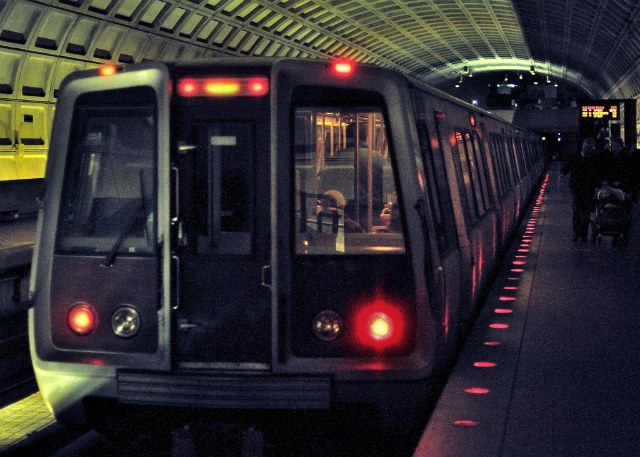
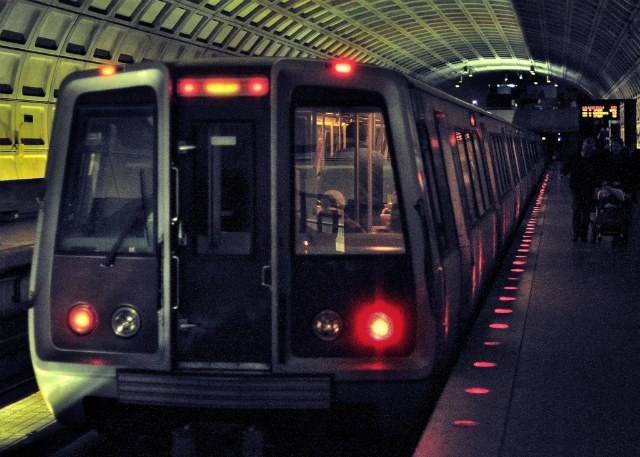
 Photo by Rolenz.
It’s been two weeks since the fatal smoke incident at the L’Enfant Plaza station and we’re no closer to finding out exactly what happened and why. But that’s not stopping Metro and D.C. Fire officials from pointing fingers at each other.
On January 17, a report conducted by the D.C. Fire and Emergency Medical Services
Department concluded that not only did firefighters “[encounter] difficulty communicating with each other in the Metro station using traditional radio communication channels,” but that they actually notified Metro about such problems existing at L’Enfant Plaza on January 8.
But Metro countered the report, saying that D.C. Fire didn’t tell them they had encrypted its radios before the January 12 incident, WAMU reports. According to a timeline of events, it took firefighters and first responders a while to evacuate passengers from the two smoke-filled trains stuck near the platform, while it took Metro officials nearly 45 minutes to shut off power to the malfunctioning third rail.. The timeline of events reveals that radio communication problems were to blame for the delayed response time.
And things continue to become more complicated, as a report by the D.C. Homeland Security and Emergency Management Agency released over the weekend now counters Metro’s claim that D.C. Fire’s encrypted radios played a role in the communications breakdown. The report confirmed that D.C. Fire told Metro about the radio problems at L’Enfant Plaza on January 8, which Metro did not address before the January 12 incident, but it concluded that “FEMS radio encryption function does not appear to have played a role in the communications difficulties.”
The back-and-forth with D.C. Fire isn’t the only problem Metro is facing over the incident. To date, more than 60 people have filed lawsuits against Metro over the smoke incident. Kim Brooks Rodney, an attorney with personal-injury firm Cohen & Cohen (Ed. note: no relation) representing the lawsuits, recently told Housing Complex that her clients are seeking “compensatory damages.”
But the L’Enfant Plaza smoke incident is just a catalyst for growing concerns many residents and riders have about the safety of riding Metro. In a statement, local transit union ATU Local 689 voiced their concerns with WMATA, writing that the smoke incident has “exposed that the [WMATA] has woefully neglected its commitment of a safety culture that can save the lives of riders and workers.”
As a result, ATU Local 689 outlines four ways in which Metro can quickly “commit itself to a safety culture now:”
- Reallocate resources to retrain the entire workforce for emergency preparedness at least annually. Additionally, commit to more substantive programs like Close Call Reporting, regular seminars, and small training sessions.
- Hold management to the same standards of emergency preparation as our members so that they, too, are prepared when an emergency strikes. Currently, management is not held to the same standards.
- Abolish the ineffective Safety Committee meetings and reinstitute the Joint Labor/Management Safety Committee to increase worker involvement and open communication between management and employees.
- Create incentive programs for reporting safety violations and hazards. By doing so, our union believes this will change the perception of retaliation many workers believe they will encounter if they make a safety report. It will also foster a trust between management and employees.
As Metro and D.C. Fire go back-and-forth over the issue of radio communication in the L’Enfant Plaza station, the National Transportation Safety Board said it could be six months to a year before their full, detailed report of what caused the smoke incident is released.