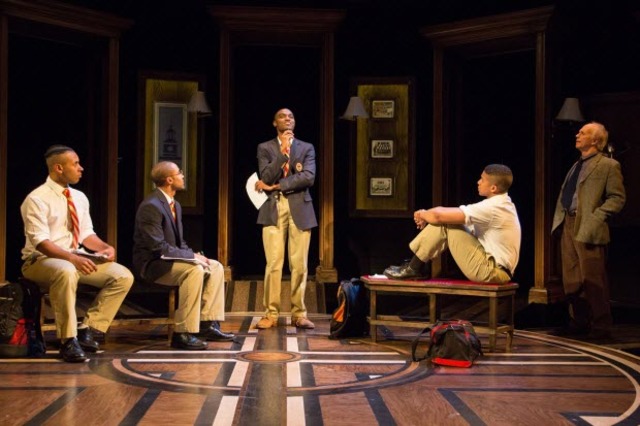
 Keith Antone, Jonathan Burke, Jelani Alladin, Jaysen Wright, and Alan Wade in Choir Boy. Photo: Igor Dmitry.
By DCist Contributor Landon Randolph
According to their depiction in art and popular culture, boarding schools function less as educational institutions and more like tidal pools. They’re self-contained ecosystems, whose denizens are forced to live and interact in close proximity; tiny communities defined by their involuntary coexistence and a constant awareness of the tides in the larger world around them, threatening or promising to sweep them out to sea. Choir Boy, a play by Tarell Alvin McCraney currently being performed at Studio Theatre is no exception. Set at a historically black all-male boarding school in the present day, the play centers around Pharus (Jelani Alladin), a closeted student whose homosexuality is something of an open secret, as he attempts to find his place in the school’s prestigious gospel choir.
The play opens with Pharus singing the school song, clearly enjoying himself, until one of his fellow choir mates starts audibly whispering homophobic and racial slurs at him. This episode begins a series of incidents that highlight just how difficult Pharus has it. He’s navigating a space fraught with people that he both desires and fears: Well-muscled young men (seriously, what Calvin Klein catalogue did they find this cast in?) who are uncomfortable enough in their own skins that they feel threatened by anyone remotely different.
Pharus pirouettes through this potential minefield with a sharp-elbowed realism that speaks volumes about both his ambition and just what he needs to do in order to survive. He’s clearly smarter than just about everybody else in the room, and in his scenes with the headmaster (Marty Austin Lamar), Pharus consistently outmaneuvers him to get his way. It’s so patently unbalanced a contest that you start to wonder how this headmaster got his job in the first place. He sputters ineffectually at the students he’s supposed to be in charge of, clearly out of his depth. Not only does he not get his way, he has no understanding of the day-to-day realities of young teenage boys.
There’s a series of moments throughout the play that ring false, moments where the words being spoken seem inorganic and disconnected from the people speaking them. The students all seem to live with their religion on their sleeves, which makes sense— it’s a religious school after all— but it’s approached with “gee-whiz” enthusiasm instead of self-consciousness or cynicism that you’d think at least some of the students would exhibit.
The result is a play that occasionally feels like a preachy after-school special from the mid ‘90s. The effect is exacerbated by the fact that many of the students are not as well-drawn as Pharus is, and can devolve into stereotypes: There’s the class clown struggling to keep up with his schoolwork; the shy one; the angry kid struggling with emotions and events beyond his ken. These are all people that you feel like you’ve met before, so the play’s capacity to surprise is considerably diminished.
The exceptions to this are Pharus and his straight roommate AJ (Jayson Wright). Their relationship manages to be platonic yet loving; it’s touchingly close and consistently more nuanced than the other interactions taking place around them. AJ is more understanding than any high school kid has any right to be, but Wright approaches his role with an assurance and easy charm that lends credence to the lines he’s given.
The show’s main draw, however, is the gospel music that forms its emotional backbone. Performed completely a cappella, there’s a richness, depth, and vulnerability to the songs that make you feel like you’re getting to the core of who these people are. It recalls a rich musical tradition, and Pharus’ fascination with it makes perfect sense. While the cast is singing, Pharus finds the honesty he craves that deep down. So does the audience.
Choir Boy runs at Studio Theatre through February 22. Tickets, $44-88, are available here.