
By DCist Contributor Jon Pacella
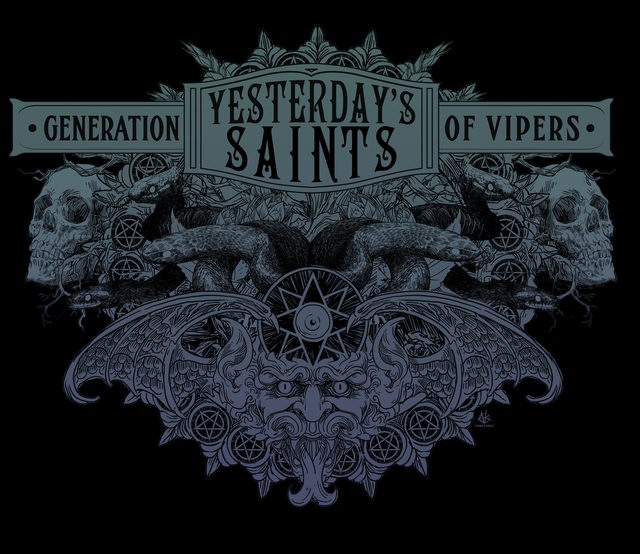
It’s been four years since Virginia’s Yesterday’s Saints released their debut self-titled EP. During that time, while honing their live show opening for some of the heaviest touring metal bands, they’ve been carefully crafting their full-length debut album, Generation of Vipers.
Vipers doesn’t come out until next week, but to satiate your hellish hunger, we have a new song from the album, “Recursion.” Thick guitar riffs and low, coarse vocals lay the foundation of the song, then give way to one of the most grandiose choruses of the album. Singer Matt Rice explains the theme behind “Recursion”:
“The theme is based off two theories of our universe and dimension. One from a theory in quantum physics called membrane theory. The other is a historical conversational theory of lore that we’re all a figment of a man’s dream. When he awakes it is the end of times. When he goes back to sleep and begins to dream, it all starts over. It’s written in a scattered way like the ending of a dream. Referencing The Crusades, Nostradamus, Flight of Icarus, Vlad the Impaler, our own current space exploration using a solar sail, and collapsing of the universal membranes.”
The time that the band spent creating Generation of Vipers has paid incalculable dividends. They haven’t just recorded an album; this is the true definition of a magnum opus. A concept album that is split into three acts like a heavy metal opera, Vipers explores historic and literary realms to tell its’ tale.
Rice says “It courses the history of Satan from pre-man to the present and the future of mankind. I pulled inspiration from Milton’s Paradise Lost, The Bible, quantum physics, and historical lore surrounding the existence of man and the universe.” Albert Born expands on the Biblical references on the album, that “it is based loosely on the story of Cain and Abel, with the idea that man has inherited some evil from Cain’s lineage. It is a constant battle and history repeats itself with the rise and fall of societies and how religion plays its role. There is a bit of a moral to the whole story, though. All that is written as being ‘divine’—such as the bible and other religious pieces of literature—are all written by man, who we all know is certainly not perfect and subsequently not really ‘divine’.“
The album is a start-to-finish thrill ride that crosses genres as it weaves its’ tale across the three acts. Right from the beginning, “Fall of the Ancients” raises the bar, and sets the tone for Act I. Each member’s role on the album is noteworthy, but when all four components of the band come together as one, it is apparent that the band has found their stride honed it to perfection. Rice’s vocals range from savagely guttural growls to soaring, operatic clean vocals. The intricate melodies and chugging riffs of guitarist Witt Black are a focal point of Vipers.
The rhythm section of bassist John Batease and drummer Albert Born are a match made in hell, as John’s bass sound fills every nook and cranny of the song, while Albert’s complex drum patterns and double-bass work that would rival the fastest feet in heavy metal. The tempo of the drums approaches warp speed in “Origen Adamantius.”
Born breaks it down mathematically: “Writing the song literally started with me doing the fast tom fills at the beginning and it just started to come out of us. I kept pushing the tempo until we hit 240bpm. I really wanted this tempo as it is easily divided in half to 120 or 60bpm—tempos our bodies naturally and easily follow. The pulse, once we got to that tempo, just felt right and really intense.”
He adds, “there’s some pretty fast parts, and some were outside of my comfort range at the time. To play those parts I really focused on cleaning up and perfecting my techniques, pushing my limit constantly. I even got a Drum-o-meter that measures how many strokes per set amount of time. It’s a great tool that really helped me push my speed up. It almost became a game for me.”
Standout tracks like “Cain’s Agony” and “Recursion” are brilliant, and the use of varied instruments like cello and violin (with guest musicians Devree Lewis and Sarah Stepanik, respectively) and piano are elegantly utilized in ”A Priori ,“ the solemn interlude between Acts I and II, and “Luctus in Mane,”. “Luctus,” the outro that both ends the album on an enigmatic note and wraps around to the beginning of the album, also serves as in intro for “Fall of the Ancients.”
To grasp the full appreciation of this three-part saga, listen to this one from start to finish, and then listen to it again. Wrap yourself around the tale that Generation of Vipers has to tell, and let the music guide you through the metal-driven narrative. This one will get inside your head and stay in rotation for some time to come.
Generation of Vipers is set for release on Tuesday, February 3rd, and can be pre-ordered here.