 Haluk Bilginer (Adopt Films)
Director Nuri Bilge Ceylan’s last film, Once Upon a Time in Anatolia, ran a forbidding 157 minutes, but I still made time to see it three times. Anatolia was my favorite film of 2012, a masterpiece about storytelling both in myth and in ordinary time, and a gorgeous study of the Turkish landscape. Ceylan’s new film, Winter Sleep, runs forty minutes longer, and feels it, every second of its extended duration taken up by slow-burning arguments among its frustrated characters. If the film is in part about winter doldrums, it conveys this ennui perfectly.
Aydin (Haluk Bilginer) is a retired actor and part-time newspaper columnist who runs a hotel cut into a mountainside in central Anatolia. It’s winter, and muddy roads make it difficult to reach the hotel, but Aydin explains to a friend that if he paved or even added gravel to the roads, tourists would complain about lost “authenticity.” This could be the director speaking of his own film, which is a major aesthetic attraction weighed down by a painstaking approach that makes it difficult to stay engaged.
The film begins with a return to the landscape familiar to fans of Anatolia. A shot of the empty countryside is followed by a shot of Aydin slowly walking down a dirt road in the distance. Ceylan likes to introduce characters as tiny figures overwhelmed by their surroundings, and scenes like this would come off more powerfully on the big screen than they do on the iPad I used to watch an online screener. The film can be trying, but it’s undeniably beautiful, from warm interiors with rich skin tones to cold exteriors that perfectly frame the vast cold that envelops these people.
Aydin surveys the land around him: A group of Japanese tourists is off in the distance, exploring the mountain above him, and then the camera looks down at his hotel. The film’s first scenes establishes Aydin as the tired lord of his domain, a man gracious to paying customers, but soon you learn his is less gracious to his own people.
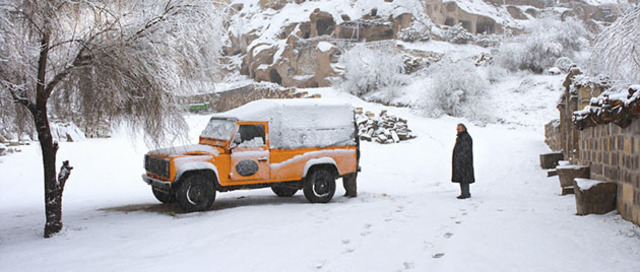
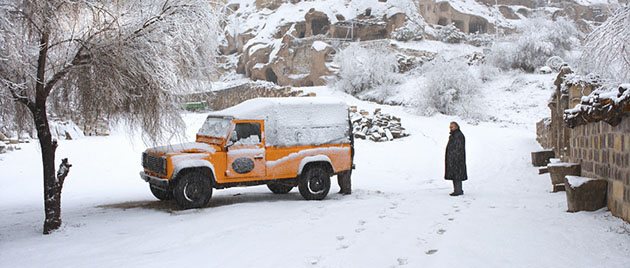
As in Anatolia, Turkey is another character, the director’s gently roving camera following characters as they walk engulfed by the land, or watching from a distance as a bright orange truck struggles through a snowstorm. Aydin is as overbearing a character as the land, thoroughly observed and fleshed out by Bilginer, who looks like an Anatolian James Mason. But the domestic conflicts that the film gradually turns to become as overwhelming as the land.
A confrontation early in the film sets the rest into its slow motion. Ilyas (Emirhan Doruktutan), a young boy, throws a rock as Aydin and his assistant Hidayet (Ayberk Pekcan) are driving. This leaves the passenger window cracked and splintered, which turns out to be an appropriate metaphor for Adyin’s view of his homeland. Ilyas’ father rents one of the rundown properties at the base of the mountain from Aydin, and the boy saw his family’s humiliation as debt collectors came to harass his father for falling behind in his rent.
Back at the hotel, we meet Aydin’s younger wife Nihal (Melisa Sözen), who has been trying to get her husband involved in a project to raise money for area schools, but he dismisses her efforts. We learn from Aydin’s long conversations with his wife and sister that he can be an arrogant, patronizing bastard. Bilginer makes this seigniorial cad watchable to a point, and there’s no faulting his performance, but this realistic unpleasantness becomes too much. Aydin’s sister Necla (Demet Akbag) expresses the boredom that everyone in the film, and eventually, everyone watching may feel. Winter Sleep won the Palme D’Or at Cannes last year, and the film is an impressive achievement. As difficult as it was to get through, its images have stayed with me, and I’d be happy to revisit a selectively edited version of the film. But I won’t be seeing it three times.
—
Winter Sleep
Directed by Nuri Bilge Ceylan
Written by Ebru Ceylan and Nuri Bilge Ceylan, based on short stories by Anton Chekhov.
With Haluk Bilginer, Melisa Sözen, Demet Akbag, Ayberk Pekcan.
Running time 196 minutes
Not rated, but there are scenes of cruelty to animals that may upset some viewers.
Opens today at Angelika Pop-up and Angelika Mosaic