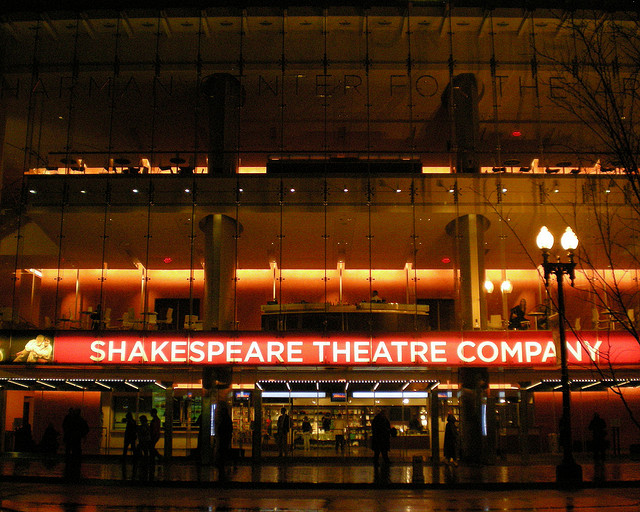
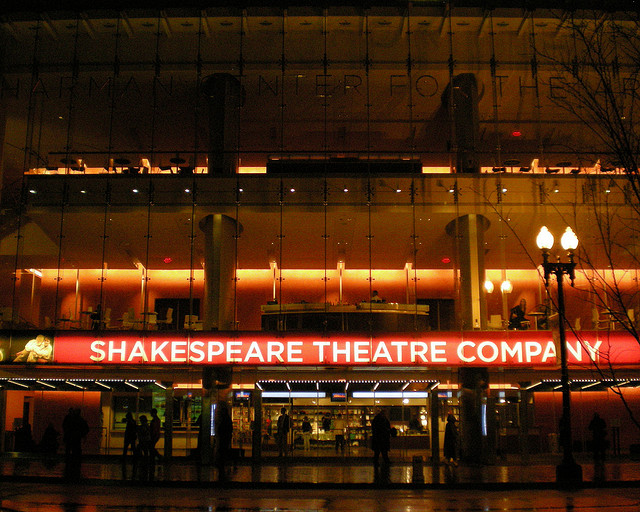
 Photo via Kevin Harber/Flickr
By DCist Contributor Anya van Wagtendonk
Dunsinane, a sequel to Macbeth, premiered in London in 2010 via the Royal Shakespeare Company. It has since gone on to several touring productions across the globe. The play opens tonight at Shakespeare Theatre Company’s Sidney Harman Hall. We spoke with Associate Director Luke Kernaghan to learn more.
DCist: How long have you been involved in the production?
Luke Kernaghan: It was originally performed in London, at the Hampstead Theatre*, in 2010. It was originally a Royal Shakespeare Company commission. So they commissioned David Greig, the playwright, and it was performed at the Hampstead Theatre, and John Tiffany, who was one of the associate directors at National Theatre of Scotland came to see the show, and he went back to National Theatre of Scotland, and he said, “Guys, this is an amazing piece of theater, and it should be OUR piece of theater, because it is about Scotland, it’s got Siobhan Redmond, who is absolutely one of Scotland’s most renowned actresses, it’s written by David Greig, who is one of our foremost playwrights. This should be ours. We need to get this out to the Scottish people to see it.”
So National Theatre of Scotland came on board at the time as a co-producer. The show then did a tour of a few venues in Scotland, then also went down to the Royal Shakespeare Company in Stratford-on-Avon. Then, subsequently, a year or so later, we did another national tour of the United Kingdom. Then last year we were lucky enough to start to take it internationally.
Last year we went to China—Beijing, Shanghai, Hong Kong, Taiwan—and then to Moscow, and it’s been fascinating to see how different cultures react and to and identify with this play. And so now we are here in America, and we seem to have—this little play that was just supposed to be on for a few weeks in London, seems to be the play that never dies. It just seems to go on and on and reach more and more people, which is fantastic.
DCist: So when you do work in front of these non-Scottish, non-British audiences, do you have to adapt anything so that it’s more accessible?
LK: The one thing that we’ve made sure is, for American ears…Scottish accents can be very, sometimes not quite as easy to attune to, so we just make sure that we can connect to the audience and that they can hear and understand all the words, because it is really beautiful language. The language that David has written, there’s a poetry to it. It’s very detailed. It’s so evocative.
He writes a lot about the landscape. Because it’s a play about Scotland, he really not only looks at the political aspect of it, but also the landscape, and how you identify yourself to your country, not just through relationships and places, but also through the geography of it. And so there’s this wonderful line, when this young English soldier is talking about Scotland, and he describes how, “the hills are so steep that the green just slides off them.” I don’t know if you’ve ever been to Scotland, but that is just exactly what the hills and mountains of Scotland are like. And so I think we hopefully take the audience through an idea of this country that they may or may not have been to, and really try to evoke Scotland in this time period.
DCist: Do you feel like a familiarity with Macbeth is required to see this play?
LK: Absolutely not. What’s lovely is, it’s very much not a sequel. It’s a look at Scotland in the immediate period afterwards, after that play. If you know Shakespeare’s play, there are some lovely little in-jokes and references and things like that. However, you really don’t need to be familiar with Shakespeare at all, let alone Macbeth. It stands very much on its own two feet as a piece of theater.
Dunsinane: Trailer – 2015 USA tour from National Theatre of Scotland on Vimeo.
DCist: Do you feel like you bring in a previous understanding of these characters, then, or do you approach them as entirely new characters?
LK: It’s really interesting, because that’s something we talk about quite a lot amongst ourselves. I think what we really do is we trust the writing. So David has written a beautiful play, and really all the information we need is there in his text. One of the hard things to do as a creative team, and for the actors as well sometimes, is to just trust the text. As soon as you do that, it actually becomes very simple to produce the play, to perform the play.
When David wrote the play, he really wanted to make sure that all of the language, every word, would be a word that Shakespeare would have been familiar with. And it’s fascinating when you see the play, the language feels so contemporary, and yet, it has a direct link to Shakespeare. That’s not to say, our play’s not in verse, it doesn’t feel like that at all, but I find it fascinating that David has been very rigorous about making sure that the language has a connection to Shakespeare.
DCist: How do those themes of contemporary political reference appear in the play? How have different audiences around the world reacted to the show?
LK: Just a little bit of context about the play: David originally wanted to write a play about contemporary warfare, and about people being in a foreign land, young contemporary soldiers, what it meant to be part of a team, a squadron, as it were. And he started to develop some ideas, some characters, some scenes. As he was developing that, National Theatre of Scotland came out with their multi-award-winning, global smash Black Watch, and David went, “Ah, someone’s basically written that play, and written it very well.” So he shelved that idea for a little while.
Not long afterwards, he had seen, in the space of a year, about three different productions of Macbeth, and he started to think about the events of what happened after the show, historically, and it started to coalesce with this idea in his mind of young soldiers, of people being somewhere and wanting to do right in a country where, in a place where you don’t really understand, or the notions of right and wrong are different.
His direct inspiration was the Iraq war, and so that’s what he originally was looking at. When you come and see the play, you really see—I think people identify with it in ways that have absolutely shocked us. So we took the play to China, and we were in Taiwan, and the Taiwanese people came up to us afterward and said, “This is our story. We are Gruach.” And that was shocking to us. We really didn’t expect that.
Likewise, when we then went to Russia and we were in Moscow, it was last year when the Ukraine and everything that was happening there was in all the newspapers, and the people there said the same thing. They said, “This is our story, Gruach is the Ukraine, Scotland is the Ukraine.” And there’s something really powerful about how this play seems to become more and more relevant, and people will absolutely read their own history, their own struggles. War is a universal theme that people are experiencing all around the world, and so people really read into it, aspects of their own history and culture in a way that has absolutely shocked us.
There’s also another interesting aspect which is the fact that it’s a play about national identity as well. Performing it last year around China and Russia when Scotland was preparing for its referendum, about whether or not the Scottish people wanted to stay a part of the United Kingdom, that was fascinating, to really have a play that was questioning and dissecting what it meant to be Scottish, and what is your sense of national identity, at a time when everyone in Scotland, everyone in the UK was talking about that. Again, David had no idea that that’s what was going to happen when he was writing the play. So it’s really interesting how this play just seems to become more and more relevant.
I’m really, really interested to see what the audience here in Washington—how they react to it, what they read into it: Does it speak to that sense of the consequences of power, the decisions we make? There aren’t many times when actually we get to really question, is power always a good thing? How do we wield that? Can we make political choices and divorce that from the personal ramifications? I don’t think it’s as easy as that. We sometimes like to try and divorce the personal ad the political, but they are always going to be indelibly linked together.
Dunsinane opens tonight at Shakespeare Theatre Company’s Sidney Harman Hall. Tickets are available here.
*Corrected