 Photo via NME
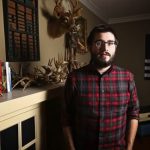
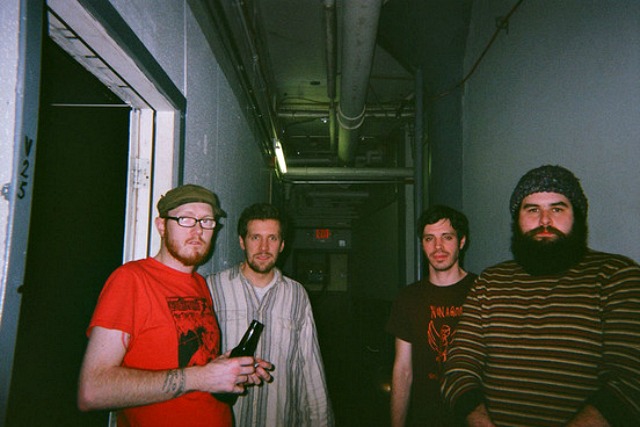
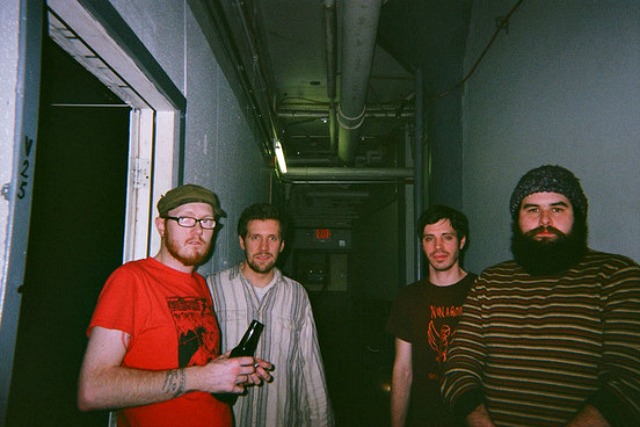
Sometimes heavy music is easy to switch off when bands are only interested in increasing the speed and turning the dial up on their amps. Boston’s Pile is not one of those bands. They are extremely loud, but their riffs are more nuanced, which makes for more rewarding listens. They sound like they were inspired by mid-’90s hard rock bands—the good ones like Hum that didn’t quite get the airtime like the Pearl Jams and Nirvanas, but had equally impressive and more unusual melodies. The closest cousin in the area is probably Baltimore’s Roomrunner, but Pile embodies a sense of tension that’s mostly absent from the Baltimore quartet’s catalog. Their live set is even more intense; a blistering performance with unmissable solos.
DCist talked to songwriter/guitarist Rick Maguire about their appreciation for DIY spaces, the advantages to booking their own tours and the surprise of seeing their band name tattooed on someone’s face.
DCist: Are you ready for a tour that’s going to extend for over two months?
Rick Maguire: Yeah! I mean, we’ve done six weeks before. I think we’ve been building up to something like this. And it makes sense that we can go to all the places we want to and we don’t have to take multiple trips to do it. So, it just seems to make logical sense and I really love the people that I’m going to be traveling with so I think it’s going to be great. I mean, there’s obviously going to be challenges along the way. I don’t see how we could avoid that. But, even so, that’s kind of what makes it interesting.
DCist: You played one of the DIY venues last time. You’re doing that again this time. Do you have a love affair with those alternative spaces?
RM: I do, yeah. I really like them. I think that we’re sort of—if we can play them and they’re all ages and that sort of thing, those are the best places to play, in my opinion. Not that I have anything against playing clubs or anything like that, but I just enjoy the vibe of those kinds of spaces.
When we first started as a band, we were playing clubs and then a friend of mine, Sean from Fat History Month, he was playing a lot of basement shows in Allston, which is a neighborhood in Boston and sort of introduced us to some of the people that were running some of those spaces and we were fortunate enough to play some of those houses. Because I think the place we’re playing, Union Arts, I don’t think it’s a house — but it’s also a DIY space. But the places we were playing were basements, like five or six years ago and that was pretty sweet. The atmosphere was very different from what I was used to and it changed my perspective on what a show had the potential to be.
DCist: Going through your Facebook page and I noticed that somebody has a Pile tattoo underneath their lip. Is that somebody in the band or is that a fan of yours?
RM: That is a fan of ours.
DCist: Is it somebody that you personally know? How do you feel about having your name tattooed on somebody?
RM: It’s not somebody that I personally know. I know that they live in Toronto and we haven’t played up there, yet, so, I’m pretty excited to play up there, needless to say. I was kind of hungover when I first saw it, so, it made me feel a little bit better. It’s flattering. It’s an honor. It’s sunk in a little bit at this point, so the weirdness of it has sort of worn off. But yeah, it was definitely a shock to see. The face is certainly a place to get tattooed. But I guess with those kind of tattoos, they do I guess kind of wear off, unlike a lot of other kinds of tattoos. So, there is that to consider. But, yeah, it’s kind of crazy. It’s nice that someone likes what I do enough to, for all intensive purposes, make an indelible mark on their face.
DCist: It looks like you guys have picked up a pretty vocal following in the U.K. One of your tracks was featured on NME, a charity comp that you were on was a U.K. charity comp. How did you make inroads in the U.K.?
RM: Basically, we were put in touch with people who were willing to put the record out over there and also with a booking agent and they’re also sort of working in tandem with each other from what I understand. So they’re doing all that sort of stuff, but as far as, ya know, doing press and promotion and all that jazz. But, before that, there are a few people in the U.K. that had written to us and said, “You’ve got to come out here!” I’ve always wanted to tour Europe.
DCist: Have you yet?
RM: Not yet. I guess, we just kind of got the tentative itinerary for late May and most of June. So, we’re finally going over there, which I’m pumped about.
DCist: Have you been recording much? Your last full length release was in 2012. Is there anything new we can expect to hear when you come through here?
RM: Yeah. We’re putting out a full length on March 3rd. That’s the official release date but we’re going to have copies of it when we’re down there.
DCist: What was going through your head when you were writing the new songs that might differentiate it from your older work?
RM: I don’t know. It’s tough to tell because a lot of times after the fact, it seems like different iterations of the same idea. Stress and anxiety are usually sort of a core value to a lot of the songwriting. I try to not take myself too seriously either when it comes to all that stuff, so it’s a balance between that — being really nervous and also trying to relax. The name of the album is called You’re Better Than This so that kind of fits the idea of the record anyway.
DCist: How hard do you focus on lyrics? What comes first, the guitar parts or anything vocal or lyrical?
RM: A confluence of the two, but not necessarily the lyrics. I’d say a melody line on the guitar. I mess around with that for a year and then just jumble a bunch of other stuff in there and make it complicated and then some lyrics kind of end up finding their way in there if I’m dilligent about it. I realize that also in the mixing of a lot of it, what I’m saying is buried. I can’t tell if that’s a self-conscious thing or just a sonic thing.
DCist: You’re doing D.C. during the day and Baltimore at night on Sunday. How often do you do daytime shows? Is this an anomaly?
RM: Yeah, kind of an anomaly. Sort of whenever it works. It was originally going to be a nighttime show but because I think there’s another show that night, it didn’t seem to make sense. Not at that place, but another show in town that has attracted a similar audience. So, the dudes putting it on were like, “Can we do this instead?” We said, “Alright, sure” and then Baltimore wasn’t working out for the night before, but that night was going to work, so we just decided to do it that way, so we can play in both cities. But that’s kind of the world that I’ve been living in is booking and coordinating — all that sort of stuff.
DCist: I take it, that’s not your favorite part of the job?
RM: I definitely wouldn’t say it’s my favorite, but I still like doing it enough because I know what’s going on. I know who I’m supposed to talk to. I know sort of like—there’s nothing that gets lost in the lines of communication. There’s not someone sitting back at home being like, “Well, this is what’s supposed to happen.” Well—you’re not here. There’s someone there to communicate with, that you’ve established some kind of a relationship with by e-mail or phone or whatever. It’s nice to know that person’s accountable and you’re accountable. I like that part of it.
It gets a little bit confusing and time consuming but ultimately, I like doing it that way. It seems like a much more organic sort of thing and the shows get better when you go back to places. That’s the way it feels to me.
Pile play with The Effects, Radiator King, Hypercolor, Ian G. McColm, and Moor Mother Goddess at Union Arts on Sunday, March 1 at 3 p.m.. Admittance is $8