By DCist Contributor Alex Tebeleff
The silent film The Cabinet of Dr. Caligari is a study of madness, created in Germany in between the two World Wars. The expressionist movement as a whole came out of this environment, with visual artists like Wasily Kandinsky and Paul Klee, and musicians like Arnold Schoenberg, bringing abstraction as a means to communicate the inner emotions. Later developments in the visual arts in America—through movements like Abstract Expressionism and the clearly stylized developments of Film Noir in cinema—both show more than a passing influence from the Expressionist aesthetic developed in Germany in the ’20’s.
All of this makes an attempt to adapt such an important and adored film into another medium both quite natural—and also quite risky.
“We put more emphasis on genre and on style than we do story; story normally comes second to style,” Matt Reckeweg, director of Pointless Theatre—and co-director of the theatre’s adaptation of Dr. Caligari, tells DCist. “We seek out a genre that has some flexibility and also has a finite aspect.”
Previous adaptations from Pointless, like Sleeping Beauty, left more room for interpretation; even though that story has a well-known movie version, Pointless was able to pull from the many different ways that story has been told. With Caligari being known for the one cinematic version, Reckeweg says, “never before have we had such clear documentation of what the original piece was. We can see the actors, we can see the sets, we can see what the original audience saw. This defined our particular process.”
Ten productions in, Pointless chose to adapt a piece that “forced them to look at darker images and indulge in them.” Reckeweg understands the history and context of the original Caligari. “Our company has always had a love affair with the European avant-garde of the 20th century,” Reckeweg says. “Expressionism started as a reaction against the culture, but it actually became part of the popular culture in Germany at the time.”
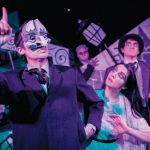
Luckily the passion behind the film, the aesthetic, and the feeling of the time period really shows in Pointless’ production. The imagination behind the stage setting is immediately apparent, with limitations presented by the nature of the original Caligari—the stylized expressionist aesthetic, the black and white palate, and the silent aspect— are fully embraced by Pointless.
The lead characters of Francis and Dr. Caligari, played by Frank Ceverich and Lex Davis, never let up for the entirety of the performance with facial expressions and body gestures—ranging from a sharp to sullen— in an attempt to convey inner feelings that display despair and madness. I really began to feel sorry for Francis’ psychological plight, and was equally moved by how Davis makes the horror of Caligari’s character terrifyingly human—especially during a latter scene that reflects his transformation into the master of Cesare, the somnambulist.
The music plays an essential role in the performances, and not only because the minimal, tasteful pieces fit the aesthetic of the silent play quite well. The additional use of more modern sound effects and samples with the three-piece string section lends further atmosphere that’s effective in enveloping the audience member deeper into the performance.
As the play moves closer towards the asylum and the descent into madness truly begins, the actors go further into exaggerated gestures and facial expressions. Like the film, the question of madness reveals itself slowly. The way the horror occurs, punctuated by Francis’ emotional pleas, ends things with a feeling exactly as creepy as a story on the nature of madness should.
Pointless has made smart, deliberate choices in their limitations to stay true to Caligari and the expressionist aesthetic, while breathing new life into the story by making imaginative choices on how they present the story within those limitations.
Doctor Caligari opens for previews tonight and runs through April 4 at the Mead Theatre Lab at Flashpoint. Tickets, $20-25, are available here.
Disclosure: As a member of the D.C. artistic community the author of this piece knows several of the people involved in this play personally.