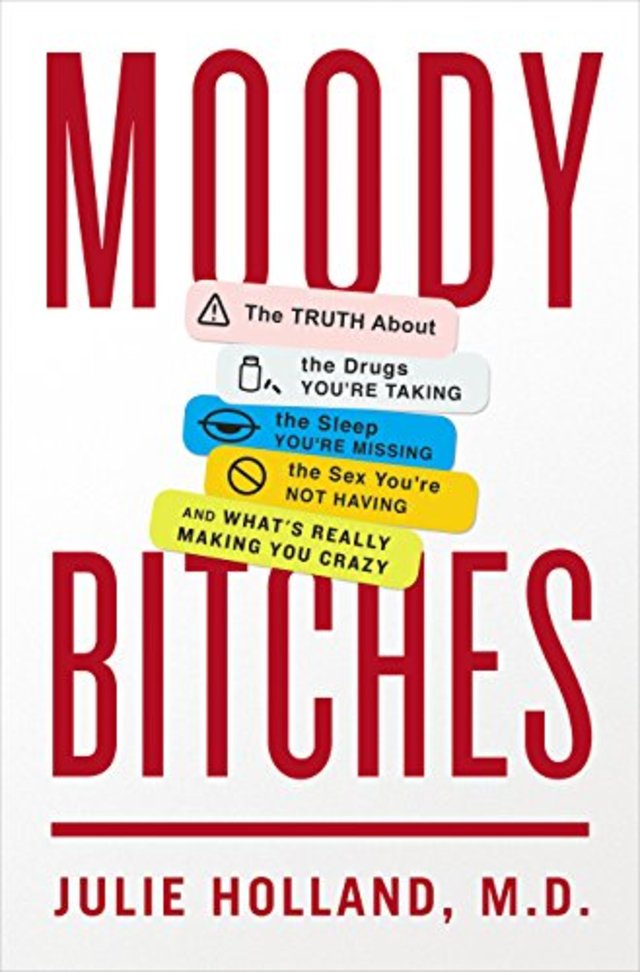
 If you’re a man seeking to understand women better, or a woman seeking to understand yourself better, seek no further: psychiatrist Julie Holland will be at Sixth & I Historic Synagogue on Monday, March 9th to talk about her new book Moody Bitches: The Truth About the Drugs You’re Taking, the Sleep You’re Missing, the Sex You’re not Having and What’s Really Making You Crazy (Penguin, $28). Her highly shared article on the same topic appeared in last weekend’s New York Times.
We know that women get flak for their moods, and get labeled as bossy, weak, high-strung, or yes, bitchy. But it’s okay, Holland says, step away from the Xanax. Women’s “moodiness” is evolutionarily hard-wired: “We feel more deeply, express our emotions more frequently and get moody monthly. It’s normal,” Holland writes.
And it’s a strength, she continues. Anxiety helps women be hyperaware and organized in the workplace, and sensitivity helps them be loving and intuitive as caretakers. These moods are part of a “finely tuned feedback system” responding to how women are living and what they need. The first step is to “own” that.
Moody Bitches explains how men and women’s biological differences affect behavior. Holland notes that while there is variety between the sexes, testosterone generally “impairs empathy” while women have “more brain circuitry” for expressing language and detecting emotions. When met with stress, men get a surge of adrenaline and go into “fight or flight” mode; women “tend and befriend,” finding strength in numbers, and increasing the happy hormone oxytocin when huddled together (or snuggling).
The book also summarizes the history of medicalizing women’s emotions, beginning with the all-encompassing diagnosis of “hysteria” (hyster is Latin for womb). Much like plastic surgery redefines expectations of appearances, Holland writes, medicine redefines how we think we should feel. The pharmaceutical industry tapped into women’s anxiety about being anxious, and today, one in four women is on mood-regulating drugs — many of them designed for conditions like schizophrenia.
Holland readily name-drops medicines she likes, which she doesn’t, and why. But much of the book is on other approaches to manage moods and all the fun things that come with them. Ultimately, Moody Bitches encourages women to tune into their bodies “to realign with your natural, primal self.”
Some tips Holland shared with DCist:
- “If you’re getting teary-eyed and you don’t want others to see, think of rhyming words or subtract sevens serially from one hundred. This shunts the blood flow away from the emotional centers of the brain and over to the calculating, more rational centers.”
- If you’re concerned about your moods, see if it passes in about two weeks. If it persists, “talk to a therapist or psychiatrist who can take a full hour to hear all your symptoms, your family psychiatric history (genetics are important), and your medication history.”
- Try “an anti-inflammatory diet (which research shows can help with depression and optimal brain function), regular exercise, going outside in the sun or nature, and getting eight hours of sleep. Vitamins D and B complex, omega three fatty acids (fish oils, or flax or hemp seed oil), and probiotics” can also help.
Holland has run a psychiatric practice in Manhattan for 20 years, and regularly appears on the Today Show and CNN. She wrote the bestselling memoir Weekends at Bellevue, based on her time running the psychiatric ER of America’s oldest public hospital. She lives in New York with her husband and two children.
The talk begins at 7 p.m. and tickets can be purchased here. One ticket is $14, or two are free with a book purchase of $28. Seating is first-come, first-served.