 Photo courtesy of Bridge 9 Records
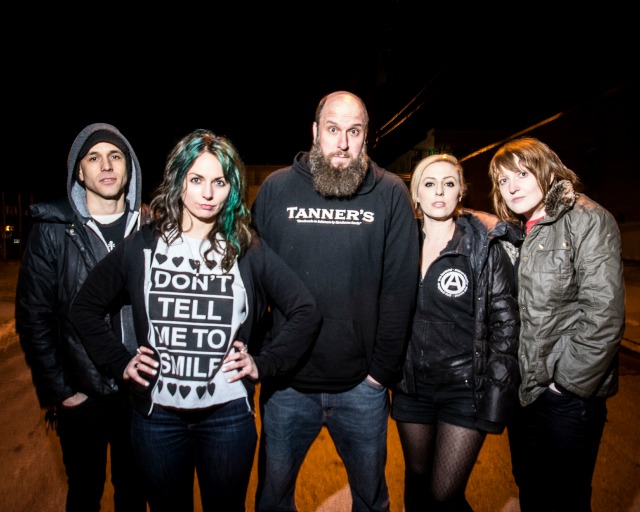
If the political stance of the five hardcore musicians who call themselves War on Women isn’t obvious, then listening to any given song should clear up any doubts. Throughout their brief tenure, the Baltimore quintet has gained a reputation as a live powerhouse. Their forceful guitar riffs and lightning fast drums hit the listener right in the jugular, and if anything the smoother production on their latest full-length LP actually makes their message more potent. Singer Shawna Potter has always been a welcome stage presence, but now on songs like “Roe V. World,” “Pro-Life?” and “Meathead,” it becomes more explicit as to why she’s shouting and throwing herself to the front of the stage. While misogyny and its side effects are the most frequent themes in War on Women’s songs, they’ll gladly take on unmovable and uninformed opinions about other topics as well.
Unsurprisingly, War on Women’s return to D.C. will be to play a Positive Force show this Sunday at the Next Step Public Charter School entitled Jobs Not War. This benefit for the Washington Peace Center also includes Priests, Trophy Wife, and Big Hush. In advance of this show, we talked to Shawna Potter about the advantages of being an intentionally heavy band and the need to call out other feminists on potentially dangerous opinions.
DCist: It seems like with this new album, you’ve moved into a more melodic phase. What I remember seeing you play off of Improvised Weapons was mostly power.
Shawna Potter: Ok. I’ll take that!
DCist: Has anything changed in the songwriting or dynamic that you can feel in the past three years?
SP: I would just say, if we wrote the same record, we ourselves would be bored. So we certainly wanted to change it up. Especially knowing that we’re writing a full length, so there’s, like, eleven songs. So, they can’t all sound the same. You can get away with that in an EP a little bit more. But for the first record—it’s actually more of a decision that with the first record, that we would strip it down a bit and make it more raw and make it sound as if you were seeing us in a basement with a shitty PA. That was as much of a decision as not doing that for this new record. So, I think it’s an extremely natural progression for us. It wasn’t a decision that we really had to worry about or that seemed important. It was just an obvious, natural progression.
DCist: Plus, “Servilia” translated really well as an acoustic track. Why record an acoustic version?
SP: Well, Anti-Flag records was one of the record labels we were talking to about possibly releasing this new record. And it didn’t work out with them, obviously because we went with Bridge 9 and we’re super happy about that and everything is cool. But, in our talks with them—it’s like, they still like us and we still like them and Chris from that label mentioned that they were doing a compilation of modern day protest songs and the goal for them was to get a bunch of recordings of just people sitting on their bed playing acoustic guitar. That’s what they wanted it to sound like. So, we literally did that. Brooks and I sat on my bed and put an iPhone in between us and hit “record” and played the song a couple times. I think that’s like the third go-round. It was a little tough for me to get the verses without any drums, I’ll be honest, to find where the melodies are supposed to sit. So, it’s really interesting without the drums. I was shocked that any of our songs could be played on acoustic and not sound too terrible.
DCist: Even your name, War on Women, indicates that you deal with a lot of feminist issues within your music. So, “Second Wave Goodbye” is interesting because it sounds like it’s directed at other women.
SP: It is directed at a specific kind of person who happens to be a woman. The important thing is that it’s directed at someone who is stuck in a certain phase of feminism and that for them has morphed into something that’s actually very trans-phobic and just as hateful to this group of people—to trans people—which is, to me, just really sad. It’s always very sad when an oppressed and marginalized group then in turn oppresses and marginalizes another group of people. It just seems so obvious why that would be wrong. It’s just upsetting that people don’t understand that they’re participating in that same system. And so, this song in particular is about kind of this very small subgroup of feminists who were coming up around the second wave of feminism and kind of never let go of the idea of this fear that men want to attack them all the time no matter what. That would include putting on a dress and pretending to be trans in order to assault women. With the reality of the violence that trans women face, especially trans women of color, that idea is just total bullshit. It’s just kind of frustrating that —me personally—I hope to just always be better. Right? I hope to continually improve as a person and grow. I’m fully aware that I will be taking in new information as I continue to age and that my ideas might change. That’s okay with me. For this particular group of people, I feel like that is not okay with them. That they know they are right about something and they happen to be wrong in this case.
DCist: That just seems like a dangerous thing in general—to be stuck in one mindset.
SP: Yes, regardless of what that mindset might be. So, I think that one misconception about feminists is one, that we’re all the same and that we all have the same ideas and that we all hate men and we’re all unfunny and all this other stupid shit. So, it’s important for me to call out this kind of rhetoric and mindset. Basically, I’m saying that I’m okay with the idea of calling someone out even though they say that they are feminist. I don’t think that just because someone else is also claiming to be feminist as I am doesn’t mean that they’re not fucking up in some way. It’s totally okay to call them out on it, especially when it contributes towards the violence against trans women. That’s just totally unacceptable to me.
DCist: As a semi-outsider, it seems like there’s a pretty strong sense of feminism within the Baltimore music scene. Has that been your experience?
SP: I would say so. There are a lot of women in bands the last couple of years. I feel like it’s grown the last five years and it’s really amazing to see. I think almost by default, having so many women involved—playing music and booking shows and running clubs—I think by default the scene or sub-scenes will become more welcoming. Having a presence there—having women and LGBTQ people present—that alone will contribute to having more welcoming spaces.
DCist: When did you get started with playing in bands? I’m not as familiar with your previous work.
SP: You mean you don’t know my high school band, Fair Verona! [Laughs] But I’ve been playing guitar since I was twelve and writing songs and touring and recording for a long time! I went to high school in Nashville so being in a band was a very normal thing. Everyone’s in a band and everyone I dated was in a band and we toured and worked with producers and went to SXSW and this is all before I was twenty years old. At some point I moved to Baltimore—actually to join a band with Brooks Harlan, who is one of the guitar players in War on Women. So, I’ve actually known him a very long time. So we’ve been in a couple bands together before this one. They were a bit different—a little bit more math-y rock but with jazz influence and more singing and harmonies. It was a band called Avec. I think there’s some videos online somewhere. This is I think the most purposefully heavy and consistently heavy band that we’ve been in.
DCist: What’s been the appeal of forming a heavy hardcore band?
SP: I just wanted to! I felt like by the end of Avec—we just sort of fizzled out—and by the end of Avec, I think Brooks and I were both feeling like we wanted something more intense and powerful and something we could headbang to a little bit easier onstage. We just wanted that and for me the best part of playing in a band is the actual performance. Songwriting is okay. Recording is okay. But I just love playing. I love performing. So because these songs feel so good and energetic and fun for me onstage it was just an easy thing to do, to embrace the heaviness.
DCist: I know that you’ve done other Positive Force shows—other shows that have a message. Do you have any connection to the Washington Peace Center?
SP: Really, our connection is to Mark Andersen at Positive Force. He’s always supported us and been really cool and we haven’t been able to play D.C. for a little while, but early on when we were playing shows, Mark was a big help and he’s always been very complimentary, so anytime he asks if we can do something, we certainly do our best to do it. That includes this show for International Women’s Day. It’s going to be a really fun show. Come early and stay the whole time. I think the show is full of bands that could headline their own show and so we can’t all do that. We can’t all headline. So, certainly don’t miss us, if possible! We’ll also have our new record with us for people who want to get it.
DCist: This is your first full-length. How long have you been working on those songs?
SP: I mean, a couple of them were actually written after the first EP was released. So, a couple of them are a couple of years old for sure. But we knew that we didn’t have to rush into another recording, because we were really just trying to build up enough interest around our band that someone would want to release our next record. So, we just tried to take our time and write good songs and keep playing live and keep talking to people. But “Say It” and “Roe V. World” have both been around for awhile. That’s actually really upsetting to me.
DCist: Why?
SP: Particularly “Roe V. World,” when I wrote that I felt like reproductive rights and abortion rights for women was already a really tired subject and I was curious if that song would even have any meaning by the time the record was released. It still is so relevant because bills are still being passed or trying to be passed to limit women’s access to reproductive healthcare and abortion. So, it’s frustrating to me that those songs are still so relevant, but I guess it’s good for record sales.
DCist: I think you said as much in your bio that women’s issues and misogyny will continue to give you fodder for songs and will probably never go away.
SP: Right. Yeah. Completely. Yes. There’s always a new way that people are trying to oppress your or some new micro-agression that is going to piss me off. So, we’ll see how long I can scream about this stuff. Right now, it’s fucking fun as hell. I’m enjoying it.