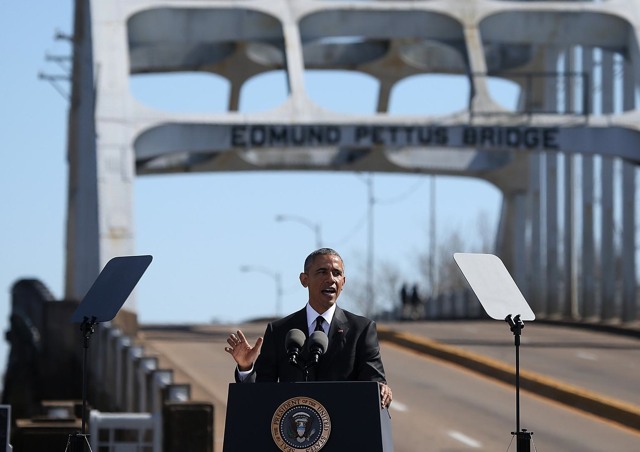
President Barack Obama commemorated the 1965 civil rights marches from Selma to Montgomery, Alabama yesterday, with a rousing speech in Selma. He told the thousands gathered, “Fifty years from Bloody Sunday, our march is not yet finished, but we’re getting closer.”
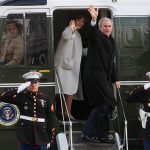
The President was joined by his family—First Lady Michelle Obama, daughters Malia and Sasha, and mother-in-law Marian Shields Robinson—as well as President George W. Bush, former First Lady Laura Bush, Rep. John Lewis, and some of the original marchers. Obama noted, “Because of what [the marchers] did, the doors of opportunity swung open not just for black folks, but for every American. Women marched through those doors. Latinos marched through those doors. Asian Americans, gay Americans, Americans with disabilities — they all came through those doors. Their endeavors gave the entire South the chance to rise again, not by reasserting the past, but by transcending the past.”
However, the president also addressed recent evidence that the country continues to struggle with systemic racism:
We do a disservice to the cause of justice by intimating that bias and discrimination are immutable, that racial division is inherent to America. If you think nothing’s changed in the past 50 years, ask somebody who lived through the Selma or Chicago or Los Angeles of the 1950s. Ask the female CEO who once might have been assigned to the secretarial pool if nothing’s changed. Ask your gay friend if it’s easier to be out and proud in America now than it was thirty years ago. To deny this progress, this hard-won progress — our progress — would be to rob us of our own agency, our own capacity, our responsibility to do what we can to make America better.
Of course, a more common mistake is to suggest that Ferguson is an isolated incident; that racism is banished; that the work that drew men and women to Selma is now complete, and that whatever racial tensions remain are a consequence of those seeking to play the “race card” for their own purposes. We don’t need the Ferguson report to know that’s not true. We just need to open our eyes, and our ears, and our hearts to know that this nation’s racial history still casts its long shadow upon us.
A full transcript is can be found here.
The Washington Post reported, “The stage where Obama spoke was built at the base of a steep pitch in front of the bridge, where demonstrators leaving Selma and marching toward Montgomery on March 7, 1965, still wouldn’t have been able to see the state troopers who were waiting for them with canisters of tear gas and cattle prods. The date has become known as ‘Bloody Sunday.’ Obama was introduced by Rep. John Lewis (D-Ga.), whose skull was fractured by Alabama state troopers on the bridge, and joined by Peggy Wallace Kennedy, the daughter of George C. Wallace, the Alabama governor who ordered the attacks on the demonstrators.”
An estimated 40,000 people, most but not all African-American, gathered on a sunny, warm day in this small town of elegant if weathered homes and buildings to mark the occasion. The celebration had a festival feeling, with vendors hawking barbecue, funnel cakes, hamburgers and posters of Mr. Obama, the Rev. Dr. Martin Luther King Jr., Muhammad Ali and others. They came from near and far, some lining up before 6:30 a.m. to make sure they got in…
Bridgette Traveler, 48, a disabled Army veteran who came from Shreveport, La., was in Ferguson last year protesting the fatal police shooting of Michael Brown.
“We have a long way to go when Michael Brown was killed for just walking down the street,” Ms. Traveler said.
Some attendees still angry about the Ferguson case interrupted Mr. Obama’s speech, banging a drum, holding up signs that read “Stop the Violence” and chanting “We Want Change.” Others in the audience tried to quiet those responsible for the outbursts, but eventually police officers — three white and two black — carried off one protester.
Mae Roberts, 72, traveled from California to Alabama against the wishes of her doctor (she has cancer) to see the president speak. She told AL.com, “I left Selma and Alabama behind 50 years ago after what happened on the bridge. I never wanted to see either ever again, but the truth is I have had such hate in my heart for this place, what he did to good people just because of their skin color. I didn’t want to die with that hate in my heart. Now I won’t, and I won’t because of that man, what he means to not just old people like me but because he proves we can change, he proves that all that suffering for all those years was not for nothing.”
And Albert Ziegler, 71, added, “I was 21 when Selma happened but I remember it like yesterday. There was so much hate then and everyone was so afraid. I don’t know how those men and woman found the courage to walk across that bridge knowing they could die. … But somehow they did and 50 years later our president looks like me. I never, and I mean never, thought I would live to see that in this country, let alone standing at that bridge.”