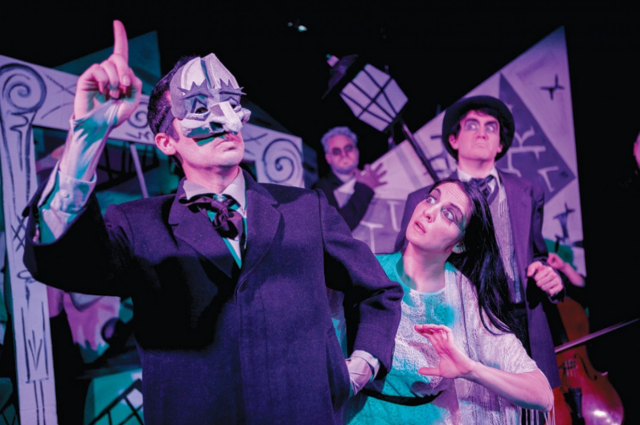
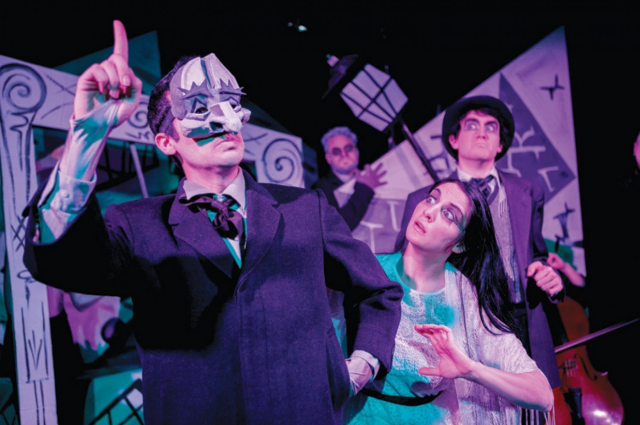
 Zachary Fernebok, Lex Davis, Rachel Menyuk and Frank Cevarich in a colorful take on the black and white classic. Photo: C. Stanley Photography
By DCist Contributor Jonelle Walker
Rising theater company Pointless Theatre Co. has found a way to not only bring to life a difficult adaptation of a silent film, but to do it with finesse— and puppets. While the piece doesn’t reinvent its source material, the magnificent three-ring circus on display in the company’s Doctor Caligari—playing through April 4—is more than worth the price of admission.
Pointless’s Doctor Caligari is a tight adaptation of Robert Wiene’s seminal German silent horror film, The Cabinet of Dr. Caligari. Francis (here portrayed by Frank Cevarich) tells the tale of a mysterious man, Dr. Caligari (Lex Davis), who arrives in town to display his amazing somnambulist, Cesare (a puppet), and appears to herald a series of unexplained murders. What follows is a dazzling, expressionist nightmare of violence, trickery, and madness.
If you’ve seen the film, entering the Mead Theatre Lab at Flashpoint feels like walking straight into Wiene’s shadowy, distorted vision. The company clearly took great care in faithfully taking Caligari from screen to stage with Patti Kalil’s sets, Frank Labovitz’s costumes, and Navid Azeez’s lighting design. The production even painted broadcast title cards for the dialogue, which the “speaking” actors mouthed. However, this bit of innovation winds up being the play’s weakest design element. Title cards work just fine in the original film because the camera directs the eye; in live theater, an audience member may find themselves constantly wondering whether to watch the actor or read the title cards.
Although they’ve been deprived of vocal expression, the ensemble cast makes extraordinary use of physical expression. Cevarich’s Francis goes just far enough to reach the silent film acting style of Buster Keaton and Lillian Gish. He utilizes absolutely enormous facial expressions and slowly curled fingers to illustrate tension. The rest of the ensemble follows Cevarich’s lead, taking every opportunity to flash a sidelong glance or a sniveling smirk, with special mention for the titular Doctor’s pair of mischievous henchmen.
At the heart of Pointless Theatre Co.’s artistic identity is their use of puppetry and mask. The puppetry in this show is largely used to bolster a sense of decaying reality. The first puppet the audience meets is a monkey, and, throughout the performance, monkey puppets occupying various regions of the uncanny valley continue to pop up. This is a clever, if indirect, way to give the audience the madman’s perspective.
The largest and most ambitious puppet in Caligari, however, is the somnambulist, Cesare. Needing a team of three to fully operate, the Cesare puppet is a true spectacle, standing at nearly the height of an adult man; its first appearance is shocking enough to draw gasps from the audience. As the performance continues, though, the puppet loses the mystery that makes Cesare both frightening and impressive. The puppet’s team of operators work in unison, but sometimes hit mechanical snags. Still, the puppet’s successful moments are unnervingly well done and often make up for any technical challenges.
The company’s use of puppetryraises a question: How does this piece distinguish itself from the Caligari film? Honestly, it doesn’t do much, which could be seen as a respectful or derivative choice depending on your audience.
If you’re familiar with the original film, you will find no twist to the ending or additional characters. You will, though, see the addition of background spectators watching events unfold, tapping their fingers in time as they plot something nefarious. This small addition, while not breaking new ground, makes use of the theatrical medium in the same vein as the monkey puppets. All of Pointless’s deviations from the film work toward a strong perspective–capturing a mind losing grip on reality. Whether or not these choices significantly justify the story’s translation to the stage, they convey a pointed, smart vision from director Matt Reckweg.
Pointless’s Caligari‘s clearest improvement over the original is its music. Like any other silent film, the Caligari play is completely scored, but has the advantage of a live string trio and Michael Winch’s stirring original music. In a program note from the director, Reckweg specifies that the music is intentionally fed through a distortion pedal to give a sense of dissolving sanity. This aural effect is potent, punctuating Francis’s fear with the sharp whining of a violin. Though the sound can be jarring and frightening, at times, that effect definitely contributed to the unsettling mood.
Whether you’re a connoisseur of German expressionist film or you just like a moody evening of highly stylized theater, Pointless Theatre Co.’s Doctor Caligari will have something to capture your imagination. At the very least, you should step right up to the Mead Theatre Lab to check out this innovative young company, which is bringing something truly fresh to the D.C. theater scene.
Doctor Caligari runs through April 4 at the Mead Theatre Lab at Flashpoint. Tickets, $20-25, are available here.