 The exact origin of the term “shrink” for psychiatrists is likely lost to history, but it’s short for “headshrinkers,” also known as “witch doctors.” It’s not exactly a compliment.
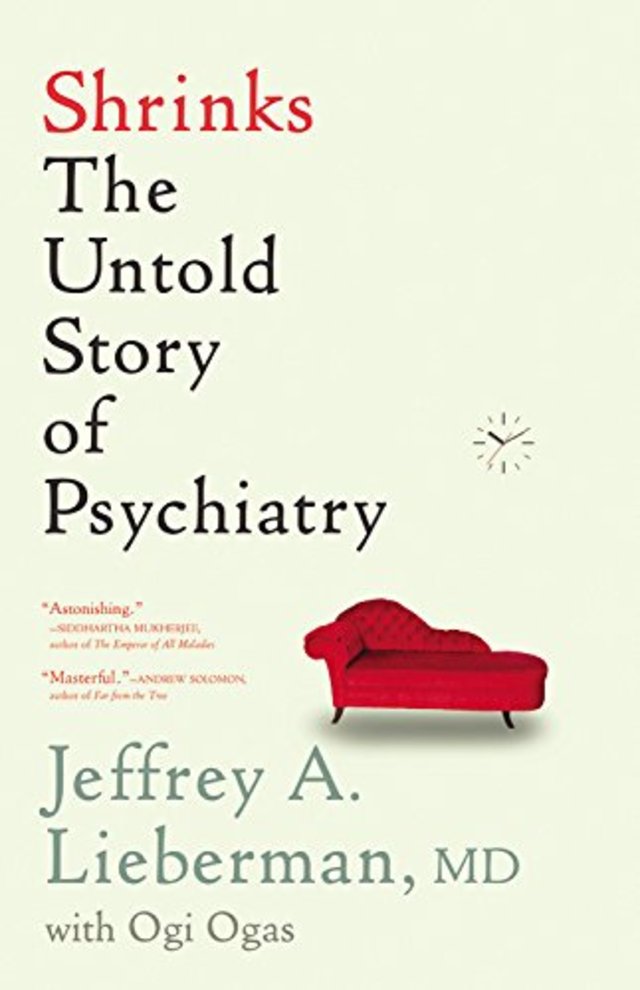
In his new book Shrinks: The Untold Story of Psychiatry (Little, Brown, and Company, $28), Jeffrey A. Lieberman gives the perspective from the other side of the couch. The chairman of psychiatry at Columbia University will chat about Shrinks at Politics & Prose on Sunday, March 29th at 5 p.m. in conversation with Robert Boorstin. Boorstin is a former journalist and Google public policy director, and is currently Vice President at the Albright Stonebridge Group (as in Madeleine Albright) and an advocate for those with mental illness.
In addition to its nickname, psychiatry has received scrutiny as a relative newbie to the medical field. As recently as 50 years ago, it was regarded as pseudo-scientific poppycock, and some people still don’t take it seriously.
Much of this has to do with scientists’—and society’s—evolving and differing understandings of the brain. In ancient times, we thought mental illness was caused by demon possession, and treatments for it were primitive and barbaric. In the 19th and 20th centuries, researchers began to trace the pathology of mental illness and use treatments that were decreasingly barbaric. Now, many medications are available for mental illnesses, inciting additional debate that Lieberman addresses in Shrinks.
As seen in Shrinks, psychiatry’s history is filled with plenty of drama and kooky (technically speaking) characters. The Diagnostic Statistical Manual (DSM) is like the psychiatry bible with nearly 300 definitions of diagnoses, so battles over its content have played a major role in the profession. Pioneers in the field, like Sigmund Freud, Eric Kandel, and others, shaped the path of psychiatry for better or worse. And of course, there are the patients, whose ailments Lieberman describes with respect and careful fascination.
Shrinks also looks toward psychiatry’s future, and what to expect for its role in medicine and for those with mental illness. Changes in technology, health care, and empathy contribute to a shifting landscape.
In addition to being chairman and professor of psychiatry at Columbia, Lieberman is Director of the New York State Psychiatric Institute and the former president of the American Psychiatric Association. He lives with his family in New York City.
The event is free and open to the public.