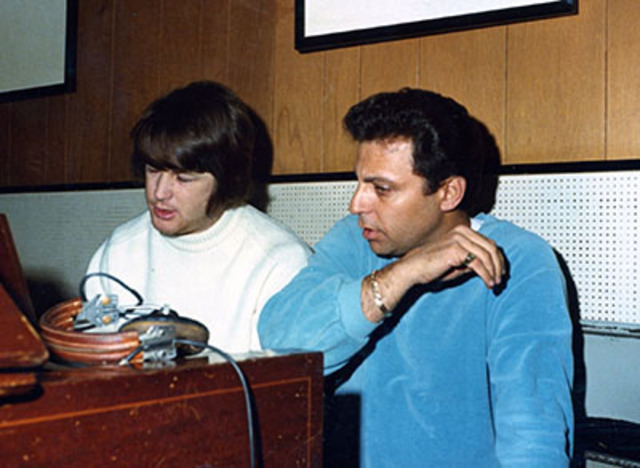
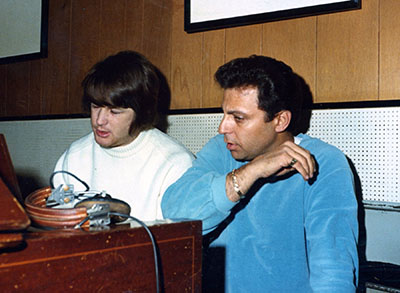
 Brian Wilson and Hal Blaine (Magnolia Pictures)
When Denny Tedesco learned that his father had terminal cancer, he knew it was time to make a record of his stories. These stories had a value that went beyond that of preserving family history; they were largely untold tales of the history of popular music in the ’60s, and these are the stories told in the documentary The Wrecking Crew.
The late Tommy Tedesco was a guitarist in a prolific group of studio musicians known as the Wrecking Crew. The late Dick Clark, one of the film’s talking heads, estimates that most of the hit records of the ’60s and ’70s were backed up by Wrecking Crew musicians. Some of them went on to greater fame; you know Glen Campbell and might know Leon Russell—but what about bassist Carol Kaye? Saxophonist Plas Johnson? Drummer Hal Blaine? Blaine and fellow Wrecking Crew drummer Earl Palmer were inducted into the Rock and Roll Hall of Fame in 2000, but you probably don’t know their names. You do, however, know their music.
That’s Kaye’s bass opening “Wichita Lineman”; that’s Johnson’s sax playing the Pink Panther theme; that’s Blaine on “Love Will Keep Us Together,” the last of seven Records of the Year in a row that featured his drums. These professional musicians worked together so often they had an easy interplay that Herb Alpert called “an established groove machine.” But they didn’t just perform Milli Vanilli-like behind stars you don’t expect to play their instruments.
The Byrds were reluctant to have session players on their own record, but the Wrecking Crew cut “Mr. Tambourine Man” in three hours while it took 77 takes for McGuinn and company to get “Turn Turn Turn” right (though as McGuinn points out, they were both number one records). The Beach Boys regularly used the Wrecking Crew, Brian Wilson counting on them to make Pet Sounds. “They were the ones with all the spirit and all the know-how,” Wilson tells us, and he played the Wrecking Crew like the sophisticated instrument they were.
Kaye, who played bass on “Good Vibrations” and many other Beach Boys records, is one of several session players who speak highly of Wilson’s genius as an arranger. Wilson wrote out complicated charts; but usually, the musicians only had a chord sequence to work with. So they wrote their own lines: Kaye’s bass intro to “Wichita Lineman,” Tedesco’s guitar figure in the theme to M*A*S*H.
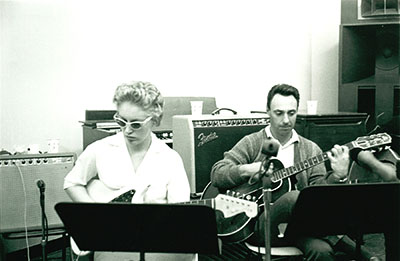 Carol Kaye and Bill Pitman ( Magnolia Pictures)
The Wrecking Crew was born as a son’s tribute to his father, but an early version of the film was reportedly less personal; friends encouraged Tedesco to make it more personal, and though I can’t compare versions, this is what makes it more than a history of pop music. These session players loved their work and were well compensated for it; Kaye recalls that at one point in the mid-’60s, she made more money than the President of the United States.
The film isn’t just about music, though; it’s also about work and family. The musicians made a living doing something they loved, but, as one crew member laments, that meant their busy schedules kept them away from their kids, and in some cases ruined their marriage. Blaine’s story is particularly sobering. At the height of his career, he made five grand a week working for John Denver; after a divorce wiped him out, he ended up as a security guard in Scottsdale Ariz., and admits to the director that he contemplated suicide.
The Wrecking Crew introduces us to musicians whose work we may have loved without even knowing their names. If it moves from personal history to pop culture study, it also moves in the other direction, instilling a sense of urgency in documenting our own personal histories. Seven of the session men interviewed have passed away since the project began.
Originally completed in 2008, when it was a hit on the festival circuit, the film’s official release was tied up for years by licensing fees. The Wrecking Crew might seem like the latest in a series of films about studio musicians, from Muscle Shoals to Twenty Feet from Stardom, but it came first. The movie covers so much territory that you may want to see individual subjects get their own films (as Glen Campbell and Leon Russell have), and it leaves certain questions unanswered: what happened to these musicians’ individual voices? The story of The Wrecking Crew is incomplete, but it’s still a must-see for music lovers.
—
The Wrecking Crew
Directed by Denny Tedesco
With Tommy Tedesco, Carol Kaye, Hal Blaine, Glen Campbell, and a cast of dozens
Rated PG for language, thematic elements and smoking images
Running time 101 minutes
Open today at Landmark E Street Cinema