 Politics and Prose hosts two events this weekend that will leave you with conflicting feelings about the future.
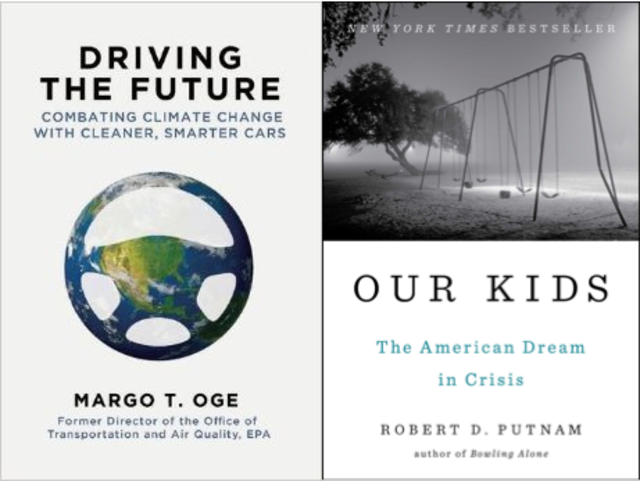
Saturday, April 11th at 1 p.m.: Before long, D.C. traffic circles will run like gears on a watch and Rep. Eleanor Holmes Norton will park her car like a model citizen—all while leaving a tiny carbon footprint. At least, that is, if EPA veteran Margo Oge’s vision comes true. Oge will talk about her new book, Driving the Future: Combating Climate Change with Cleaner, Smarter Cars (Arcade, $26), and the vehicles that will improve our lives.
How will they do this? First, cars will be built lighter and with electronic architectures more like airplanes. They’ll also be smarter and able to network with other cars on the road in order to drive and park themselves.
Driving the Future goes on to address the policy that is making this vision possible. It began with the Obama administration taking the EPA more seriously than a certain predecessor. Oge crafted the 2012 deal with U.S. automakers to double their fleets’ fuel efficiency to 54.5 miles per gallon and halve greenhouse gas emissions by 2025 —the first regulatory action of this kind.
Oge’s perspective is from the center of the political, environmental, and industrial firestorm of climate change and technology. The book tells us where the intersection of these issues currently stands, where it is headed, and the potential for the more distant future.
Since retiring from the Office of Transportation and Air Quality after 32 years at the EPA, Oge has been vice chairman of the board of DeltaWing Technologies. She has an MS in engineering from the University of Massachusetts-Lowell and attended George Washington and Harvard Universities.
Sunday, April 12th at 5 p.m.: Liberal arts colleges have been teaching Robert Putnam’s Bowling Alone since the original essay came out in 1995. Lonely bowling is just the start of our problems today, and Putnam has a new story to tell: Our Kids: The American Dream in Crisis (Simon & Schuster, $27).
Our Kids is about the inequality tied to an attitudinal shift over four American generations. The author’s hometown of Port Clinton, Ohio is used as a specimen. In the 1950s, Putnam writes that Port Clinton was a “passable embodiment of the American Dream … a place that offered decent opportunity for all the kids in town, whatever their background.” But 60 years later, the town “is a split-screen American nightmare, a community in which kids from the wrong side of the tracks that bisect the town can barely imagine the future that awaits the kids from the right side of the tracks.”
Putnam explores what happened between his graduating class of 1959 and the kids in Port Clinton and around the country today. The chapters follow the paths of individual people as well as revealing trends in data.
Our Kids makes an impassioned call for policy action, but in Putnam’s intelligent and modest style. And he stays away from involving any “upper-class villains” in the book, because the focus is on “our kids,” present and future.
Putnam is a public policy professor at Harvard University and a nationally honored humanist and scientist. He has written fourteen books and consulted for the last four U.S. presidents.
Both events are free to the public.