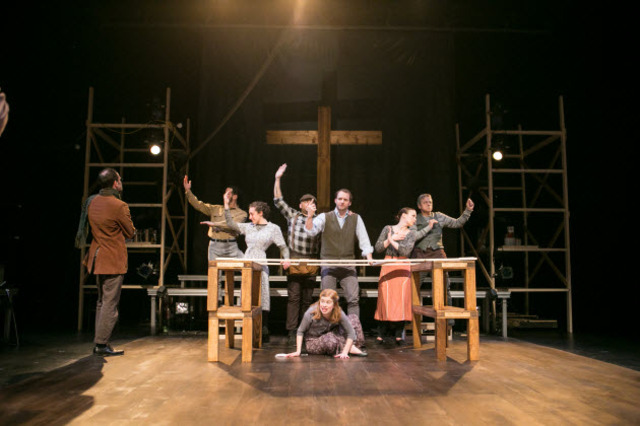
 A scene of The Last Supper in Forum’s Passion Play. Photo: C. Stanley Photography
By DCist Contributor Jonelle Walker
What part do you play?
For centuries, theater has provided communities with an opportunity to come together and tell the most important stories of their culture. Forum Theatre’s production of Sarah Ruhl’s Passion Play follows three towns in three different eras putting on the story of Christ’s death and resurrection—the Easter Passion. While Ruhl’s piece muses on faith and politics, it really lingers on the relationship between theater and community. Throughout each of the play’s lengthy three acts, characters fight for “their part.” This is often just as indicative of their part in the play as their part in the community, the world, and history at large.
Passion Play’s three temporally separated communities of players are distinct in time and place, but cleverly alike in spirit and politics. The first act reminds the audience that by 1575—just before the time of Shakespeare—Elizabeth I’s tyrannical banning of religious theater reached all the way to small villages in northern England. The second takes us to Bavaria in the more recent past of 1934, where the specter of the decade to come hovers over the action, with Adolf Hitler embracing the Passion for his own ends. Finally, the play lands in Spearfish, South Dakota, spanning a period of time from the Vietnam War to Reagan’s presidency. In each of the acts, regardless of locale, the players struggle with recurring troubles: sexuality, unexpected pregnancy, religious persecution, and illness.
Each act begins with the actors as themselves: taking the stage with the stage manager, putting on their costumes, and greeting any friends they might have in the audience. Though this first contact with the audience is casual, it is nonetheless a performance. By directly addressing the audience out of character, the actors bring the audience into the playmaking process. It is as if they are saying, “You are a member of this community, too, and we welcome you as an insider.” It is a cunning and warm framing device that sets the tone for the entire piece.
Those whose hearts are hardened to the niceties of the relaxed beginning might take interest instead in cameos from Elizabeth I, Hitler, and Ronald Reagan, each of them played by the extraordinarily talented Tonya Beckman.
Ms. Beckman is in good company with Forum’s truly exceptional cast, one of the strongest ensembles in recent memory. Among them are three actors who stand out above the rest, which is no small feat. It would be impossible to review this production without noting Beckman’s hilarious and powerful portrayals of the three villains. Her Elizabeth, in particular, is striking; in her short time on stage she embodies the monarch’s formidable presence, tremendous charm, and fierce command. Megan Graves as Village Idiot/Violet is a startlingly good mimic of children; the audience could easily forget that she is an adult actress. Her fearless physicality and genuine delivery make her a joy to watch. And Jon Hudson Odom as Pontius Pilate/ Foot Soldier/P is a highlight, seducing the audience with enormous charisma whether playing a Vice-like fish monger or a troubled soldier home from war. He provides the play with essential gravity, all the while effortlessly making himself the deserving center of the piece.
One of the biggest assets of Forum’s Passion, aside from the cast, is Sarah Ruhl’s bold script, which provides the whole team with rare, meaty substance to wrestle with, and effortlessly beautiful language to interpret. As with so many of Ruhl’s plays, Passion is full of dream-like imagery which begs to be performed. One moment in particular will remain with you long after you leave the theater. Making full use of cast member Ben Cunis—a Synetic Theater Company Member—and a large white sheet, director Michael Dove choreographs a gorgeous picture of the surf rolling in over a young woman’s corpse. It is one of many images in the show that have arresting context, but nonetheless leave you delighted and breathless.
Though it may seem at this point like Passion Play is entirely fantastic, it has one tragic flaw: its length. Perhaps it is gauche to complain about the run time of such a beautiful piece of work, but it should not be left unsaid. Attending Passion Play is a nearly four hour commitment. It’s no fault of the play or the production, but before buying a ticket one should certainly know to get in a square meal before the show and make no plans for after. You’re in for a long, but deeply satisfying ride.
If you’re not frightened away by the length, Forum’s Passion Play makes for an enlightening evening. Easter has passed and Passover is well underway, but you may well leave with a few new revelations of your own.
Passion Play closes this weekend, April 11. Tickets are $30 or pay what you will at the door one hour before the show.