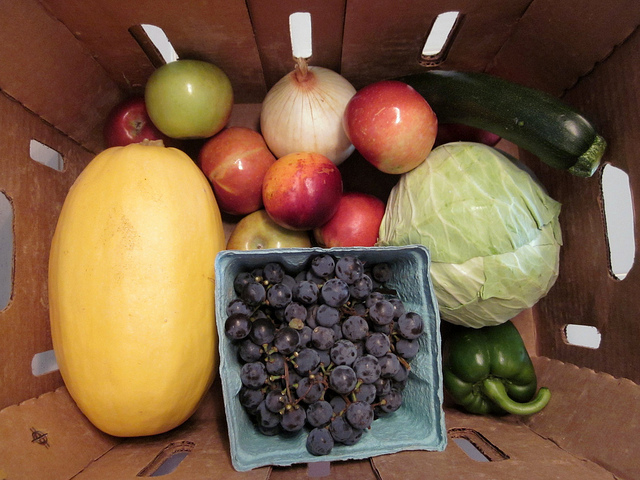
 Photo by Alyson Olander.
This week DCist is getting sprung for spring. All week long we’ll be spotlighting ways to eat and cook the bounty of fruits and vegetables that are finally peeking their little green heads out of the soil.
Sustainable. Farm-to-table. Locavore. These words have been bandied about the food world so much that they’ve started to lose all meaning, reduced to cringe-inducing buzzwords on a menu page. Still, it’s hard to deny that the local foods movement is having a moment, and that’s largely a good thing. The D.C. area is home to countless CSAs, an economic model that allows city folks to buy food directly from a nearby farm. And while CSAs have been around since the 1980s, growing demand and the advent of technology have made joining increasingly easy and convenient. So if you’ve always thought that a CSA sounds like a nice idea but it could never work for your lifestyle, think again.
What exactly is a CSA? “CSA” stands for community-supported agriculture or community-shared agriculture. CSAs are run either by a single farm or group of farms. People sign up to become a member of the program, typically paying a fee at the start of the growing season in exchange for periodically receiving a portion of whatever the farm produces. Most CSAs provide a weekly box of produce to members, with the contents and quantity varying, depending on the time of year—think asparagus in the spring, tomatoes in August, and so on.
Why should I join one?
There are a myriad of compelling reasons to eat locally, from lowering one’s environmental impact to getting fruits and vegetables picked at the peak of ripeness. If you’ve made it this far, chances are good that you’ve watched Food, Inc. or otherwise read at least one article about how horrible our industrial agriculture system is on the environment, workers, and animals. Joining a CSA is one way to opt out of that system. But even if you’re not driven by social or environmental causes, consider this: It can save you time and money.
Why shouldn’t I join one?
The typical CSA model is challenging for a lot of people. The weekly produce shares are often too much food for a single person or even two people splitting a membership. And seasonal eating can get repetitive; there are only so many ways to cook zucchini before it becomes unappetizing. While some CSAs try to consider members’ preferences, most expect you to happily eat whatever comes in the weekly box. Tough luck if you happen to hate radishes. We’ll highlight several CSAs that allow members to control the contents and quantity of their shares, making the experience a lot closer to Peapod than a pandora’s box of kale. That said, even the most flexible CSAs are designed for people who cook their own meals at least a few nights a week. If you’re the type of person that doesn’t have the time or inclination to cook, a CSA probably isn’t the right fit.
With that in mind, here are our suggestions for CSAs that make life easier rather than harder. Skip to the bottom for a complete list and handy-dandy comparison chart.
From Farmer to Your Front Door:
Most CSAs expect members to pick up their food each week at a designated location in the city or at the farm. If this doesn’t fit with your schedule, consider joining one of several CSAs that offer home delivery. Karl’s Farm, Little Farm Stand, and From the Farmer will all deliver right to your front door. And if you work near one of the many FRESHFARM Markets, there’s a good chance your office may be eligible for workplace deliveries through their Community Business Partner Program.
Avoiding the Endless Zucchini Trap:
It’s hard to transition from picking out exactly what you want at the grocery store to figuring out what to do with a box of occasionally obscure produce (hello, kohlrabi). To meet changing tastes, some CSAs allow members to place a customized order online each week. Ordering is similar to online platforms like Peapod or Instacart. Members typically pre-pay a membership fee and debit their account with each order. Star Hollow Farm was one of the early adopters of this system, but locals can also place custom orders through Bending Bridge Farm, Farm To Family, and From the Farmer.
Another option is to sign up for a CSA that uses a market debit system, which allows members to shop for their produce at a the farmers market and have the total deducted from their membership fee. It’s basically like having a credit with the farm. Radix Farm offers a market-style CSA at the Petworth Community Farmers Market, while Even’ Star Farm operates one at the Broad Branch Farmers’ Market in Chevy Chase. Regular Radix CSA members also get some ability to select their produce—say choosing between squash or cucumbers—when picking up their share.
Aside from regulating the contents of each order, both of these options also allow members to control the quantity of food received. This helps cut down on waste and makes it possible for single folks to enjoy the benefits of a CSA as well.
Ditch the Weekly Commitment:
Frequent traveling can wreck havoc on a CSA membership, forcing members to either forgo their food that week if they can’t find a friend who will pick up their share. Luckily, CSAs that run on the custom order or market debit model do not require a weekly commitment. Order whenever it suits your schedule, provided you use up your credit by the end of the season.
Kiss the Grocery Store Goodbye:
Imagine a world free of weekend trips to Giant or Whole Foods: no more long lines, no more harried shoppers banging their carts into each other, and no more fighting for the last head of garlic. CSAs offer more than just fruit and vegetables: many farmers partner with other local producers to offer their members eggs, meat, cheese, artisan bread, and even fresh cut flowers.
Lancaster Farm Fresh Cooperative offers six different CSA share types, including fruit, veggies, eggs, cheese, and even herbal medicine. In addition to produce and tree fruit, Gravel Springs Farms offers members full and half meat shares that include a mix of chicken, beef, pork, and lamb. And Farm to Family members may never need to set food inside a grocery store again: their CSA includes options for grass-fed meat and daily, produce, bread, soy products (tofu, tempeh, and vegan sausage), homemade pizza, pasta, preserves, and honey.
I’ve managed to quit the Columbia Heights Giant thanks to two CSA memberships. I get my produce, eggs, and honey from Star Hollow Farm and all my protein from North Mountain Pastures, a meat CSA offering beef, chicken, pork, lamb, rabbit, goat, duck, and sausages. There are several meat CSAs that can be paired with a more traditional CSA subscription.
Contact information for the CSAs mentioned in this article are listed below. We’ve also created a comparison table to help readers decide which CSA is right for them. Some CSAs cap their membership, so be sure to sign up soon. Many farms will pro-rate membership for anyone who signs up part way through the season.
Bending Springs Bridge Farm
CSA includes organic vegetables, orchard fruit, honey, preserves.
Season: Summer (25 weeks starting in June)
Pick-up: Various locations in D.C., Maryland, and Virginia
Even’ Star Farm
CSA includes organic fruits and vegetables, herbs, and flowers.
Season: Year round, divided into high summer, winter, and farmers market options.
Pick-up: Various locations in D.C., Maryland, and Virginia
Farm to Family
CSA includes options for vegetables, fruit, meat, eggs, soy products, pizza, pasta, bread, and pantry items like coffee, tea, and preserves.
Season: Year round, divided into spring/summer and fall/winter shares
Pick-up: Various locations in D.C. and Virginia.
FRESHFARM Markets CSA
CSA includes vegetables and fruit, with the option to add on bread, eggs, and dairy products.
Season: Year round, divided into spring/summer and winter shares
Pick-up: Summer shares can be picked up at the Ballston, Penn Quarter, Foggy Bottom, or CityCenter FRESHFARM markets. Winter shares can be picked up from the Dupont Circle market.
From the Farmer
CSA includes fruits and vegetables, with the option to add bread and eggs.
Season: Year round
Pick-up: Home delivery to all of D.C. and much of Maryland and Virginia suburbs.
Gravel Springs Farm
CSA includes vegetable, orchard fruit, egg, meat, and fresh flower options.
Season: Spring/summer
Pick-up: Various locations in D.C., Maryland, and Virginia.
Karl’s Farm
CSA includes seasonal vegetables.
Season: Spring/summer
Pick-up: Home delivery to the District.
Lancaster Fresh Farm Coop
CSA includes options for vegetables, fruit, cheese, eggs, fresh flowers, or herbal medicine.
Season: Year round, divided into spring/summer, fall, and winter shares
Pick-up: Various locations in D.C., Maryland, and Virginia
Little Farm Stand
CSA includes fruits and vegetables, with the option to add on eggs, grass-fed beef, preserves, pies, honey, and maple syrup.
Season: Spring/summer
Pick-up: Home or work delivery available anywhere in the District.
Radix Farms
CSA includes seasonal vegetables.
Season: Summer
Pick-up: Columbia Heights, Bloomingdale, or Petworth for the market CSA option.
Star Hollow Farm
CSA includes produce, mushrooms, eggs, chickens, cheese, pickles, jams, honey.
Season: Year round, with rolling membership
Pick-up: Adams Morgan