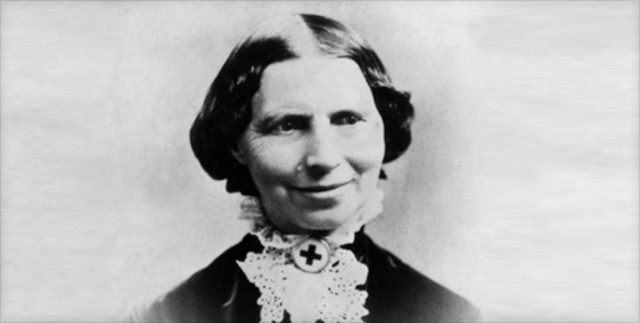
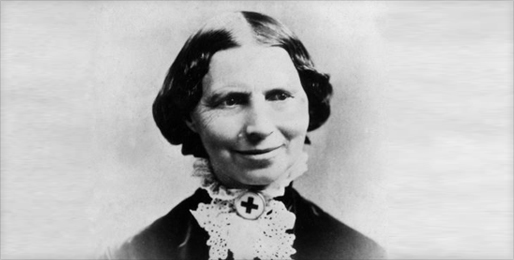
 Photo via The Red Cross
By DCist Contributor Caroline Baxter
Through the evening of September 16, 1862, in Sharpsburg, Maryland, 131,000 soldiers sat by the light of their campfires and waited for morning. On one half of the battlefield sat 87,000 Union men under the command of George McClellan; on the other sat 45,000 Confederates commanded by Robert E. Lee. Also on the front line was 41-year-old Clarissa Harlowe Barton.
Born on December 25, 1821, in Oxford, Massachusetts, Clara Barton had little medical training but a profound sense of humanitarian duty. She would later write that it was “a miserable night. There was a sense of impending doom. We knew, everyone knew, that two great armies…were lying there face to face, only waiting for dawn to begin the battle.” By day’s end, 3,654 men would be dead, 17,292 men would be wounded, and 1,771 men would be deemed missing or captured. The Battle of Antietam would be the bloodiest day in American military history.
Many of those who have heard of Barton know her, by and large, because of her efforts at Antietam or because she created the American Red Cross. The details bear repeating. She not only brought supplies, many of which she purchased herself, to the front lines of battle, but she was also one of the first American medical professionals to do so. And though she was a daughter of the Union, she tended to the sick and wounded regardless of uniform.
Fewer people know her as an early and vocal feminist. She was also one of the first women to hold a government job, working as a clerk in the Patent Office in the 1850s, and one of the first women to earn a man’s wages.
One hundred and fifty years after the signing of the Treaty of Appomattox, a group of D.C. musicians put together a selection of music inspired by her life and times, and recorded it in Clara Barton’s Missing Soldiers Office. They are the Clara Barton Sessions.
The man behind this project is a Washingtonian bluesman by the name of Jonny Grave. As he told DCist, “Music and history always go together. Music is the way people tell stories, especially traditional American folk music. We want to show how the memory of these songs and all of the stories of that era survive.”
Grave stumbled upon the Clara Barton Missing Soldiers Office Museum in Chinatown one Saturday afternoon and connected with the space; he couldn’t help but think of it as a music venue.
He found an excited co-organizer in David Price, one of the museum’s directors. Bringing more people to the space is one of the main missions of the museum, so the collaboration was “perfect,” Price said.
As Price recounts, the museum itself almost never was. The General Services Administration had owned it for years, but, not realizing what it was, had earmarked it for demolition. “The space was ‘discovered’ in 1996 when a carpenter went up to the third floor and found in a hole in the ceiling a metal sign that said, ‘Missing Soldiers Office, Ms. Clara Barton. The attic was full of stuff—more than 60 boxes of artifacts they took out—that was going to be destroyed.”
Grave then recruited friends from D.C.’s music scene to join a project that would celebrate not just the life of this remarkable American figure, but also the music of her time. Grave’s collaborators include Marty Frye; Margaret Wasaff, Anders Fahey and Manny Arciniega of Ballad’ve; Jonathan Een Newton; Brian Farrow; Laura Schwartz; Kate Saylor, and Greg Adams.
Grave gave the group two tasks: find a period song to play and write a new song inspired by the period. He was also adamant that this effort was not a re-enactment. “We want to show how the memory of these songs and all of the stories of that era survive,” Grave said. “It’s like a game of telephone. It changes from generation to generation with every person that plays it,”
Laura Schwartz picked the tune “The Cumberland and the Merrimac,” which is based on eyewitness accounts of rebel ship the Merrimac sinking the Cumberland in a naval battle. Kate Saylor, a fiddle player, drew inspiration for her original song, “Two Soldiers,” which she worked on with Fahey, Een and Frye, about two friends promising to tell each other’s families what happened to them after the war. This was one of Barton’s most lauded accomplishments: determining the fate of thousands of missing soldiers. Saylor explains, “After the war, Clara Barton made it her mission to help find answers for these families.” Fahey, an ethnomusicologist, and Wasaff wrote their song about the Civil War photographer Mathew Brady, who is widely considered to be the father of photojournalism despite not being recognized during his time.
Once all the selections were solid, the participants came together for a single all-night marathon recording session in Barton’s office itself. In addition to creating an air of drama, the overnight technique also minimized traffic noise, which is hard to do in Chinatown. Sleep was the last thing on their minds. Fahey remembers feeling “an intensely focused giddiness.” At dawn, Brian Farrow led the men of the assembled in “The Battle Cry of Freedom.”
So far, the project has been self-financed by the group of musicians who produced it. They are hoping to raise enough money through a Kickstarter campaign to recoup what they’ve spent and also raise enough money to print CDs and make music videos from the footage shot that night. Many in the group are adamant that this is not going to be a one-time collaboration and hope to bring more music into other similar spaces around the District.
One hundred and fifty years after the American Republic averted disintegration, our country still remains profoundly, harmfully divided. Voting rights, equal pay for equal work, even the integration of women into the infantry—many of our current issues are ones that Barton would be recognize. Reviving the music of Barton’s time enables us to better understand our own historical moment and to knit together the remaining distances. The words of Lincoln’s second inaugural still quicken our pulse: “With malice toward none, with charity for all, with firmness in the right as God gives us to see the right, let us strive on to finish the work we are in.” The Clara Barton Sessions reminds us of how much work we still have yet to do.
The Clara Barton Sessions musicians will speak at the National Archives’ after-hours party on Saturday, April 18th. You can contribute to the Clara Barton Sessions’ kickstarter here. Keep up to date with the group here.