 Rachel Sadon
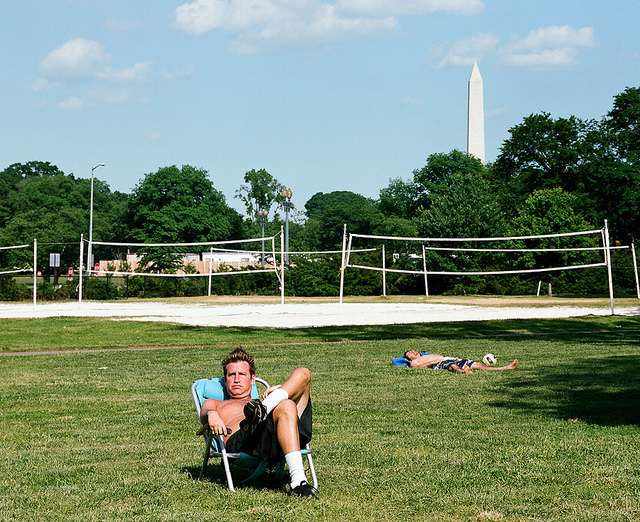 Photo by Joshua Yospyn.
Under a new plan from the National Park Service, beach volleyball players in D.C. can no longer just pick up a ball and head over to the courts on the Mall for a free, impromptu game. And many of them are very unhappy about it.
Last month, NPS put up an announcement seeking comment about proposed changes to the 11 courts that line Parkway Drive near the Lincoln Memorial. The changes would mandate a two-hour reservation and a $30 fee to use them, and they went into effect nine days later.
“For a number of years, we had received complaints about groups monopolizing the courts, be they leagues or other organized groups,” said Mike Litterst, a spokesman for NPS. “The reservation system would allow us to more equitably oversee the use of the courts by all users.”
But a group of players is vehemently arguing that the changes would have opposite effect, and they have started a campaign—replete with a Change.org petition, Facebook page, flyers, and a planned rally—to get NPS to reverse the move.
The petition’s entreaty, “Don’t kill D.C. beach volleyball! Save the Lincoln Memorial Sand Volleyball Courts!” may be a little bit of, er, overkill. But pick-up players say that a major consequence of the new system is that the once first-come, first-serve courts will become monopolized by leagues during the high-demand period after work on weekdays. And they point out that renting a campsite for the night in Yosemite National Park during season costs less than two-hours of court time. “This is the sale of a national park to companies, and the price is steep,” the petition argues. Nearly 2,000 people have signed it.
“The fees came about simply as a way to properly care and maintain the court. It gives us a steady stream of revenue to maintain the nets, collect trash, and replenish the sand,” Litterst said. When NPS initially sought comment on the plan last month, they wrote that “the rates were determined following a comparability study of other court fees in the area.” Litterst adds that one hundred percent of the fees will go back into maintaining the courts themselves.
John Gay, who has been playing volleyball on the Mall for more than 25 years, said the problem isn’t just that they will have to pay to use the courts. He points out that players, including himself, have bought sand to fill in the courts and done maintenance work on their own dime (and time) for years. He is more troubled by how the reservation system affects the city’s pick-up players.
“Virtually all the courts are now controlled by the for-profit leagues for the after-work times between 6 and 8 p.m.,” said Gay, a “long-time volleyball enthusiast” who works at a trade association. He explained that many players aren’t involved in such leagues, and instead prefer to just show up as the mood strikes.
“The park service doesn’t understand how this community of pick-up players operate,” he said. “We don’t have six or eight people that we get together with and say ‘we’re going to go down and play on one court.’ ”
Instead players show up, form teams based on who is around, and challenge people on the sand. “You call ‘next,’ and if you win, you stay. If you lose, you get back in line or go to another court,” said Gay. “The beauty of it is that you can go any time and pick up a game. Now that is threatened.”
Indeed nearly all of the most-coveted time slots have already been reserved through the next month. Previously, only six of the courts could be reserved on weekdays and all of them were open to the public on weekends.
In a letter to the editor of The Washington Post, Bonnie J. Morries, the daughter of the man who designed and built the courts in 1980, writes that the change is the “antithesis of my father’s vision.”
“Roger Morris designed and built our D.C. courts around 1980 as a permanent free space for amateurs and competitive doubles players,” she wrote. “Lives are turned around by the opportunity to play and to belong. In this way, my father struck a blow against racism and loneliness, against elitism and exclusion.”
NPS, which was surprised by the strong reaction to the plan, moved to extend the comment period until April 27 and they have reverted back to the original system for the time being.
A confusing note on the reservation system says: “Volleyball Courts will be closed indefinitely starting April 14, 2015. Existing reservations made prior to the closure will be honored.” Litterst clarifies that the courts themselves aren’t closed, just the reservation system is, as they work out what to do next.
It is “certainly still an ongoing conversation,” he said, and encouraged anyone with concerns to register their comments on the website. There is currently no plan for a formal meeting at this time.
After the 27th, NPS will review the comments. “Depending on the content, or if they have merits, we’ll tweak [the plan],” Litterst said.
Meanwhile, the players are planning a rally down at the courts tomorrow at noon; more than 50 people have RSVP’d already.