 Rachel Sadon
 Via getdctrees.
That empty box sitting across the street may well have a tree’s name on it—if only you’d ask.
Any District resident can request a tree in an empty box or grass strip between the sidewalk and the street at 311.dc.gov. A new website is making it even easier to figure out which spots are available and submit a request.
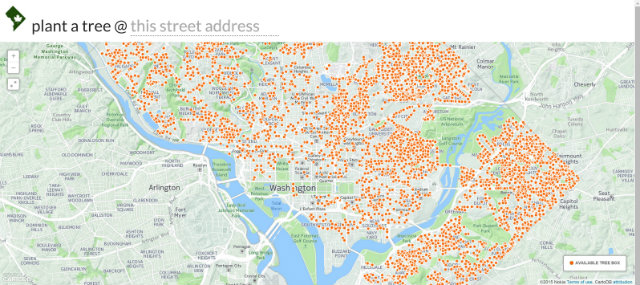
Getdctrees takes the city’s data on empty tree boxes and maps it clearly. Zoom in on a particular street, click on a dot, and a link will take you to the specific 311.gov page where you can copy in the address. During the planting season, which runs from October through May, D.C.’s Urban Forestry Administration will pop by and put in a tree.
“There is a very direct cause and effect,” said Emanuel Feld, who built the site using the city’s open data. “You’ll be shaping the environment directly around you.”
Every day is Arbor Day for D.C.’s Urban Forestry Administration, a team of twenty arborists that maintains the city’s roughly 140,000 trees year round.
“Trees are one of the only pieces of infrastructure that actually appreciates over time,” said UFA’s deputy associate director Earl Eutsler. “Street trees become more valuable the longer they’re in place.” During this year’s planting season, UFA added about 8,000 trees to the city’s canopy.
To that end, UFA actively maintains a database of all the trees—inspecting about 300 of them a day and noting where more can be planted.
Getdctrees uses that data to show residents where the available spots are and make it a little simpler to put in a request. Once those requests are made, arborists from UFA will inspect the area and make sure a tree can be supported there. If it can, they’ll come back during the next planting season and put one in.
UFA makes note of areas that can be planted (say, when a dying tree has been removed). But when they have too many work orders, the arborists prioritize spots that people have requested. “It lets you know that there is likely going to be an advocate for that tree, someone who might water it,” said Eutsler. “We would encourage anyone to call us for any tree space to have it planted.”
“You have some control over [trees being planted] and that’s awesome,” said Feld, who also built a nifty browser plug-in called “Books for D.C.” that searches the D.C. Public Library whenever you look at a book on Amazon, Goodreads, or Barnes & Noble and tells you if there is a copy. “They really prioritize citizen requests.”
It certainly beats trashing the Mall in the name of Earth Day.
scenes from the Earth Day concert on the Mall pic.twitter.com/3kKQOe2qax
— Christine Rousselle (@crousselle) April 18, 2015
The data that Feld used has also helped UFA see which areas are underserved by the tree canopy. While less than 2 percent of tree boxes are free in Ward 1, more than 10 percent are open in Wards 5, 7, and 8.
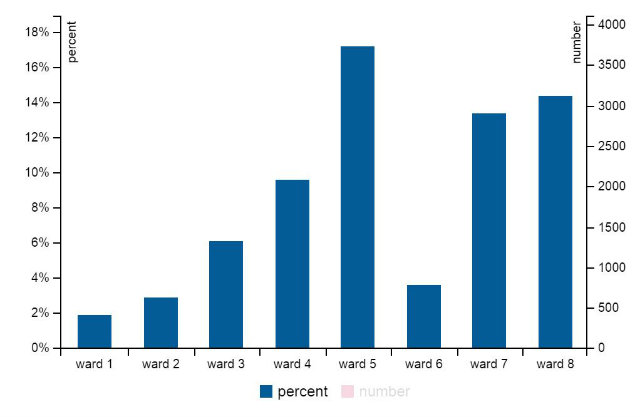 See getdctrees for a dynamic version of this graph, which is updated as trees are being planted.
“When people are surrounded by trees, they’ll call about the one open space on the block,” Eutsler said. “But other parts of the city might be dominated by open spaces and we’d receive no calls.”
So for the past few years, UFA has focused their planting efforts in those places. The darker green areas represent where they planted the most trees this season.
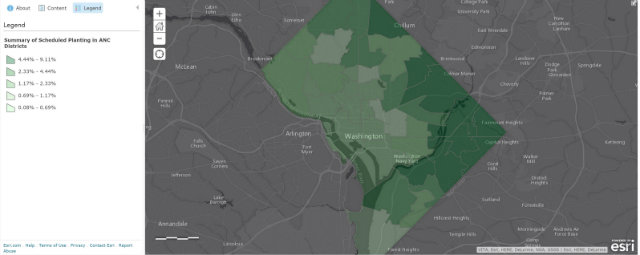 Via Urban Forest Administration.