 Photo by Mr. T in DC
Shocker: Capital Bikeshare membership is continuing to grow. Ok, not that surprising. But according to a new survey, Capital Bikeshare’s presence in the D.C. area isn’t just growing, it’s shaping the way the region is evolving—from the transportation and commuting habits of many Washingtonians, to the local economy.
Mobility Lab issued the results and analysis of their annual survey sent out to all Bikeshare members and the results are both surprising and not surprising. “Growth in membership numbers has been steady since the program launched in August 2010,” Lori Diggins, who owns the consulting firm LDA Consulting that performed the survey, said in a statement. In 2014, Bikshare had nearly 28,000 members, which, compared to the 22,200 members in 2013, gives you a picture of just how much it grows in a year.
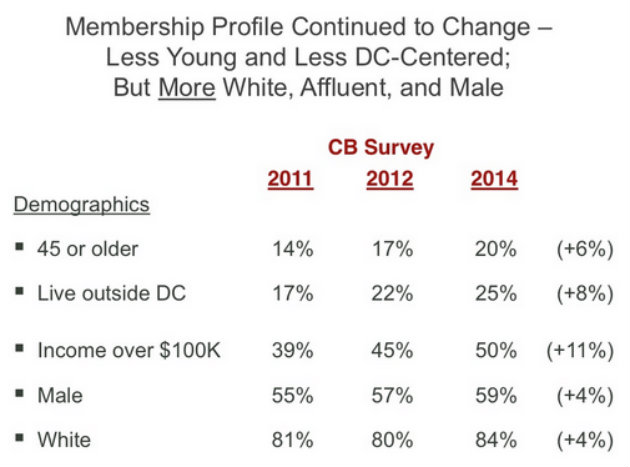
But the survey, of which 16 percent (4,314) of Bikeshare’s nearly 28,000 members completed, gives you an idea of who, exactly, is signing up for Bikeshare. Basically, Bikeshare members are becoming older, whiter, and richer.
 Via Mobility Lab.
In 2011, the same survey found that 14 percent of members were 45-years-old or older. In 2014, that number jumped to 20 percent. In 2011, 39 percent of members claimed to make a household salary of $100,000 or more. Now, 50 percent of members say that’s their current income. And now, 84 percent of Bikeshare users are white, compared to 81 percent in 2011.
And the membership is rapidly expanding outside of just D.C. 25 percent of members live outside of D.C., compared to 17 percent in 2011. Moreover, the survey found that a lot of members aren’t just relying solely on Bikeshare to get around. 52 percent of members have their own bike in addition to Bikeshare memberships, while 39 percent also has a car2go or Zipcar membership.
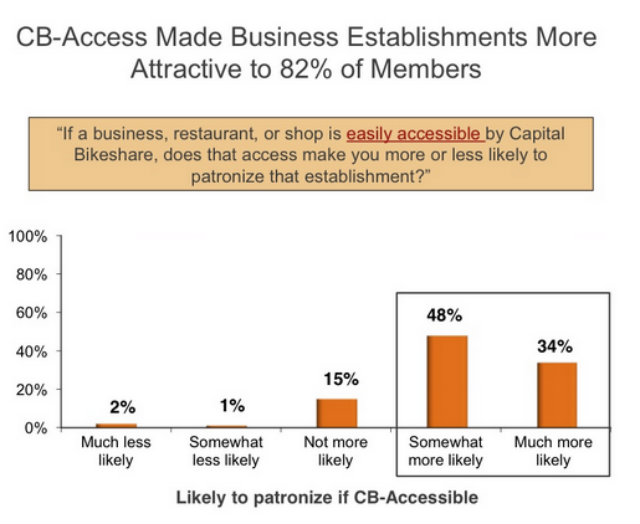
Capital Bikeshare has grown so much since it debuted in 2010, that the survey says it’s impacting local businesses, with 82 percent of the survey’s responders saying that they’re “somewhat more likely” or “much more likely” to shop or eat at a place accessible by a Bikeshare station.
 Via Mobility Lab.
“Some even said they would not go to these places—period—if there is no Capital Bikeshare station nearby,” Diggins also said in a statement.
Furthermore, the increase Bikeshare popularity has painted some interesting trends in the region’s traffic. Eight percent of respondents sold their household vehicle and didn’t replace it, “with 76 percent of those people saying Capital Bikeshare played an important role in the decision.”
The survey also found that, on average, Bikeshare members “reduced 158 driving miles per year,” which “equates to 4.4. million miles of driving eliminated annually from the region’s roads.