By DCist Contributor Arielle Milkman
It seems like few stones in D.C. have been left unturned by developers, who envision incredible progress for the city. Plans for condo conversions, mixed-use developments and mega-projects are announced almost daily.
Two new exhibits are inviting viewers to question that rapid development for themselves, albeit from very different angles.
The Historical Society of Washington, D.C. has a juried show that features the most endangered parts of D.C.’s built environment at the Carnegie Library, while just down the road, District Architecture Center’s exhibit on five massive urban development projects celebrates change on an enormous scale.
Go see these shows. They contain a lot of information about big changes—and perhaps more importantly—big money and specific interests informing this city’s development.
The Historical Society of Washington’s For the Record: Artfully Historic D.C. is a quick, rich collection of community work documenting the D.C.’s most endangered spots.
To the left of the entrance, a space devoted to the Anacostia Historic District includes a vibrant screen print on wood by Hamid Lagder and Edward Savwoir’s digital photo montage, titled Drum Major (a favorite of Historical Society Executive Director John Suau, who admits to having a thing for photo montages).
The Carnegie Library gets a lot of love, too, with nine pieces representing its storied exterior.
“There’s a lot of emotion behind this building,“ Suau said. “It’s a beautiful, Beaux Arts building that all the communities in D.C. sort of have a soft spot for because it was the only public library in its day that was not segregated.”
And there are a number of images that depict the McMillan Reservoir Sand Filtration Site, a defunct water purification project that’s slated for redevelopment after years of controversy.
Elaine Wilson’s starkly minimal drawings of the sand towers particularly stand out in an exhibit that’s heavy on digital images.
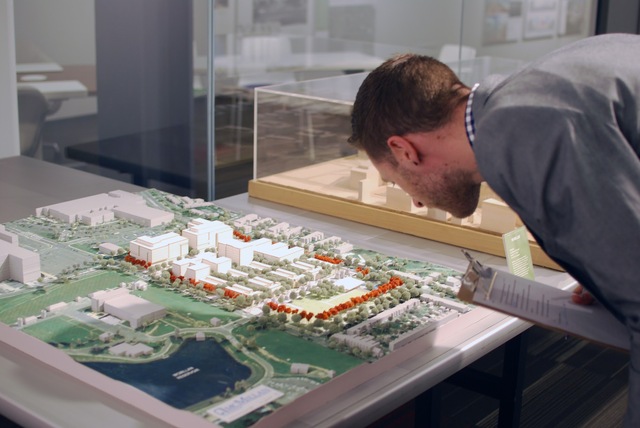
The site is also featured in District Architecture Center’s reVISION: Thinking Big, New Projects in Washington DC. The exhibit examines five mega-scale development projects that have transformed or are slated to transform the city in a major way: The McMillan plan, The Yards, The Wharf, Burnham Place at Union Station, and Capitol Crossing.
In contrast to The Historical Society’s documentation of the current state of affairs, District Architecture Center’s promises a vision of the future — and it comes in bright colors and polished presentation boards.
For Mary Fitch, the executive director of the Washington Chapter of the American Institute of Architects, the rapid pace of change means that D.C. is coming into its own. Not only is the city investing billions of dollars in new developments, but the current climate provides an opportunity to correct past planning mistakes.
“There are many things about Washington—changes made in the 70s—that need to be revisited … now we can actually go back to those things that were open cuts and really look at a way to put those back into a walkable city again,” Fitch said.
Fitch’s team has chosen projects that make use of D.C.’s waterways (The Wharf and Yards Park), build across physical obstacles (Capitol Crossing), and put defunct public works sites to use again (McMillan).
The way that the architects have imagined D.C.’s spaces looking in the future is, quite frankly, exciting — if you can get past the presentation of the whole thing looking like a very high-quality science fair project.
In one image of Capitol Crossing, a barefoot toddler looks like he’s having a good time, dancing barefoot and rather bizarrely to his own beat, while a racially diverse cast of business folk mill about in the background. Nothing says mixed-use development like kids, casually dressed passersby, and serious slack wearers out for a jaunt in the same enjoyable public space.
But beyond the glossy renderings, the Architecture Center’s storyboards are fairly sanitized. They lack the high drama and human-scale disruption that large-scale development projects have wrought, particularly on the topic of inclusion.
The description of Vision McMillan details some of the controversy around the project: “The filtration plant is valued by many as open space … historic preservation considerations added further complexity to the site’s development potential. At the same time, the community wanted more retail options, affordable housing, and jobs.”
But such measured descriptions don’t really capture the level of tension — and high stakes — around projects that have and will significantly change the structure of D.C.’s built environment, not to mention kick some folks out of their homes.
“The downside to quick, massive, and drastic change, is that it’s unsettling for people who have history in those neighborhoods,” said street photographer Lisa Diop. Diop’s Folklife in Deanwood is among the top five pieces chosen by the jury of For the Record.
Architecture and urban planning nerds, particularly those in the smart growth and bikeable, walkable city set, will enjoy visions of projects that take space away from the automobile and encourage active participation in urban space.
But in focusing on large-scale projects and shiny things, Fitch’s team loses sight of some of the other implications that come with such development. There are a few lines about affordable housing in there — but just a few. And the exhibit doesn’t contain any discussion about what development means for communities currently living in the areas targeted for Fitch’s corrective efforts.
For Fitch, D.C.’s inclusionary zoning program should ensure that affordable housing is included in new developments. And she says the onus is on politicians and their constituents — not just designers — to create an environment that is amenable to inclusive development.
“This may be the pivotal moment, the lynchpin that sort of tips everything over, and we may do it right,” Fitch said. “Everyone deserves great housing — rich and poor — and it makes no sense for a teacher not to be able to afford to live in the city [where they work].”
Meanwhile, back at the Historical Society, Suau is not taking sides. “I’m like Switzerland,” he said.
He describes D.C.’s upwardly mobile trend as exciting, and commits to letting the preservationists protest change. “I really think there’s room for everyone; there’s room for the new.”
For the Record: Artfully Historic D.C. is on view through May 27, 2015 at the The Historical Society in the Carnegie Library building. The Carnegie Library is located at 801 K Street NW and is open Tuesday through Friday, 10 a.m. to 4 p.m.. Free.
reVISION::Thinking Big, New Projects in Washington DC is on view through June 13, 2015 at the District Architecture Center’s SIGAL Gallery & Sorg Gallery. The District Architecture Center is located at 421 7th Street NW and is open Monday through Thursday, 10 a.m. – 7 p.m.; Friday 10 a.m. – 5 p.m.; and Saturday 10 a.m. – 2 p.m. Free