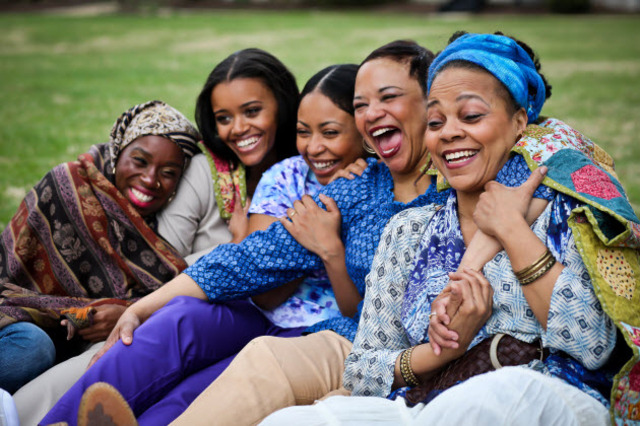
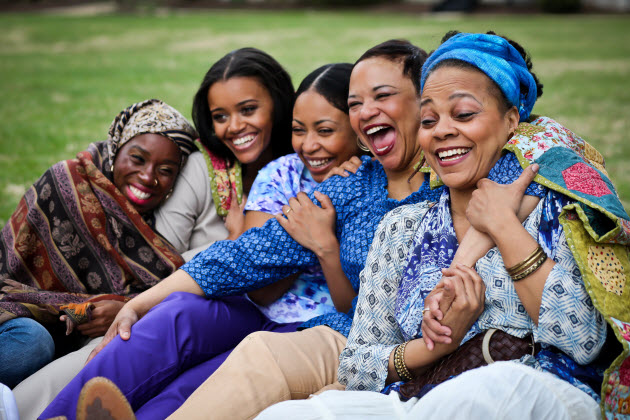
 Afi Bijou, Meeya Davis, Nikiya Mathis, Caroline Clay and Tonye Patano in Katori Hall’s The Blood Quilt. Photo: Tony Powell.
By DCist Contributor Anya van Wagtendonk
One could say that Blood Quilt, a new play making its world premiere at Arena Stage on Friday, is a family affair.
The creative team—playwright Katori Hall, director Kamilah Forbes, and a cast of five actors—are not, of course, related to one another. But over the course of shaping a work about sisters, they established a familial bond of their own, says actress Meeya Davis.
“It’s really a good sisterhood and friendship that has been created,” Davis says. “And I will attribute that to being able to be sisters in the play. Somehow that trickles its way out into real life.”
Davis plays Amber, the youngest of the far-flung Jernigan sisters who reunite (one with her daughter in tow) at their childhood home on an island off the Georgia coast after their mother’s death. What begins as a ceremonious quilting bee in honor of their late mother turns into a conflict over her will.
Hall, the playwright, wrote Blood Quilt in residency at Arena’s American Voices New Play Institute. She worked on the script for several months alongside director Forbes, and continued to make changes after rehearsals began in late March.
“Katori would see and hear the actors and how we would work through the script and what would land and what wouldn’t,” says Forbes. “We had a lot of script revisions in this process … which is what you want a really successful and healthy new play process to be about.”
Davis says that this spirit of collaboration offstage lent itself to building a strong sense of family onstage. But she adds that the behind-the-scenes unity also stemmed from the fact that the cast (Davis is joined on stage by Tonye Patano, Caroline Clay, Nikiya Mathis, and Afi Bijou), as well as the playwright, director, choreographer, and musical composer, are all black women. Not only do they share passion for their work, but they’ve also struggled similarly to find meaningful, challenging roles.
“Being black women in the business, we have very few roles,” says Davis. “There’s not a lot [of plays] with characters that are very interesting and relatable… women that have a statement, that have a life.”
Forbes agrees: “We just don’t get opportunities like this.” Hall, who originally trained as an actor, has said that she began writing to address that dearth.
For Forbes, another grounding force was the island setting and its rich history. The Jernigan family is rooted in the Geechee/Gullah cultures found on islands around Georgia and South Carolina.
“My family is from the Caribbean,” says Forbes, “So what’s interesting to me is really swimming and living in a world and a culture that feels very ancient.”
Some of the conflict of the play comes from cultural clash. Quilting is steeped in African American tradition, and so part of the sisters’ choice of tribute is, in part, a fight “for their cultural relevance in a larger mainstream context,” says Forbes.
But some of the conflict stems from the natural, and universal, passion of family. “Regardless of if you are coming to this world having any knowledge of the island, or quilting, or the Geechee/Gullah culture, what you do recognize is siblings,” Forbes says. “They love hard and they fight hard.”
It’s a lesson the team behind Blood Quilt learned by supporting one another through onstage tensions and spats.
“Particularly in plays with a lot of conflict, you want to make sure that the actors off-stage are tight and supportive and make each other right,” Forbes says. “And that’s ultimately what you want, also, in a family. No matter what happens, through strife, through conflict, we always have to make each other right.”
The Blood Quilt. April 24-June 7 at Arena Stage, 1101 Sixth St. SW. Tickets, $45-90, available at www.arenastage.org.