Photos by Rob Cannon. Words by Max Steinmetz.
When Huddie “Lead Belly” Ledbetter arrived in D.C. in 1937, the near-universal respect and admiration he now has was nowhere to be found. In town for a recording session at the Library of Congress, Lead Belly planned to stay with famed musicologist_and his one-time manager—Alan Lomax, but Lomax’s landlord wouldn’t allow it; Lead Belly was black.
But on the black side of town, Lead Belly and his crew were excluded because they had white people in their group. Exhausted and annoyed, someone in the group cried that D.C. was a “bourgeois town.” Lead Belly loved the phrase, and the next year, recorded the first version of “The Bourgeois Blues.”
Don’t try to buy no home down in Washington, D.C.
Cause it’s a bourgeois town
I got the bourgeois blues
I’m gonna spread the news all around
Though some may argue the moniker still fits, times have changed for Lead Belly and the nation’s capital. The songwriter was on welfare when he died in 1946 from Lou Gehrig’s disease. He missed out on the folk revival that would make his songs and name instantly recognizable to generations of music fans, in the ranks with Woody Guthrie and Pete Seeger. But The Kennedy Center on Saturday night gave him more than his due.
Some of the biggest names in folk, Americana, and rock music channeled Lead Belly’s spirit for a concert called “Lead Belly at 125: A Tribute to an American Songster,”
The concert, hosted by young banjo visionary and Carolina Chocolate Drops co-founder Dom Flemons, comes on the heels of a career retrospective box set from Smithsonian Folkways Recordings. Over five discs, the box set includes five hours of music with 108 tracks, along with a coffee table book with rare photos of Lead Belly, pictures of his handwritten notes and album covers.
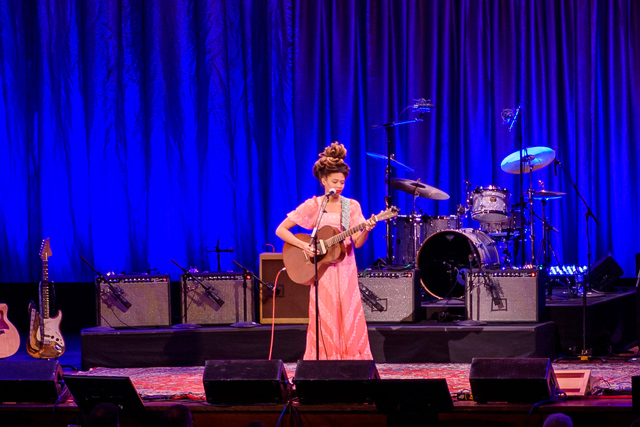
Valerie June opened the show with “Governor O.K. Allen,” Lead Belly’s second “pardon song,” which he recorded while incarcerated at Angola prison in hopes that Louisiana Governor O.K. Allen would hear it and grant his pardon. (Lead Belly was released soon after, though the state claimed it was only because he had served his time with good behavior.) “[From] learning how to play Lead Belly tunes, [an] artist can go and learn how to do any genre of music that they want to do,” June told DCist before the show. “That’s how I, and many other artists, do it. Nothing we do is ever our own.”
Shannon McNally, with support from the Billy Hector Band, kicked off her set with a country bar band rendition of “You Can’t Lose Me, Cholly,” a song that would have been played at local dances in Lead Belly’s youth, and “Good Morning Blues.” As Lead Belly developed his repertoire through childhood songs, his music was in McNally’s musical vocabulary long before she was a professional musician.
“My dad had a record called ‘Huddie Ledbetter Sings Negro Spiritual for Children,’” McNally said by phone the week before the concert. “I grew up on Long Island with that record, not realizing, of course, that it was ancient even then.”
As with any tribute performance, the songs are meant to be interpreted and reinvented for a new audience,” McNally said. “I do analyze it for the the period stuff, and I don’t want to lose that entirely, but it just has to feel natural coming out of my mouth,” she continued. “And some of it’s fun to just straight up channel. It’s kind of like time traveling.”
That’s how it felt when Alvin Youngblood Hart took the stage, leaning back in a plain wood and leather chair in the center of the stage. He hunched his shoulders over a 12-string acoustic guitar, similar to the one Lead Belly favored for its percussive qualities. His baritone worked wonders for “Alberta,” one of Lead Belly’s original blues tunes. The sparse arrangements highlighted the simultaneous biography and the universal sorrow. When Hart sang “Oh, Alberta / Would you tell me where did you stay last night / Woman you didn’t come home till before daylight,” the pain is the same today as it was 70 years ago.
“Being a follower of the cult of Lead Belly for a few decades now,” Hart said, “this is the icing on the cake.”
While all of the musicians in Saturday’s show have been influenced by Lead Belly’s music in some fashion, Josh White Jr., the last performer of the first half of the show, was the only one to actually meet him. White Jr.’s father, an accomplished musician, performed with Lead Belly in the 1940s. On stage, he highlighted Lead Belly’s political and social activism, through an elegant, acoustic guitar version of “House of the Rising Sun,” before bringing Billy Hector back on stage for “The Bourgeois Blues.” Sung with a smirk and received with knowing laughs from the Kennedy Center audience, that tune now carries a sharp bite in reference to lingering racial tensions.
The second half of the night began with a set from host Dom Flemons on banjo, followed by Lucinda Williams performing “Rock Island Lines” and “Into the Pines,” the weight of which hangs heavily on the Lead Belly repertoire ever since Nirvana’s famous performance of the song on MTV Unplugged. The reference to Lead Belly on that stage was the first time many fans had heard of him, and the howls of recognition from the audience when Williams began to play attest to the vast influence it still carries.
For the final set of the night, Robert Plant, Alison and Viktor Krauss, and Buddy Miller provided arrangements that were, at times, haunting and mysterious; far removed from the image of Lead Belly sitting with his 12-string guitar. With Plant and Krauss singing in the center and Miller and Viktor Krauss to either side of them, “Out on the Western Plains” became a chilling ghost story. “Gallis Pole,” made famous by Plant as “Gallows Pole” as a member of Led Zeppelin, was vast and reverberating.
“Little did he know what we were going do with that back in 1975 when we grabbed it and shook it,” Plant said afterward.
Finally, Flemons brought all of the night’s performers back on stage for a sing-a-long of “Midnight Special,” with the chorus projected on a screen over the stage so the audience could sing along, and then “Goodnight Irene,” one of Lead Belly’s most famous songs.
The performance, which included an appearance by some members of Lead Belly’s family, encapsulated the way that his songs have touched so many performers over the years, and the way that they will continue to reach new ones.