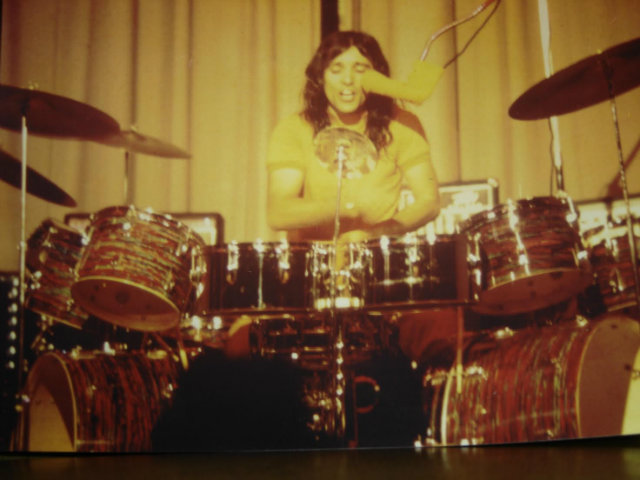
 Courtesy of Vincent Tornatore/Lion Productions.
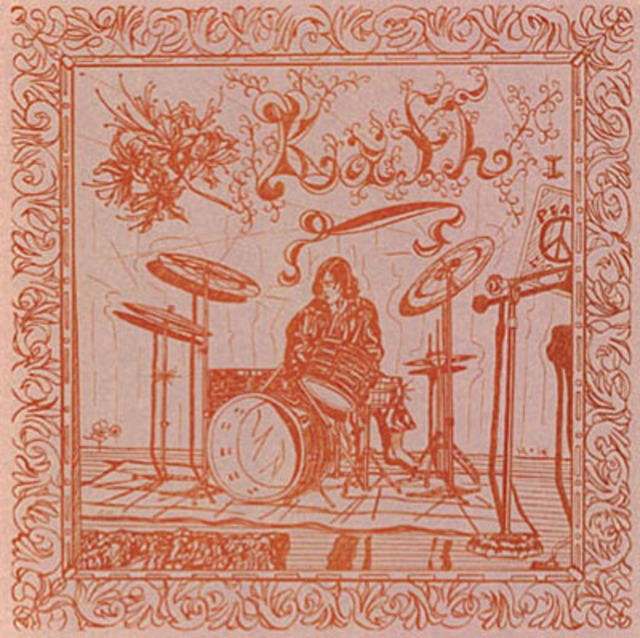
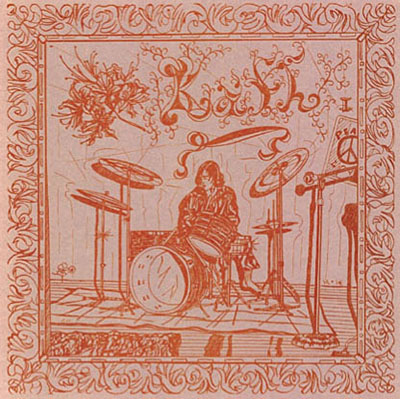
One of the rarest private press albums to come out of the greater Washington area is Kath’s 1. Only 60 copies of the original album were made, so it took some doing for one of those copies to end up in the hands of the dedicated crate diggers who champion this music. I spoke with Val Rogolino, Kath’s mastermind.
DCist: What part of Maryland are you from—where did all this happen?
Val Rogolino: I’m in a little town between Fort Meade and Annapolis called Odenton. I’ve been here for quite a few years.
Was there a music scene in that area?
In the ’60s, after the Beatles happened, it seemed like everybody in the neighborhood had a band. I started off playing guitar and it just didn’t work out. But one girl told me, “You play guitar like you should be playing drums.” We needed a drummer, so I tried the drums and it stuck.
You formed the band Badge before Kath—how did that come about?
In ’64 [I] was in a band called the Serfs. Later we developed into a three piece that did a lot of Hendrix. Around 1969 or 1970 I met Jim Sellers [also known as Cheese Sellers.] We became Badge around 1970.
How did you meet Cheese?
Through the local bands. We had one of his old bass players and we needed a guitar player, and our bass player said to try this guy out. It worked out well—Cheese was a good singer and a good guitar player. We had a great relationship, recording and playing for more than ten years. Cheese and I and Jim O’Dell started Badge.
Listen to Badge perform “As I Looked”.
When did you start playing gigs?
We played the old sock hops and teen clubs that were big at the time. Sometimes we got gigs at night clubs and our parents had to take us to those because we were too young to drive. We were a novelty—we tried to sound like the Beatles, and a lot of people liked that. Then we started developing. We listened to a lot of groups and could always tell their copy tunes from their originals. We wanted to see if we could pull off an original as a cover, so when we played the teen clubs we’d sometimes introduce one of our original songs as a song off Beatles V [which doesn’t exist], side one. It worked!
Did Badge release any records before the Kath album?
We did two 45s. We already had the 4-track machine, so we mixed as much down as we could and took a tape to a studio to make a master and an acetate for us. That was probably in the early ’70s. After that came the Kath LP in 1974.
I made the Kath LP for a girlfriend’s birthday. I only made 60 copies of that—it was a gatefold, which was expensive at the time.
My mother submitted that LP to a company in Cincinnati and they called me up. At first I thought it was a joke. They said they were interested in recording us, so we went to Cincinnati and we did four songs. They never pressed a record, but I have the master tapes. From those four songs came a Badge EP in 1978 [included on the Lion Productions CD]. For that one we had different colored vinyl—we had clear vinyl and black vinyl and orange vinyl. It wasn’t that expensive back in those days. We sat there when they were pressing it and watched the blob of the black acetate going in.
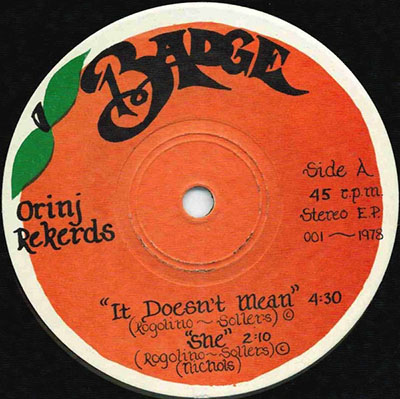 From a 1978 Badge EP (Discogs)
Where was the pressing made?
Huntsville, Md., north of Baltimore. After Kath, we did a few EPs and heard from another place in Cincinnati that wanted us to record. Cheese and I went there to make a 45, but that never really panned out. This was 1976, 1977 and disco was coming out. It killed a lot of playing in clubs because instead of putting up a whole band and paying them you could just pay one guy to spin records.
That was about it. Cheese was staying the same—and there’s nothing wrong with that. But I wanted a female vocalist, I wanted horns. Almost like a Brian Wilson thing. Not necessarily soul or anything like that, but I wanted to get a huge band, and I started to sound pretty good. We covered a lot of different songs and wrote a lot of songs, but disco killed everything. Nothing happened after that for quite a few years.
In 2005 I got a call from Rich Haupt from Rockadelic Records, and he wanted to reissue the Kath LP. What he reissued is not the original album. He took out some songs. The first CD is the original Kath LP. I wanted to do a Kath 2, so that’s where the second CD comes in—it has a few of the Kath 2 tracks and other stuff as well.
Tell me about recording the Kath LP—it sounds like it was a lot of fun, with the toilet bit, turning over the record bit [a jingle announcing when the side was over—Monty Python did something similar]. Tell me about the tape experiment, “Seagulls.”
“Seagulls” came from a tape my sister had. I don’t know where she got the seagulls from. All I did was cut and splice, slow it down, speed it up. Going out and recording seagulls might have taken me forever. We just wanted something a little funny.
The recording equipment was nothing like nowadays with ProTools and computers. With the Teac, if I recorded something on the first three tracks, I’d mix those tracks into the fourth track so I’d have three more tracks, but then I’d lose quality. I don’t know if you’ve ever seen the Kustom amps that Creedence Clearwater Revival used, but I used those as columns for playback speakers and mixers. We lost a lot of quality but it was a lot of fun. I learned so much. It was tough because you had to edit everything and splice everything together and think ahead when you’re mixing.
I’ve read that the Kath LP is dedicated to your pet monkey.
The girl I recorded the LP for, Kathy, she wanted a monkey. At that time you could buy exotic pets. A lot of people had a spider or squirrel monkey. [We found a] a stump-tail [macaque], and we had no idea what a stump-tail monkey was till we saw it. This monkey stood about two or three feet. These things were very strong. We called it Stewy. So we dedicated the album to Stewy. [They later gave the monkey to a more appropriate owner]
Are you still playing and writing music?
Once in a while, the bug gets me. But it’s been a long time. I’m in my ’60s now. I still have the love for it. Once you have it, you just never get rid of it. You get older, you don’t sound as good, you’re a little slower, but the love of it is still there. I recorded quite a few songs, especially in the 80s, but it’s not that easy. You have to make a living. I got more recording equipment and musical equipment than I’ve ever had before, but I don’t have time to do that anymore.
In the next few months, Lion Productions, who reissued the Kath album on CD, will reissue the original Kath LP on vinyl. If you see the Rockadelic issue, the color is bluish; what you see on the CD is the original color. Lion is even going to make it a gatefold. I never expected this attention. I never liked the way Kath 1 was recorded. But it’s been a fun trip reminiscing about it.
It’s still finding fans today.
That’s what’s strange. In places like Japan, they love that stuff. Maybe they don’t understand the words. To me, I never liked the quality. I had a 4-track recording of Kath 1 and I wanted to go into a studio and mix it down but it would have been two or three days to mix one song and I would have spent thousands and thousands. At the time, it wasn’t worth it. But for the new one, I found the master tape and the quality is a little bit better. What you hear on the Rockadelic version is sped up! I didn’t know at the time, but when I got a copy of the original record, I thought damn everything is fast. But you can only put a certain amount of minutes on each side, and I went over that. On the CD, you have the original tempo, and the new LP should have the right speed too—they’ll put it on two LPs to fit the music at the right speed. They wanted to capture the original sound. There’s a few little tidbits that were taken out on the Rockadelic LP and the CD too, but the new Lion Productions release will restore everything.
Listen to Kath perform “I Want to Love You.”