 Photo by Victoria Pickering.
The second iteration of the Funk Parade promises to take a giant leap forward from its inaugural predecessor. A year after city officials forced the parade route along V Street NW, creating a bottleneck that some now refer to as “the rally in the alley,” Saturday’s parade take its rightful place on the main stretch of U Street.
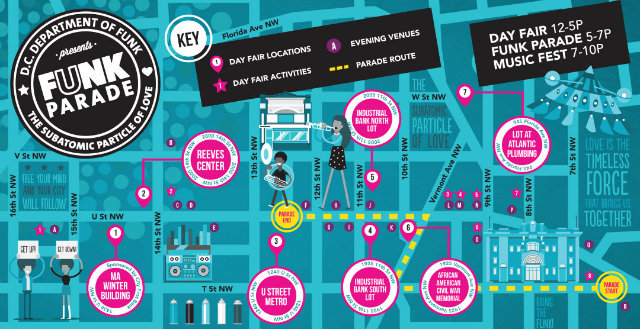
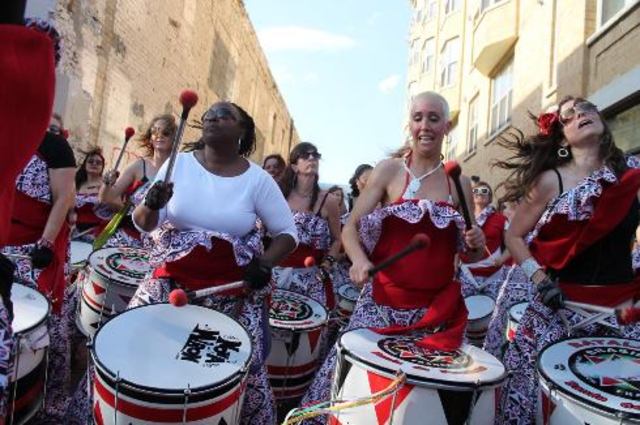
The parade itself takes place from 5 to 7 p.m. on a route between two U Street landmarks, The Howard Theatre and The Lincoln Theatre. A loose affair without floats or vehicles, participants are encouraged to bring their own instruments, dance, and play along to rhythms by local high school marching bands or the much loved ladies of Batala Washington.
The evening procession is the highlight of Saturday’s programming, but only a small part of the festival’s complete schedule. A street fair featuring 14 performance areas and dozens of acts begins at noon. Highlights include the lineup at the JBG Lot at Atlantic Plumbing (945 Florida Avenue) hosted by Union Kitchen and DCDIT, CapitalBop‘s stage featuring dance oriented jazz and the Kennedy Center’s lineup at the Reeves Center.
After the parade, several venues along the U Street corridor will open their doors for free shows. U Street Music Hall will host SEE-I, Tropicalia will feature DJs spinning all-vinyl sets of international music as well as live bands, while The Funk Ark and Elikeh play Liv Nightclub.
The sheer scale of the Funk Parade in comparison to last year is impressive, offering something for everyone. The forecast calls for clouds with temperatures in the 70s, so a solid crowd can be expected if that holds up. DCist also took the opportunity to interview festival co-founder and organizer Justin Rood to get some insights into this year’s event.
DCist: Who is the team behind this year’s festival and how did you all come together? What was the original vision?
Funk Parade was co-founded by myself and Chris Naoum. It came to me in a dream several years ago. I spoke with people and eventually was introduced to Chris, who had started a small organization, Listen Local First, to support local musicians. Together we built a group of several dozen stakeholders—local businesses and venues, arts groups, community organizations, civic leaders—and Funk Parade was born.
DCist: Aside from the fact that U Street will close for at least part of this year’s festival, what are some other changes?
I think there will be a lot of new people coming to the day’s events, which is good. Funk Parade should recreate itself every year, reflecting the joy and creativity and love for the city that its participants bring. We have a lot of new musicians and performers, but I’m mostly excited about what the participants—the neighbors and residents—will bring to the event. They are the ones who make each year unique and awesome.
DCist: How did you go about curating this festival? Were there any themes you wanted draw out?
Funk Parade is participatory and collaborative. The city is full of amazing musicians, arts and education groups, DJ collectives, B-boy crews, and more. Funk Parade as an organization doesn’t curate as much as it tries to create spaces for those groups to fill with music and joy and surprises, invoking the history and culture and spirit of the neighborhood and the city. We have over a dozen different organizations involved in programming the day fair alone, producing over 50 music and dance performances. It’s a kaleidoscope of visions around this central spirit of funk. The parade is the ultimate participatory collaboration, with every musician, dragon, and hand-clapper playing a part. And the music festival at night—that’s just a really good time.
DCist: Who are some of the standout acts for you? Is there anyone who is as a particular surprise?
Everyone has their favorite acts, and I love that depending on who you talk to, the acts they think are the “headliners” are totally different. I’m more excited for people to come hear an amazing band they’ve never heard of before. Hear a rhythm from an African guitarist repeated in go-go later in the day. Dance with strangers. Come to be surprised and delighted! Life is so much more fun that way.
DCist: U Street was built on a rich African American culture and the demographics of the area have changed dramatically over the past few years. Was this in any of your thinking when you first came up with the idea of the Funk Parade? How, if at all, is that reflected in the programming?
U Street has been the heart of live music in D.C. for maybe a century. That is a tradition that began when it was a predominantly African-American community, and the music it’s built on is African-American music—jazz, soul, R&B, funk. We want to celebrate that, and celebrate the spirit of the music that has made U Street great. That spirit that resides in the music you can hear on U Street today—from jazz and hip-hop, to reggae, Ethiopian pop, funk remixes, you name it. The history of U Street is black history, for sure. It’s city history too, and being part of D.C. means knowing that history, being proud of the accomplishments that came before, being proud of the music and history that have helped make this city and this neighborhood great.
DCist: Is it your intention to keep this as an annual event? If so, what are some things you are doing to make it sustainable?
As long as people love this city and want to celebrate its heart, we hope Funk Parade will be around. It’s sustained by the support and participation and creativity of local residents and artists and businesses. What it is is up to all of us. Keep showing up, keep dancing, keep making music, and Funk Parade can continue.
DCist: If you were an attendee spending May 2 on U Street, how would you go about planning your day?
Don’t plan. People try to plan too much already. Just come down to U Street, follow the sound of the music that moves you, meet great people, have a good time. Feel the mighty love. We have 364 days to live on a schedule, grumble about the woman on the escalator in front of us or the guy who cut us off in traffic. Take one day to listen to that woman sing, or dance with the guy from the car. We may all be different, but we love this city together. Everybody’s got a little light under the sun.
DCist: Is there anything I missed that you’d like DCist’s readers to know?
Funk Parade is a lot like life: The more you bring to it, the more you’ll get out of it. The best moments are going to be the ones no one planned. And you’re never going to get to see everything, but it doesn’t hurt to try.