Welcome to the first in a new series that looks at some of Washington’s late, lamented concert halls, cabarets and clubs.
There’s a Sun Ra recording that triggers a particular memory for a certain generation of Washington music lovers. “Space is the Place” was the soundtrack to radio spots for d.c. space. From 1977 to 1991, the building at 7th and E Streets NW that currently houses a Starbucks was home to one of the area’s premiere venues for punk, avant-garde jazz, cult movies, and poetry readings. If Penn Quarter, as they call it these days, seems more and more like a tourist trap spilling over from the Verizon Center up the street, in 1977 the area was still reeling from the 1968 riots. The Post’s Richard Harrington wrote in 1983 that d.c. space “paved the way for clubs such as the 9:30 (whose original location opened up a few blocks away in 1980) and even the Wax Museum (a short-lived club that operated at 4th & E SW from 1982-1984) by getting people used to the idea of going back downtown at night.” Co-founder Bill Warrell told Harrington that “We broke ground for an awful lot of what they do … most people thought it was a desert, a lost region.”
Imagine having the Artisphere in someone’s living room? That’s kind of what this versatile venue was like. A March 1989 calendar advertises appearances by Czech underground legends The Plastic People of the Universe, Teenbeat favorites Unrest, jazz saxophonist Steve Lacy, and garage band The Brood (I think I was at that show) and you’d pick out your own highlights.
The club hosted alternative theater performances and the independent film series I Am Eye. I saw friend’s punk bands and poetry readings at d.c. space as well a 16mm print of Beyond the Valley of the Dolls.
Carl Cephas (AKA the Washington Psychotronic Film Society’s Doctor Schlock), told me that “d.c. space was the only club where a man could run in from the bus-top outside, jump on the stage, play the piano, and hop-off when the bus arrived to crowd applause.” In 1987, I saw Cephas perform at the club with his band The Psychotics, and space was probably the only venue in town that would have let them be their own opening act, a parody of the lesbian a cappella group Betty that they called Barney. You can see the club in performance footage in the Psychotics’ video for “Uptown Psychosis,” here.
It was a space for local artists at the beginning of their career and for legends. Sun Ra. Bad Brains. Laurie Anderson. Philip Glass. In a 1991 Washington Post article on the venue’s imminent closure, Eve Zibart wrote that, “[f]or years, d.c. space has been arguably the only, and certainly the only reliable, venue for original music outside the mainstream. Hardcore, improv, go-go, gothadelic, zombie grunge, grunge, surf garage, metal, indie—all the new adventurers and spoofers and counterrevolutionaries who couldn’t draw big enough crowds for more commercial clubs were welcome here.”
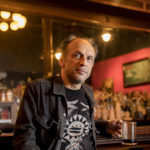
I chatted with co-founder Bill Warrell last week.
DCist: My phone was buzzing right as I biked past the Starbucks that used to be d.c. space.
Bill Warrell (chuckling) That is a shame. The world has had one d.c. space and it has tens of thousands of Starbucks.
This is a big question: do you have any favorite shows that you did?
Warrell: I could go on for hours with that! I loved what I was responsible for because that was my primary interest. I love that the place took on the personality of dozens of people and their primary interests. This place had more primary interests than any small room the city ever had or probably ever will. Some seriously heavy people all wanted to make something happen and they saw this as the spot. My thing was primarily new jazz, a lot of the film early on and a lot of the improvised music.
Sun Ra and I met before we opened and he kind of influenced what I did there. One of my fondest memories is a New Year’s Eve which I think was 1979-80. Sun Ra was playing upstairs at d.c. space, and local band The Urban Verbs were opening for the B-52s for a show at the Corcoran. We had a pretty modest crowd here for the first set—the space didn’t hold a lot of people. When the Corcoran show ended … well quite a few of the people who worked at d.c. space were Corcoran students, and the Urban Verbs were almost like family. So everybody comes over to d.c. space from the Corcoran and there was a bigger mob of people downstairs waiting to see Sun Ra than there were upstairs.
Sun Ra knew it. He had like 18 pieces that night, and after midnight he marched his orchestra down that skinny stairwell and through the restaurant—by then we had maybe 400 people—and he just electrified the place. He never stopped! If Sun Ra was hit by the spirit you basically had to be ready to serve breakfast. We definitely saw daylight. It was just kind of a magical mix of this weird artsy new wave crowd who knew they were tapped into something and knew they had to go somewhere to keep partying and they ended up in this building where Sun Ra was literally raising the roof.
So how do you feel about the current state of D.C.’s music venues?
Warrell: I think we‘re heading into a period not unlike the d.c. space days where mass audiences are not the end-all-be-all. I was pretty bitter the last fifteen years, I thought, “This is just shit!” But I’m seeing it coming back where smaller things find the audiences they should. There’s this group in D.C. called Transparent Productions that’s been at it for as many years as d.c. space has been closed, doing really edgy really out there music. They work at a lot of different venues—they worked in Takoma Park for years, now they do shows at Bohemian Caverns on Sundays. CapitolBop are doing loft jazz things a la d.c. space over on New York Avenue.
I really look at the late ’70s through the ’90s as pretty much the most creative burst the country has seen. And Washington was our microcosm of the country, and we are again. But although I’m born and raised here, for the first time I’m thinking about leaving because it’s become so soft. The 9:30 [Club] has come along in a great way but it‘s become a major commercial venue. The return of the Howard [Theatre] was done in such a typical national commercial way, almost like mall venues with elevators and bars on every floor and TV screens. That’s not what the Howard was; the Howard was the richest old vaudeville house Washington had ever seen— that the whole country had ever seen! And by far the blackest vaudeville house in the country—more than the Apollo. To have it come back in the way it did, I’ve been thoroughly disappointed.
Who knows what’s going to be next? Smaller venues are always critical. People have to continue to be willing to see someone who’s not famous. Unfortunately we go into these waves where everyone has to fall into lockstep but now I think we’re out of synch with that. I’m optimistic at 62!
—
Watch Root Boy Slim performing at d.c. space in 1989