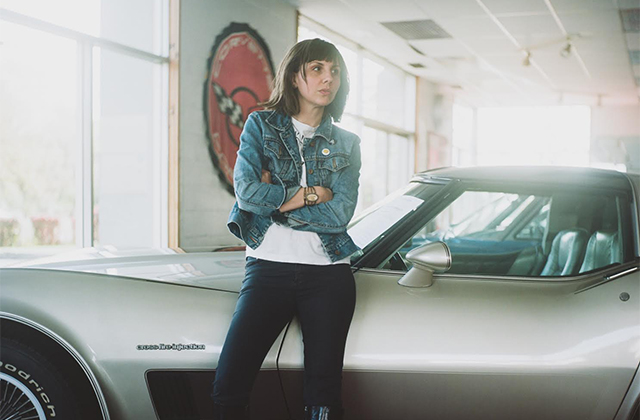
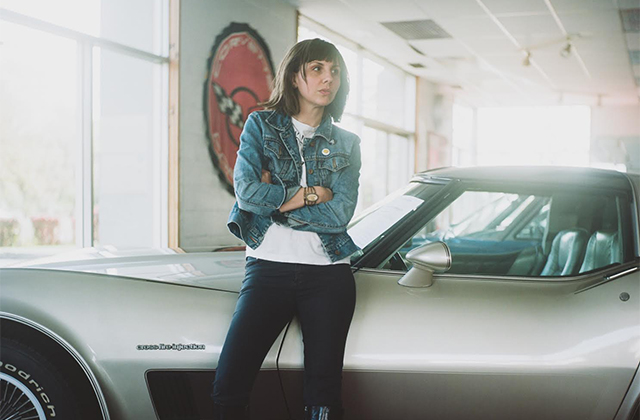
 Photo courtesy of Jessica Hopper
There’s a trope that the only people that ever pay attention to bylines are other writers. There may be some truth to that, but anyone who seeks out music writing on even a semi-regular basis knows Jessica Hopper. Listeners of This American Life may recognize her name as one of the people Ira Glass once sped through at the end of each program due to her role as Music Consultant.
Readers of Pitchfork, Rookie (or really any nationally renowned publication) may recognize her long form music criticism and record reviews. Meanwhile, bands from the D.C. area may remember Hopper from her former roles as a publicist for bands like Beauty Pill. She’s since become one of the most essential music critics of the 21st century. Whether it’s exposing the awful sexual assault allegations against R. Kelly, or a critical reevaluation of the work of Joni Mitchell—regardless of the content, it’s going to be insightful.
Hopper just published her book, The First Collection of Criticism by a Living Female Rock Critic and will be speaking tonight at 6:30 p.m. at Brookland’s Busboys and Poets location (625 Monroe Street NE) along with one of D.C.’s own living rock critics, The Washington Post’s Chris Richards. In advance of this talk, we spoke to Hopper about making the jump to full-time writing, looking back at her old work and the bright future of the young writers that she now edits.
DCist: I’m curious as to how it must feel to be on this side of the interview process other than the one asking the questions?
Jessica Hopper: I try to always be mindful of giving anything that sounds like a canned answer because I was always like, “UGHH!” I had to interview people weekly for years for my Tribune column and sometimes they were people who got interviewed all the time and people that had been waiting their entire lives for someone to ask them about their music. It’s really nice, though, that anybody has any sort of an interest in my book, so, I appreciate that, at least.
DCist: And you’ve been writing about music for years, but thanks to the liner notes of Emergency & I, I know that you’ve also been in other parts of the music industry.
JH: I did PR for a bunch of D.C. bands. I did Bluetip and Smart Went Crazy and Beauty Pill at their very start and all the bands on DeSoto. I did Jawbox. I did everybody. So it’s a city that I have a lot of affinity for, musically and otherwise. I did PR for eight years to pay the bills before I jumped into writing full time but the whole time I was still—whether I was managing bands or doing PR or what not, I was still always writing. Those two things had always sort of been tandem for me. For a very long time they were both just expressions of fandom and forever championing all of my favorite underdogs.
DCist: Do you see as much of that fluidity any more—the people that are writing but still involved in other parts of the industry?
JH: I mean, some. You definitely do still see that in part because so many people have online platforms and whether people are blogging or chronicling their scene through Vines or whatever you people are doing, I think just by virtue of the avenues for expression for fandom, we just see so many more things. But at the same time, there’s also probably less of “industry” as there’s ever been.
So, I don’t know if it exactly equals out in the same way that it did ten years ago when I was handling all these bands that had records. All the people that I worked with then, by and large I’m sure would be putting out their own records now on Bandcamp. I think it’s a very different world than when I was doing it.
DCist: The title of your book is The First Collection of Criticism by a Living Female Rock Critic. Do you think the landscape has become easier or harder or changed in any way for female rock critics?
JH: I think much like the Internet did for bands, it took down a lot of barriers for people to be able to express themselves, have a voice, have their writing get out there. You don’t have to wait for the gatekeepers to unlock the gate and give you a key and give you permission in order to have people read your stuff. And so I think that is really different. I know that a lot of the young writers that I work with as freelancers at Pitchfork still face very much face the same things I faced when I was 19 and trying to grind as a freelancer. So I mean, I think there’s always the challenge of coming from the outside and making space for yourself in industries that have been long male-dominated. Even though there’s a long history of female rock critics—a lot of the first rock critics WERE female—there’s always the presence of the white male standard bearer canon of criticism, of how we do criticism, of the artists that we pay attention to, of the artists that we revere as standard. And so I think that is changing and I think that’s one of the exciting things about cultural criticism is that having that be the only framework you’re supposed to work inside of has changed. I’m grateful for that for my sake and for many of the writers that I love to read.
DCist: Who were some of the writers that you looked up to?
JH: When I first started reading about music, I was reading fanzines. I was reading the weekly paper where I lived and so I was reading—in City Pages we had Terri Setton who at the time was one of the real leading lights in music criticism. But then, you know, Will Hermes, who is a well known critic and author and all of that. I read a lot of some of the things that were most encouraging to me as a writer was reading fanzines by people who like me were amateurs and knowing that there was a space for that. But I was very much encouraged by editors who were in positions of power to give me work that they too appreciated that the only way you could describe my writing—I was in high school—was absolutely amateur and really over the top excitable. I was presented with a lot of peer example and that was incredibly meaningful and even the sort of way that reading Bikini Kill #2 when that came out and I was introduced to Riot Grrrl and what encouraged me there was that there were girls who weren’t asking and other women who weren’t asking for permission either. They were just doing what interested them and claiming space.
DCist: For this book, you probably had to compile a lot of things that you worked on over the years. What did you find when you went back over your older pieces? How did you react to some of the things that you had written in the past.
JH: Well, naturally, you look over things that you wrote at 20 when you’re 38 and you’re like, “Oh, Lord!” Because unless you’re a psychopath, your world view has shifted and evolved. And there were times where I just thought, “You know, this book’s going to be a couple pages long at this rate.” Particularly when I was starting with some of my earliest stuff, when I was reading it, I was like, “Oh! This is…not good!” Sure, I had some writing, but I don’t think I actually learned how to write until I was 28. Sometimes I was proved wrong by that and I found pieces from when I was wrong when I was at a place when I could see that my voice was like start to develop or the first piece where I got an idea that I was trying to work my way in and crack open twelve years later. Aside from all of the general embarrassment of just looking of one’s own work—my fanzines from when I was younger were essentially diaries that I saw fit to publish for some reason.
But looking over my career, there were arcs that surprised me. I didn’t realize how much I had written about Chicago, where Chicago was constant, even though I lived here for fifteen years, that the city was such a character in my writing. Or, there’s chapter that’s a grouping of faith. I thought maybe I had two pieces, but then when you look at it, I have quite a bunch of other things that are not just in the strictest sense about faith, as in faith writ large, but faith in music and worshipping people and worshipping albums. If music means anything to you, it’s very familiar. So that was the revelation.
DCist: Also on the subject of young writers, do you still work as music editor at Rookie?
I used to. For the last six months I’ve been senior editor at Pitchfork and I’m Editor-in-Chief of our print publication, The Pitchfork Review. But I was at Rookie for two years. That tends to show up in things if you Google me. But I still work with a lot of Rookie writers at Pitchfork. I brought some of those people and their pieces along with me as freelancers. Rookie is very much my family. If someone is familiar with the roster of Rookie writers and they look at the thank you in my book, I think I thanked everyone that was on the staff of Rookie at the time that I was making the book. A lot of those people and girls and women were really instrumental in cheerleading this and giving me feedback and some of them were my early readers and some of them helped me sequence the book. I had a constant resource there, which was really lovely in part because when I imagined who I was writing this book for, it was them. It gave me a really clear idea of what I would say and what I was assembling and how strong I wanted the big picture of it to be. They are a group of very ambitious young people and part of what I want to do is help open doors to them in particular.
DCist: That had to be exciting working with a group of young women. Did they teach you anything that surprised you? What did you learn from them?
JH: Other than learning stuff from them everyday—I learn about all sorts of ideas that are generally exciting to me. The thing is, what makes it so exciting to work with people that are of that Rookie generation—and I work with a lot of pretty young writers at Pitchfork—is getting a chance, a really fortunate chance, to give people an opportunity to do the work that they love and they’ve really thought about and to also challenge the idea that I came up fighting against very much by virtue of my presence that we have very dumb ideas about what female fandom looks like and the things those young women taught me is—they so regularly blow my mind about how developed their theories, their criticism and how incisive they are blew my mind. And I’m somebody that knows that teenage girls can be that smart and can be that articulate and still—they’re doing such incredible work. In part, this is because you look at Hazel Cills or Tavi [Gevinson] or Amy Rose Spiegel, there are so many people that I’ve worked with where—if the kind of writing they’re doing at 18, 22, 24 is this incredible and articulate then we have so much to look forward to. Long story long—they never cease to amaze me on a daily basis. All of them. At once.
DCist: At this point, you are kind of one of the gatekeepers. Yes, thanks to the Internet, anyone can read anything, but you must have realized at some point that you’ve become one of the writers that people look up to.
JH: Being an editor at Pitchfork where my main dominion is that I oversee most of The Pitch, which is sort of our op-ed blog—I’ve been really fortunate to have that sort of position of editorial power for both people and ideas that we’ve gotten to loft up and also show people how elastic Pitchfork is. I think for a long time people would think of it as just reviews or just representing a particular viewpoint but it’s also a place that’s very invested in voices and young voices and old voices. There’s a whole range of marginalization that goes on in terms of who is allowed to talk about what sometimes. I’m really, really lucky. I’m working a dream job and this is about the only thing that could have made me leave Rookie was to come work at Pitchfork.
DCist: When were you able to start writing full time? When was that something sustainable?
JH: At the time of the publication of my piece about Warped Tour that’s in the book. That, at this point was about nine years ago, I think. It might be a full ten! I did that with the encouragement of my now-husband. I was really burned out on doing PR and I was tired of pushing my career and my ideas and my ambitions to the side to prop up other people’s as much as I loved everyone that I worked with and managed and promoted and did PR for. A lot of people were coming to me with work that I couldn’t do because it was too much of a conflict of interest. It would have involved shitting where I eat, so to speak, so I needed to just fully be done with PR and just accept that I was a writer and that was what I was going to do. I was also able to do that by virtue of my very cheap Chicago rent and that I had a few editors that were just basically waiting for me to quit PR. They said, “Let us know when you’re done because you have work here to do.” My career stands on my good luck I think and the support of some very kind editors because I think that’s a very rare thing.