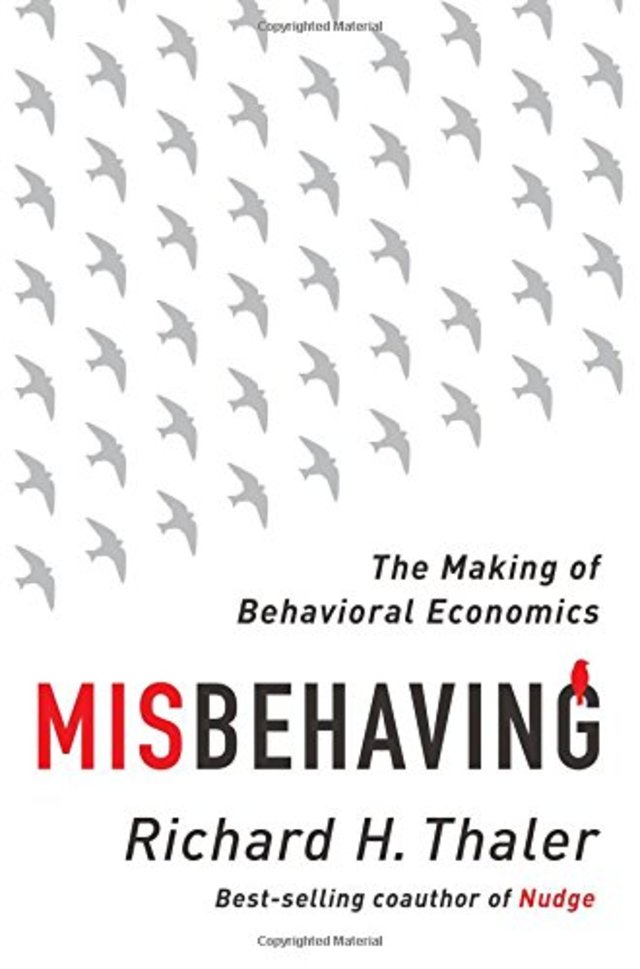
 Traditional economics assumes that people are rational actors. Not so, says Richard H. Thaler in Misbehaving: The Making of Behavioral Economics (W.W. Norton, $28). He will discuss the consequences of such an assumption, and an alternative outlook, at Politics & Prose this Thursday, May 21st at 7 p.m.
Misbehaving begins with a story about one of Thaler’s early microeconomics classes, where students were unhappy with their average exam scores in the low 70s out of 100. Thaler decided to make his next test out of 137, and got a surprising result: Students did slightly worse on average, but were psyched to get scores in the 90s. Thaler continued scoring all of his tests out of 137, and received far fewer complaints.
This example shows where economic thought can diverge from real people — there was no logical reason the students should have reacted more positively to their second score, but because they did, Thaler was able to do what he wanted without the grief.
Economic standards would classify this as “misbehavior”, Thaler writes, and ignoring it “means that economic models make a lot of bad predictions.” These predictions can have serious consequences, like the financial crisis of 2007-2008.
We tend to listen to economists because they “carry the most sway” out of the realm of social scientists. They stick to a unified, core theory that optimization (choosing the best option on a limited budget) + equilibrium = economics. However, that equation doesn’t account for psychology, bias, and other supposedly irrelevant factors that drive our actions, Misbehaving claims.
By combining psychological discoveries with a practical understanding of market behavior, Thaler seeks to show readers how to make smarter decisions from a different economic perspective. Along the way, he shares his experience with trailblazing a relatively new field, and anecdotes of his many squabbles with old-school economists. As he said in a recent Q&A with Forbes, “in writing the book I decided only to include things that were fun to talk about. I hope that makes it fun to read.”
Thaler is a professor of behavioral science and economics at the University of Chicago Graduate School of Business and president of the American Economic Association. His previous books include Nudge: Improving Decisions About Health, Wealth, and Happiness, and Quasi-Rational Economics.
The event is free and open to the public. A signing will follow the discussion.