By DCist Contributor Dalton Vogler
While there are a whole lot of things to love about live music, the experience is almost always marred by a few glaring flaws. Obstructed view by a sea of cell phone cameras? A talkative crowd whose conversations ruin the sound quality? We’ve all been there before.
Yet, despite these shortcomings, the live music business continues to thrive, posting record-breaking sales over the past five years. There are alternatives of course, but it can be hard work finding the underground shows that pepper the District. On the more publicly visible side, one company is attempting to make things easier on D.C. residents, offering smaller crowds and noteworthy bands in exchange for a few concessions from both the artists and attendees. With one show last March and another scheduled for June 4th—has the future of concerts arrived in D.C.?
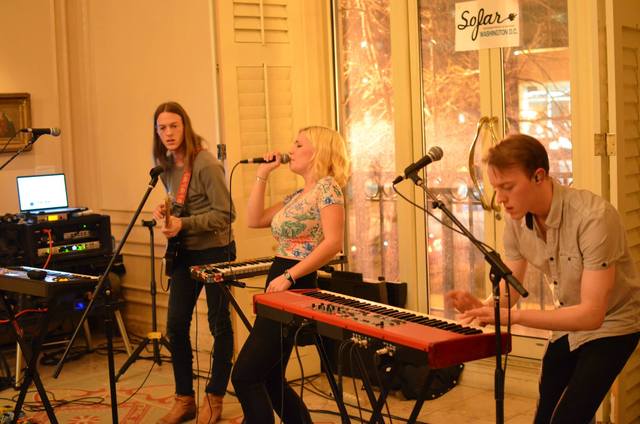
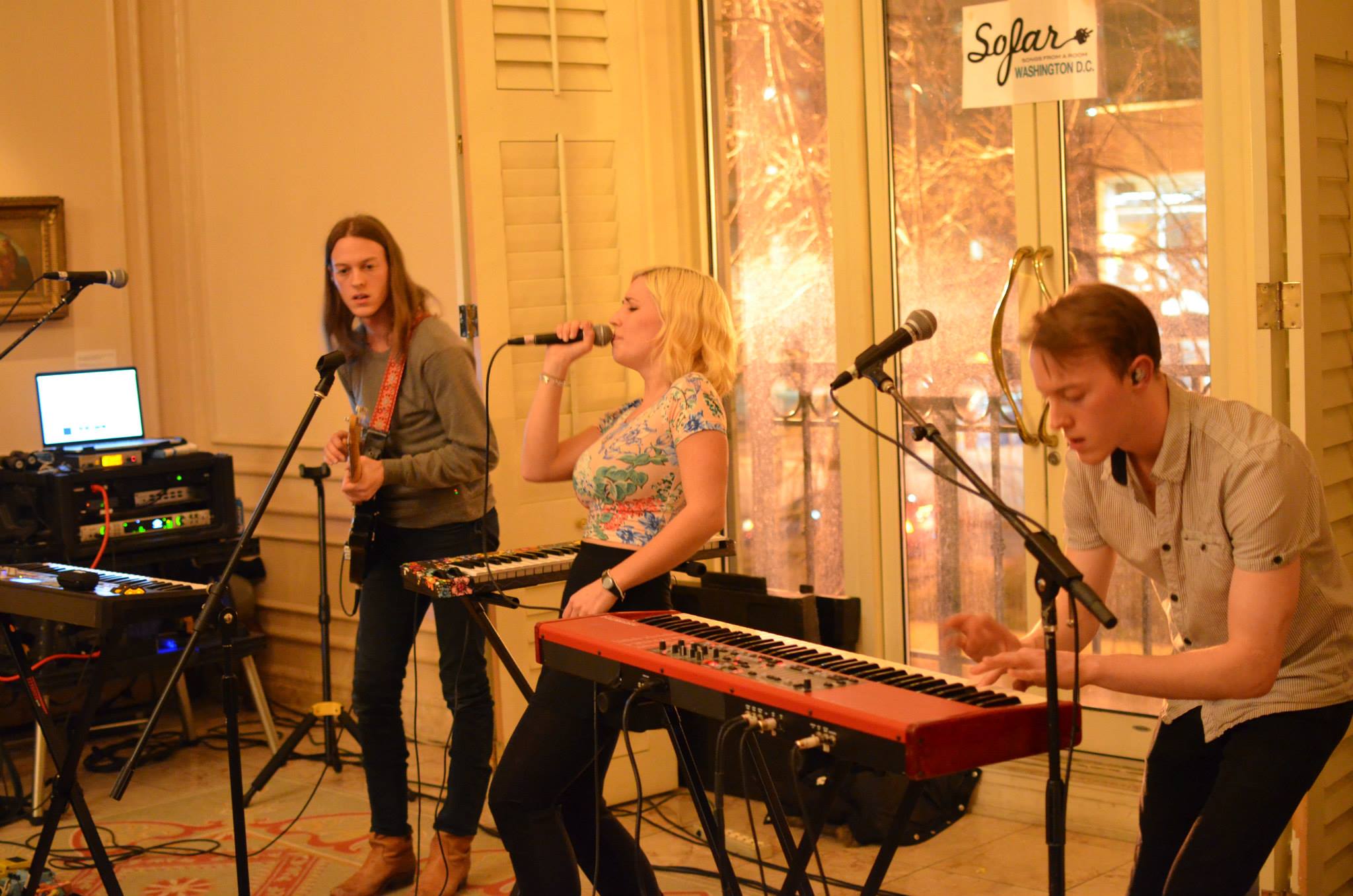 The Walking Sticks at Sofar’s March event. Photo by Henry Gallagher
“Put your phones down, have a seat, pay attention. It’s all about the music.”
Take a visit to the Sofar Sounds website and that’s one of the first pitches you’ll see from the London-based, live-concert company. Sofar—short for Songs from a Room—promises a different experience for those that have become disenchanted with the current state of live shows.
Originally conceived in 2009 during a noisy live concert in North London, Rafe Offer, Dave Alexander, and Rocky Start were frustrated by their inability to hear a local performance and decided to set up their own private gigs in the living rooms of friends. What initially started as hobby suddenly turned into a full-time project, with the trio putting on numerous gigs across London.
“They started spreading that formula,” says Fitz Holladay, Sofar’s Director of D.C. “It started to grow and become popular so they had to start making the locations a secret in order to manage the guest list appropriately.”
From there, they expanded Sofar to New York and eventually worldwide. Nowadays, Sofar boasts locations in over 105 cities, from Mumbai to Santiago.
“What they found was that while people were watching in these intimate spaces it was a much more respectful audience—it was more around the music,” Fitz tells DCist. “Really just a magical experience.”
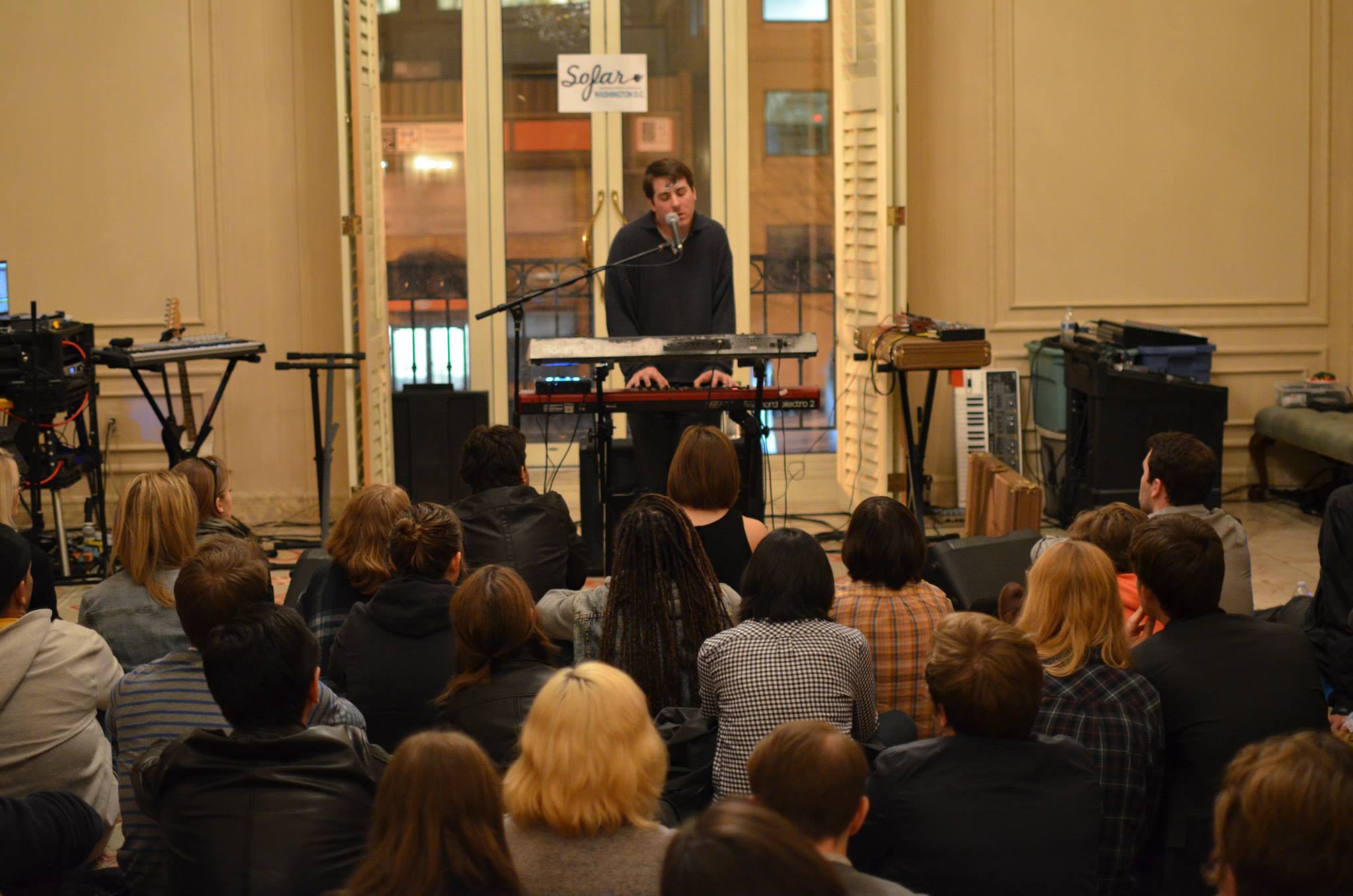 Dan Gleason. Photo by Henry Gallagher
Fitz Holladay is hoping that he can recreate that kind of experience here in the District. Involved in D.C. through his concerts app (wēgo), Fitz already had a passion for organizing live shows and joined with Sofar upon finding out they weren’t already in the area.
“They used to be in D.C. but stopped three years ago,” he says. “It used to be that artists would plan their tour and either not even stop in D.C. or they’d plan a New York gig on Saturday and a Philly gig on Sunday and then maybe stop in D.C. on Monday when they didn’t really care. I think that [opinion] has really turned around through IMP (Independent Music Productions) Presents … and the 9:30 Club is such a great venue that artists really want to play there now.”
How does the service work? You sign up for a newsletter from the city in which you want to see a concert and fill out basic information about yourself and why you want to attend the shows. After being accepted by Sofar, you’ll receive a monthly email with dates for any upcoming concerts. There are however, a few caveats. Once you RSVP, you won’t know who’s playing and the location won’t be revealed until the day before. In addition to the shroud of mystery surrounding the event, attendees are expected to refrain from talking during the concert and limit their cell phone use.
“There is an internal debate [that] always goes on with cell phones at shows,” says Fitz. “We want social posts, we want people to take pictures and get excited, save their moment, and post it to their social [profile]. But we provide some instruction. I actually tell people feel free to take a picture or two but don’t post it until the break. You take the picture but you don’t want to be on your phone writing the caption.”
In terms of booking a show with Sofar, artists are either contacted by the local director or can submit a request to perform on the company website.
For many artists, the process is simple and familiar. “There’s not a lot of difference than from any other booking situation,” says Max Ernst (of local dream-pop trio The Walking Sticks). “He just reached out to us and asked if we wanted to do the gig.”
The bands are compensated in the form of donations at the door. Also, a video from the show gets uploaded to Sofar’s worldwide YouTube channel, providing additional exposure outside city lines.
It may seem like a lot to sacrifice, but when it all comes together the results looks a little something like this:
[The Walking Sticks perform at the National Museum of Women in the Arts]
For the reboot of Sofar’s first show in D.C., The Walking Sticks, Stronger Sex, and Dan Gleason (of Young Rapids) performed at the National Museum of Women in the Arts on March 11th. To hear it from the artists, they were enthusiastic not only about the venue but with the audience.
“It’s nice to treat yourself to a special performance in a special room filled with inspiring art,” says Johnny Fantastic (of Stronger Sex). “You’ll expose yourself to a group of listeners who otherwise would have never heard of you.”
It’s possible that this new format could in fact improve regular live music performances. Dan Gleason didn’t know any of the crowd going in, but came away refreshed.
“Everyone sat and was very attentive. It was the sort of thing we should take note of and place those rules in more venues,” he says. “I think it not only benefited me to be able to get in the zone without any distractions but I think that everybody was really taking everything in and absorbing all the music.”
[Stronger Sex perform at the National Museum of Women in the Arts]
Unlike Sofar’s brief stint in D.C. three years ago, it appears that this time the service is here to stay, with a second show planned for June 4th. With it’s exclusive membership and rule-enforced policies, Sofar won’t be for everyone. And for artist’s expecting to collect a significant paycheck, they’d better be in it for the exposure.
“We don’t make money on this,” acknowledges Fitz. “Most people don’t—in New York they might have found a way to make a little bit of money. But for the most part it’s a passion project, everybody that’s involved just loves live music. That’s really the objective.”