
 Photo by LaTur.
Don’t recognize that word on your dinner or drink menu? Sick of surreptitiously Googling at restaurants? Menu Decoder is your guide to obscure ingredients popping up on local dinner and cocktail menus.
Other than the fancy fare at Zaytinya, Turkish cuisine tends to fly under the radar in D.C. even though we’ve got plenty of it. Most of the dishes we recognize as Turkish today come from the palace cooking of the Ottoman Empire, which—at its height in the 16th and 17th centuries—ruled over lands from the Balkans to the Caucasus and as far south as the Horn of Africa.
However, the roots of Turkish cuisine stretch farther east to Mongolia and Central Asia, where you can find the same grilled kebabs, the dumplings that gave rise to manti, the many yogurt-based dishes and variations on a theme of dough wrapped around savory fillings. Below are several dishes you’re likely to find on Turkish menus across the city:
Imam Bayıldı (imam by-ill-duh)
Literally “the imam fainted.” Legends about the origin of its name vary, but center around an imam who couldn’t even handle it when his wife made this dish for the first time, either because it was so delicious or used so much expensive olive oil. To prepare it, eggplants are roasted, stuffed with an aromatic mélange of sautéed onions, garlic, tomatoes, and herbs, then braised in olive oil until they reach a melt-in-your-mouth consistency. Turks serve it at room temperature.
Hünkar beğendi (huhn-car bay-endy)
Another in the line of Turkish dishes named for the reactions they elicited, this one translates to “the sultan liked it.” Expect gently spiced braised lamb atop a creamy puree of roasted eggplant and mild cheese.
Yaprak dolması
Grape leaves stuffed with ground meat or vegetables, rice, and herbs.
Sigara böreği (bo-ray-ee)
Small “cigarettes” made out of paper-thin sheets of dough called yufka (though phyllo is more readily available here) stuffed with melted cheese. They can be served at any meal, including breakfast.
Peynir (pay-neer)
Peynir means cheese (note the similarity to the Hindi word paneer, which you may be familiar with from your last visit to an Indian restaurant). Turkish cheeses on D.C. restaurant menus generally come in one of three varieties: the familiar feta, kaşar (pronounced ka-shar, a semi-hard cheese like Meunster and provolone, usually made from unpasteurized sheep’s milk that has been aged for several months), and hellim (better known here as halloumi, a salty, semi-hard sheep’s milk cheese with a high melting point, so it’s great for frying or grilling).
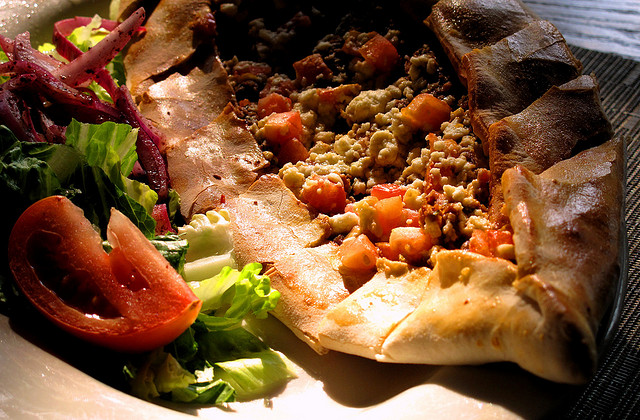
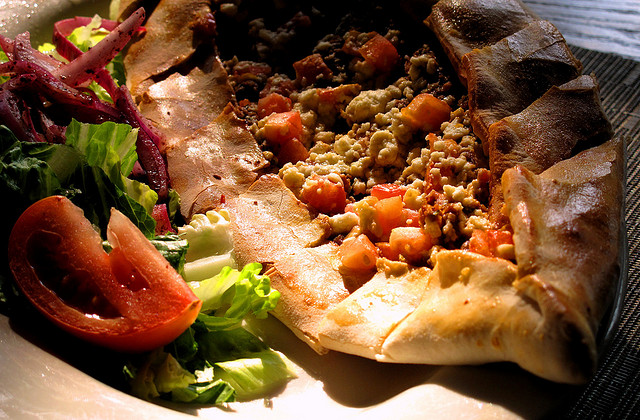
Pide (pi-deh)
Flatbread topped with meat, cheese, or vegetables. Common toppings include sujuk (spicy dry-cured beef sausage), roasted eggplant, and kasar cheese.
Lahmacun (lakh-ma-joon)
Thin, crispy flatbread topped with finely ground meat (lamb, beef, or both), tomato, red pepper, and parsley.
Köfte (kuhf-teh)
Grilled meatballs (lamb, beef, or both), or a vegetarian version, typically made with bulgur wheat and lentils, onions, herbs, and spices.
Mantı (mahn-tuh)
Tiny dumplings stuffed with ground meat and served in a garlic-yogurt sauce.
Künefe (kyu-neh-feh)
This popular pastry—not only in Turkey but also throughout the Levant—comes in various forms. The one I love best sandwiches semi-soft cheese between two layers of buttery shredded phyllo dough. The pie is drenched in a sugar syrup, sprinkled with crushed pistachios, and served just out of the oven with clotted cream or ice cream.
Fırın sütlaç (fuh-run syoot-lach
Like a combination of rice pudding and crème brulée: heaven, essentially.
Ayran (eye-rahn):
A cold, thin yogurt drink mixed with a little salt. Not for everyone, but very refreshing on hot summer days.
Rakı (rah-kuh)
Anise-flavored clear spirit traditionally distilled from grape pomace (the skins and pips left over after wine has been made) and enjoyed as an aperitif. It contains approximately 45-50 percent alcohol by volume, but don’t shoot it as you would vodka: it’s meant to be sipped slowly while you snack on meze or seafood. You can either drink it straight or mix it with a small amount of cold water, which will turn it cloudy. This effect earned the drink the nickname “lion’s milk.”
Where to find it: You can find upscale takes on Turkish, Greek, and Lebanese flavors at José Andrés’ Zaytinya (701 9th Street NW). Agora (1527 17th Street NW) serves Turkish favorites in a small plate format. Not far away is Rosemary’s Thyme Bistro (1801 18th Street NW), which offers a variety of Turkish and Mediterranean dishes (plus some random Tex-Mexy things). Café Divan (1834 Wisconsin Avenue NW) in Upper Georgetown offers a mid-range sit-down experience as well as takeout. Ankara, the newest addition to D.C.’s Turkish restaurant scene (more on that later today), is located at 1320 19th Street NW, just south of Dupont Circle in the space formerly occupied by Levantes.