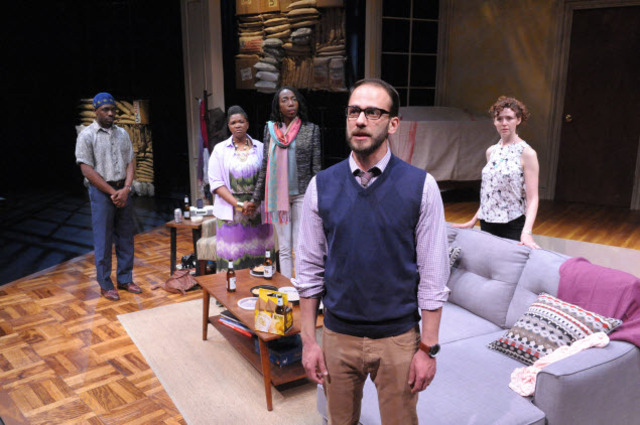
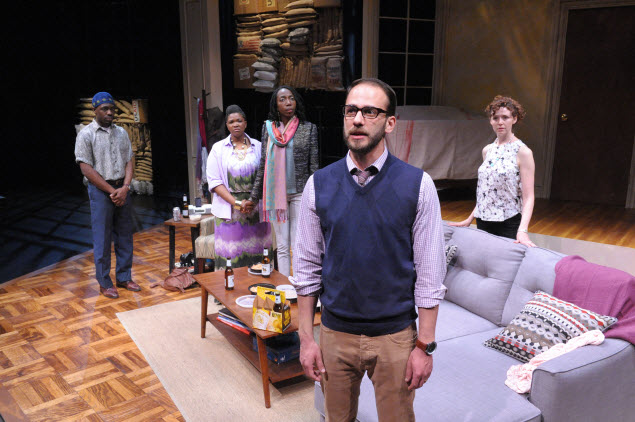
 The cast of The Call: Bru Ajueyitsi, Kelly Renee Armstrong, Joy Jones, Jonathan Feuer, Tessa Klein. Photo: Stan Barouh
By DCist Contributor Rachel Kurzius
The Call begins with a dinner party, where one couple regales the other with stories from a recent trip on an African safari. Their tale about an encounter with a lion gives way to a thornier discussion: on their trip, children begged tourists for a pen. Would giving the pen further entrench a culture of dependence? But how could they begrudge these children, who have so little, a simple pen? This conversation is the vanguard of a string of murky ethical quandaries that The Call conjures, highlighting what happens when our visions of ourselves — as global citizens, parents, or good partners — wither in the face of an unwelcome reality.
Theater J’s rendition of Tanya Barfield’s The Call is ostensibly about white couple Annie (Tessa Klein) and Peter’s (Jonathan Feuer) decision to adopt a child from Africa, and the questions it raises with their recently married black friends Rebecca (Joy Jones) and Drea (Kelly Renee Armstrong).
The play broaches the fraught questions of what it means for a white couple to bring a black child into the house. Peter worries about how it would come off to others: “We’ll have to deal with everyone thinking we’re making a fashion statement,” he says. Drea wonders why they’ve got to cross an ocean to adopt, when “there are plenty of black kids here.” Further complicating things is neighbor Alemu (Bru Ajueyitsi), an African immigrant who keeps dropping off soccer balls and used shoes for Annie and Peter’s upcoming trip.
Other subplots follow, each with their own set of complications. Annie and Peter are still trying to work through their inability to conceive, while Annie envies Drea’s artistic career. There’s even a distracting subplot about Rebecca’s unresolved feelings about her dead brother—a close friend of Peter’s. But all of these varied tensions have a common root: the characters must reconcile their lofty notions of what they deserve in life against the reality of what they actually get.
Both couples feel lived-in, with the actors nailing everything from nagging to jokey dancing. And the set design from Tim Jones certainly helps; he carves Atlas Performing Arts Center’s black box into a number of comfy-seeming rooms without crowding the stage. While Ajeuyitsi does what he can with the role of Alemu, who largely serves as comic relief, the character veers often into the black savior trope that Drea would deservedly give some epic side-eye. Luckily, Armstrong nails the looks of incredulity that Drea doles out on a constant basis.
“We didn’t ask to solve the world’s problems,” Annie says at one point in the show. “We asked for a baby.” Fair enough. But in a show with parenthood as such a clear motivating factor, there’s surprisingly little discussion about why Annie and Peter want kids in the first place, especially when The Call spares no detail in their specific requirements for their future daughter (including, for instance, that it must be a girl).
Maybe Barfield is making a bigger point about how we lose sight of the bigger picture, but it feels more like an oversight.
The Call raises a tangled knot of questions that no one could ever hope to answer. It is at its best when it navigates that sense of uncertainty, letting the audience get lost in the confusion, disappointment and regret that typify adult decision-making. When it reaches a moment of certainty, it rings less true.
The Call runs through May 31 at Atlas Performing Arts Center. Tickets run from $25 to $45 and are available here.