In November of 2013, we launched a series called Abandoned D.C., in which contributor Pablo Maurer documented his exploration of decaying, abandoned places throughout the D.C. area. As it turns out, the number of places within driving distance of the District are few and far between. So it became that “Abandoned D.C.” outgrew its own geography. But Pablo was still traveling around the country, shooting gorgeous and haunting photographs of the country’s forgotten places. Since the series started on DCist, we’d like to keep it here, so we’re rebranding it as “Abandoned States” (we know, D.C. is not a state). Some of these pieces (like this one) are from places in the DMV region, but some aren’t. Whatever abandoned place it may be, however, its history and documentation will have a home at DCist. — Matt Cohen
Spec, Virginia is a town even smaller than it sounds. If I’d have blinked, I’d have missed it.
Its fifteen or so residents are tucked away in the Blue Ridge mountains, four hours or so southwest of D.C. It’s a handful of mobile homes and trailers, a gurgling creek and the occasional lumbering freight train providing its bucolic soundtrack.
During a drive down the Blue Ridge Parkway last year, a friend and I pulled over at a scenic overlook. A sign just beyond the guard rail read “Iron Mine Hollow,’ and Spec lay in the valley below.
It got me thinking.
I headed home, pulled up some satellite imagery and started looking for a mine in the mountain range surrounding the overlook. A couple of hours in, I found it—a black spot at the base of one of the mountains, butted up against a creek bed, a pair of iron rails jutting out of the opening. I had to go.
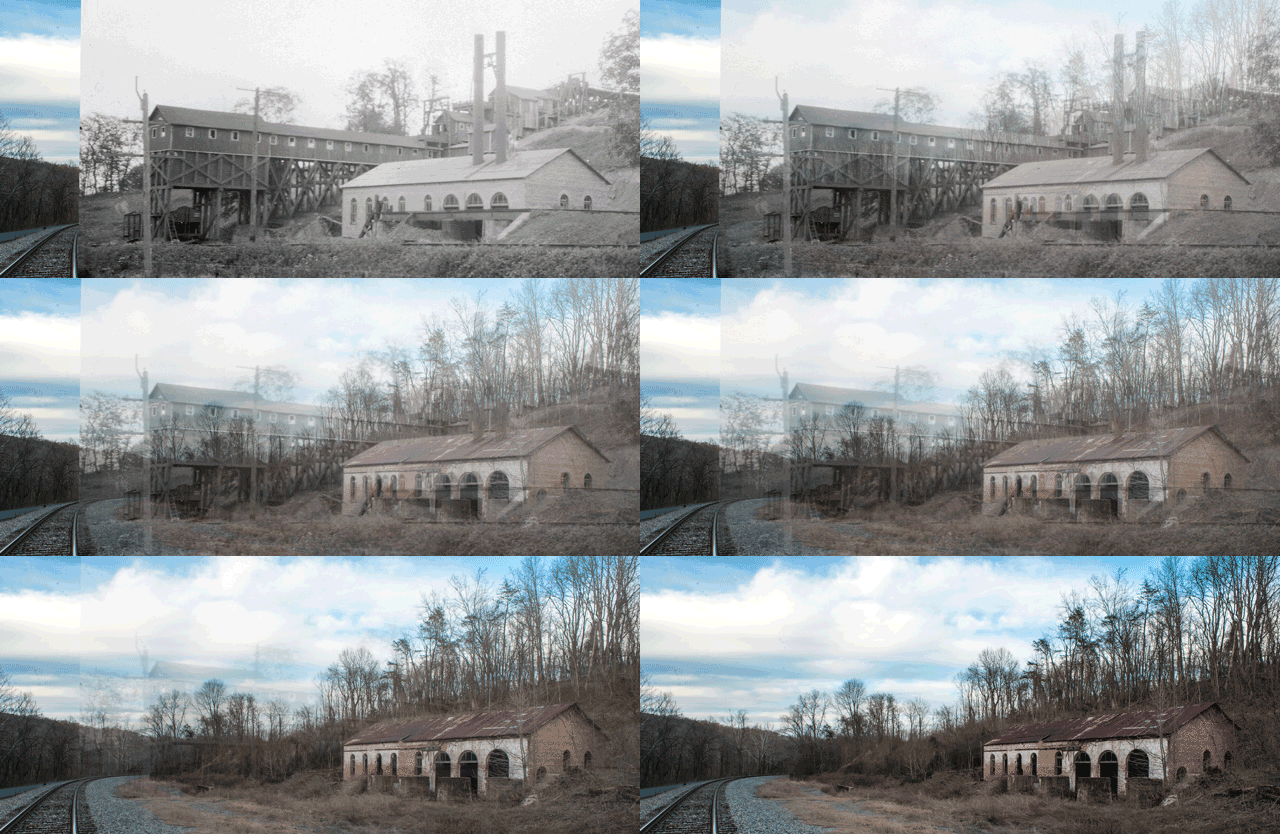 The old powerhouse in Spec, then and now. Photo by Pablo Iglesias Maurer (historical imagery courtesty USGS)
Spec—named for the specular hematite buried in the land around it, wasn’t always such a tranquil place. Mining operations in the early 20th century once supported a larger community. 25 or so workers and their families put down roots in these parts, roots that took very badly to the Depression and the local soil.
The place first pops up on a U.S. Geological Service map in 1920, around the time when the Pulaski Iron Company—PICO for short—purchased a large tract of land with the intent of mining iron ore from a nearby mountain range. The land had previously been home to a similar operation, the Cloverdale mine, but hadn’t been used for some years.
In just over a year, PICO built an operation nearly from scratch. They erected a tipper, washer, and powerhouse adjacent to the Norfolk & Western railroad line to process the incoming ore, a system of electric cars to haul it into town from the mine to a nearby furnace and about 20 bright yellow houses for the miners and their families.
In the decade that followed, the company did well—much better than the miners, who labored from sun-up to sundown, tirelessly chipping their way into the mountain range. Predictably, many suffered the ill effects of working underground with little-to-no safety equipment.
“My grandfather [who worked in the Spec mines] died when he was 36,” local historian Stephen D. Vassar, Sr. tells me. “And of course back then they had no idea why, they just called it a ‘respiratory illness.’ But now we know the dangers these men had to work through. He left a widow and a bunch of children behind.”
In the late ’20’s, mining operations at Spec ceased; after that, the Pulaski Iron Company suffered greatly during the depression. Some families stayed, but many left to find work at other area mines. PICO salvaged what they could of the operation and high-tailed it out of town.
You won’t find much evidence of Spec’s mining heritage these days. The old brick power house—later purchased by a local family and converted to a cannery—still stands. Though uninhabited for decades, the structure has held up remarkably well. The tipper and ore processing facility, which it once powered, is long gone, though you can still see its footprints in a foundation that leads up the hill behind the place.
Trains still rumble through Spec. They pass within a stone’s throw of the only other remaining structure in town, the former Pulaski Iron Company general store. The single-story building, now empty, survived for some years after PICO’s departure as a family-owned grocery. It, too, has weathered the decades surprisingly well.
But if you dig a good deal deeper—if you’re willing to risk life and limb and spend a few hours studying old topographical maps and surveys—you’ll be rewarded with much more. Several miles away, a couple thousand feet up into the adjacent mountain range, is the very mine which used to support this town.
 Iron Mine Hollow. Photo by Pablo Iglesias Maurer.
Though I typically explore alone, I knew better than to enter something like an abandoned mine without company. I dragged along a friend—exploring partner and experienced climber, Jesse Florig—and we headed back into the mountains, dragging along my photo gear, a few bottles of water, lighting equipment and some waders.
It did not take long for me to realize that I was in over my head. There are several approaches to the mine opening, none of them suitable for the amateur hiker. What we thought would be a quick two-mile hike down the side of the mountain to the mine’s adit quickly turned into a crash course in scrambling as the two of us essentially slid down the grade. The way back, we correctly figured, would be even worse. We arrived bruised and battered but were thrilled to discover that the dark, grainy patch on my satellite map was indeed a way into the mines.
A cold, uninviting wind blew out of the adit, one of three that had been bored into the side of the mountain.
What we found inside of it was mind-boggling. The lower level of the mine stretched for almost a third of a mile into the side of the mountain; we followed the narrow gauge rail tracks that once carried thousands of tons of iron ore out of the place deep into the mine’s “stope,” wading through knee-high water and bracing ourselves against walls covered with white mold. The badly rusted tracks snaked back and forth beneath our feet; an oxygen pipe once used to keep the miners from suffocating ran alongside them. Timbers used to support the mine at various places moaned and buckled as we squeezed by.
Every hundred feet or so along the lower level was a vertical shaft. Shining a light upwards revealed what looked like four separate floors, and we quickly realized that what we’d thought was a single tunnel was in fact a network of many, stretching deep into the mountain and reaching 90 or 100 feet upwards. I’d brought Jesse along for his experience as an outdoorsman—and former military member—but couldn’t count on him to keep me from going up. I quickly realized his sense of adventure, like mine, often overpowered his prudence.
We reached the end of the first floor and shut our lights off for a moment, to soak the place in. The darkness was overwhelming. I can’t even explain it. You could taste it, you could feel it in your ears; it was easily the most disorienting experience of my life.
Ascending, we crawled through an upper stope, shimmying across one of the shafts used to dump ore to the levels below—and taking care not to peer down at the 30 foot drop. With risk comes reward; a bit further along on the third floor we began to find relics—an old mine cart, still full of iron ore, had rusted away but was still easily recognizable. Pitchforks, used to load the carts, leaned against one wall. Rusty light sockets protruded from the walls of the stope.
People who explore these spaces often say things like “it’s as if they just shut the lights off and walked away,” but that’s rarely true. Abandoned places are too often quickly gutted by vandals and scavengers, covered with graffiti or demolished entirely.
But in a mine, the saying often truly applies. The difficulty of reaching it likely helps keep the idiots at bay; tools, personal effects and equipment are all still leaning against the walls of the place, right where some miner left them almost a century ago.
Exhausted, we reached what we assumed was the uppermost level. I’d commented to Jesse that I was surprised we hadn’t seen any life in the place, a spider at least. Out of the corner of my eye, I caught sight of one single mushroom, sprouting up from a fallen timber. I’d later learn that it was a type of cave mushroom capable of surviving in areas devoid of much oxygen.
My head had begun to hurt. I crouched down to snap a photo of it and immediately felt my legs get weak, among the early signs of Carbon Monoxide poisoning. Crawling along the ground, we’d found our way into a pocket of bad air.
The mushroom, I suppose, was our canary. Both of us knew it was time to head home.
Special thanks to Stephen D. Vassar, Sr and Debra Alderson McClane, both of whom were essential contributors while researching this piece.