 Rachel Sadon
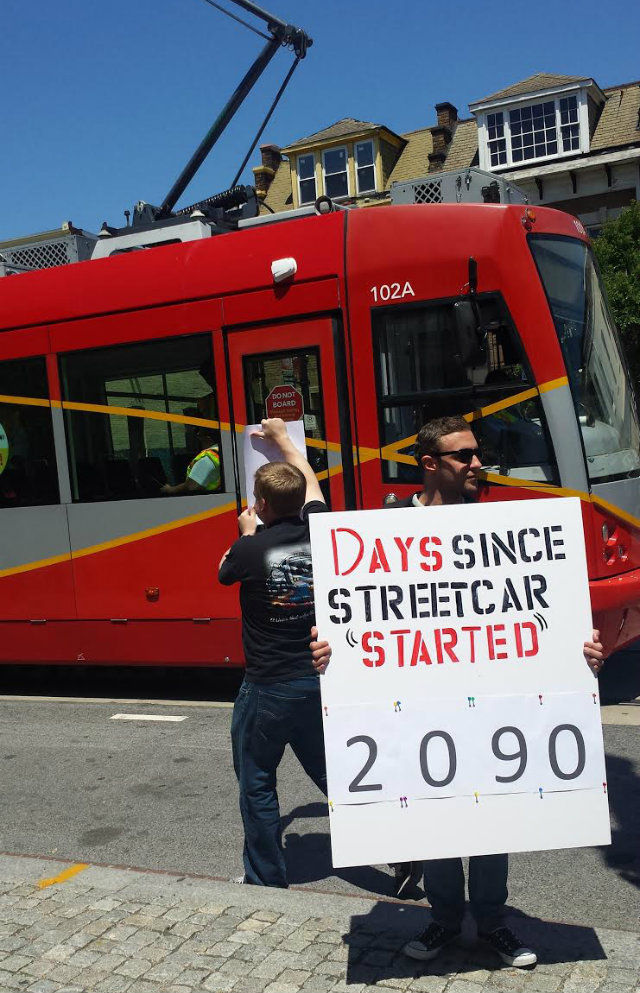 Photo by Rachel Sadon.
Standing just a few feet from the tracks that she helped to meticulously maintain for a year, Germaine Wells watched in the sunlight as empty streetcar after empty streetcar passed her by on a Friday afternoon.
The petite electrician is no longer responsible for ensuring that the gleaming red cars don’t get waylaid by trash or that they make it back into the car barn safely. Wells was fired unceremoniously about three months ago, she says.
When asked what happened, she responds with “I’d like to know myself!” But Wells, one of the first people to sign a union card with the Amalgamated Transit Union, has a deeply held suspicion.
It is one that ATU, whose Local 689 represents Metro workers, shares: namely, that eight workers were fired for signing union cards or being vocally supportive of efforts to organize.
The ATU has filed an unfair labor practice complaint with the National Labor Relations Board, but it could be weeks or months before it gets resolved.
In the meantime, a handful of union members and supporters took to the corner of H and 14th streets NE last Friday to show support for the fired workers and pressure the city to finally open the project.
“[The streetcar] needs to become the job creator they said it would be. Otherwise it is just in the way.” said ATU Local 689 spokesman David Stephen. “We’re asking the city to fix it, staff it, start it.”
That was the message on signs they held up to the passing Memorial Day weekend traffic and several empty streetcars (the drivers looked pretty happy to see them), as well as a petition the small group asked passersby to sign. Few people that stopped had kind words for the project.
Jill Normington, who lives just around the corner from the protesters perch, was particularly incensed that the city considered pulling the plug after years of disrupting life along the corridor. “It seems to me that they dug up our streets, spent how many millions of dollars. The idea that they are even contemplating not running it is ridiculous,” she said. “I had no idea that there were worker issues in addition to the usual government ineptitude.”
One reason that the workers’ cases could take longer than usual to settle is the streetcars’ complicated employment system. Technically it’s a District Department of Transportation project. But DDOT contracted out the operations to RATP Dev McDonald Transit (RDMT), a national subsidiary of an international public transit operator based in France, which in turn partnered with a local staffing company, The Midtown Group, for their human resources needs.
Wells, for example, reported directly to managers with RDMT for her day-to-day work as a maintenance technician, but was told to go to The Midtown Group with any HR issues.
In her telling, after covering an extra shift for another employee, Wells’ supervisor told her on Friday, Feb. 13 to return Monday for her regular shift. On Saturday—Valentine’s Day—Wells got a call from a Midtown employee telling her that her supervisor had actually fired her the day prior.
“I had been there for a year, I had no write-ups,” Wells said. “What kind of job lets you go for no reason?”
Jennifer Sweeny, a lawyer for RDMT, wouldn’t comment on the union’s complaint or any of the specific cases, citing the ongoing investigation. “We believe that such allegations are without merit,” she said.
The Midtown Group did not respond to requests for comment on the workers’ cases and a spokesperson for the D.C. Department of Transportation said it is “inaccurate” that their contractors fired workers for supporting a union, but didn’t respond to repeated requests to elaborate. In a statement to the Post, DDOT indicated that there was video evidence of drivers using cellphones—but that hasn’t been released and, for her part, Wells says she was never operating a streetcar.
“We want to see it run and we want to see the people who were fired reinstated,” said ATU organizer Todd Brogan, who was one of the handful of people holding signs on H Street NE. “They trained people for a year. If you don’t think firing a third of their workers slowed things down,” he said, trailing off.
After missing deadline after deadline during the Vince Gray administration, DDOT has been tight-lipped about any future plans.
“How long does it take to test a streetcar? Just talking about it makes me mad,” roared Nick McMcann as he walked along H Street NE. Like just about everyone else, he wanted to know if the ATU group had any idea when the streetcar might finally open (they don’t).
When asked about a timeline—even any vague idea of things to come—DDOT spokeswoman Michelle Phipps-Evans said “we cannot keep providing these arbitrary deadlines until we really look at it in an all encompassing way and ensure that this is the way to go.”
As for the frustrations of residents, she said that “DDOT knows they’ve been through a lot,” but stressed that the “administration has to get it right. Safety is the priority.”
As for Wells, a D.C. native, that is her hope, too—that the District gets it right—but also that she gets her position job. “I turned down another job, a career opportunity to do it,” she said. “I am a proud Washingtonian; I wanted to dedicate myself to the project.”