By DCist Contributor Arielle Milkman.
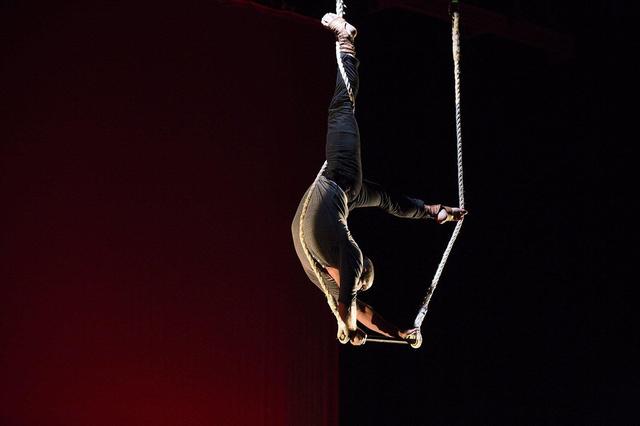
Cowboy boots, chains, a triad on the double trapeze: Capital Pride opened with its first-ever trapeze performance last weekend, thanks to the brand-new Sweet Spot Aerial Productions.
In Where I Belong: Finding Myself Under a Big Top, Clark (Rémi Gottheil), a homophobic straight guy, is shocked to find himself surrounded by queers and circus folk in the afterlife.
Clark’s attitude starts to shift with the prompting of his spirit guide (played by Caitlyn Larsson), a campy femme who pairs cowboy boots with shirts featuring thematic aphorisms like “Love is love, y’all” and “Closets are for brooms” (but not secrets, duh) and makes it her mission to open Clark’s mind to the possibilities of a different (queer) experience.
There’s nothing obtuse about Clark’s storyline, which reads as a Cass Identity Model coming out story. Initially closed off to the possibilities of queer circus life, Clark’s spirit guide helps him gradually come to respect the ways of life of the folks he meets in the afterlife (which include lesbian acrobatic partner balancing, rope hammock soul searching, and an adorable man-to-man partner juggling act in neon pants and black light).
Eventually his shirt comes off, and Clark embraces his coming out process in a stunning, dramatically lit solo rope act. He joins the (queer) circus community—literally supporting (spotting) others as they complete a series of flips, balances, and splits.
Yes, the protagonist is white and male, the women on stage serve as supportive characters who lack their own transformative arch, and yes, the sexy S&M number (there is one!) happens to the tune of Rihanna’s S&M.
But the show can be forgiven its overwrought platitudes because it’s a lot of fun—especially “On Fire,” the Rihanna-drenched dance and aerial number, which the audience loves, and “Transitions,” a piece Caitlyn Larsson performs featuring a Dreamcatcher, an aerial device she invented.
Overt queer themes seem like a necessary evil (and ploy) to get folks in the door for an art form which is fairly new on the DC theater market.
Elliot Proebstel, 33, the show’s writer, director, producer, and a performer in one of the acts, in “See You Again,” a triad on the duo trapeze, is the first to admit that the show was timed—and adjusted—with Capital Pride in mind.
“I was a little on the fence,” he tells me as we sit on the stage in the brief break between his first and second shows Saturday evening. “I kind of didn’t want it to be a hit-you-over-the-head gay story … we did veer more in the direction of making it a pride themed event and putting it on the Capital Pride calendar, which sort of meant making it a little bit more hit-you-over-the-head with the theme sort of approach.”
But Proebstel, who identifies as queer and trans, has a long-term project of putting queer themes on stage in a way that’s more subtle—and more in line with everyday experience. In fact, the idea for Where I Belong came into being when Proebstel talked to two male duo-trapeze performers who are a gay couple. When performing, Proebstel said, the artists were separated and paired with women in scenes. “I talked to them backstage,” Proebstel said. “They said that they had been given professional advice to never appear gay on stage and that they would never get gigs [if they did].”
Proebstel wanted to create space for artists to be queer on stage.
“I thought, ‘That’s crazy, there needs to be a space for performers to be gay on stage, and not in just niche things where it’s over the top sex sex sex … I was driven to make that happen because I didn’t see it happening around me.”
Where I Belong certainly features lots of sex. But it’s also filled with queer subplots that speak more to collaboration, partnership, and transformation. Kathy Hart and Sheri Baxter shine in a partner balancing act to“When I’m Sixty Four,” in which two older women look back on their shared life together, and all the twists and flips they have accomplished together. All of the partner acts in the show are homophilic—they feature women or men together, instead of heterosexual pairings.
In these more subtle ways, Proebstel is successful: he queers the circus.
Ultimately, Clark’s transformation prioritizes self-actualization through community —both for the characters and their performers.
“We’ve all come to the circus world with different backgrounds, different lives, different struggles, different closets that we’ve come out of,” Laura Wooster says. Wooster performs in the show and doubles as a board member and PR representative for the company.
“But we’ve found this accepting home here … Every single one of us in this show and in this production can tell some kind of [coming out] story and it has nothing to do with sexuality.”
Sweet Spot Aerial Productions is in talks with the Atlas to provide talent for their October fundraising gala (which is circus-themed this year). Proebstel said we can also look out for a family-friendly holiday show from Sweet Spot in December, which will feature queer subplots.