 Photo via Facebook.
I was prepared for the polka-playing accordionist and the tchotchkes and the schnitzel. The Hessian regiment eating dinner one table away, though, still managed to take me by surprise.
But then, you can never truly prepare for dinner at Old Europe.
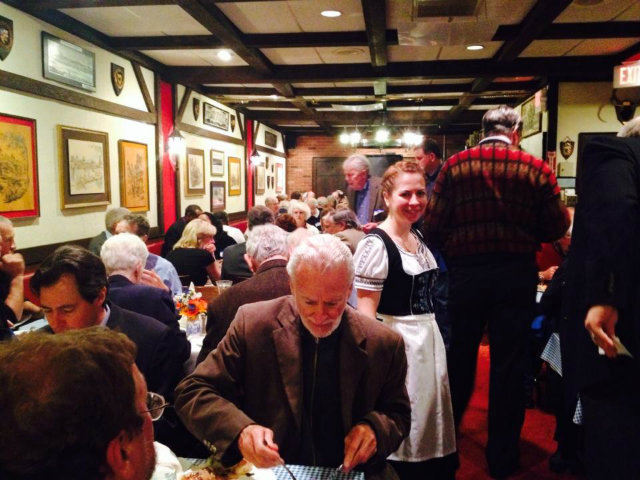
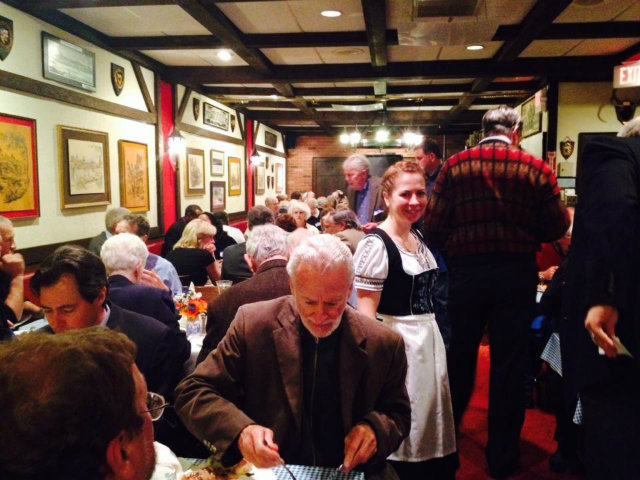
The restaurant has been in the same location in Glover Park since 1948, serving the same menu ever since. Dirndl-clad waitresses offer mugs of beer by the liter. Every Wednesday is polka night.
Old Europe is mentioned as one of five D.C.-area restaurants “that time (almost) forgot” in a 2013 Post article. Tellingly, only one of the short paragraphs mentions the food.
You don’t go to Old Europe for a five-star meal (if you want great German food, Biergarten Haus on H Street NE is surprisingly solid, and I’ve enjoyed Cafe Mozart, which should technically be Austrian, but who’s counting). You go to Old Europe to drink liters of beer in the kooky atmosphere, which includes a bunch of stuff that dates back to when the restaurant first opened: a shelf of coats of arms for various European states, paintings of cigar-smoking men, wooden model ships hanging from the ceiling, and an intensely ornate cuckoo clock. And then there are the other diners, who, like the Hessians, often add to the bizarre, theme-park feel of the place.
They are a group that, according to the “Kapt’n”‘s business card, are available for historical events, educational programs, ceremonies, and weddings. Apparently they come to Old Europe to have an excuse to dress up when there isn’t a wedding requiring an entire German mercenary unit. So, most of the time?
They brought three pages of German pub songs, and over our meal we learned how to belt out “My hat, it has three corners” in German (“Mein Hut, der hat drei Ecken,” for the curious). The accordionist comes every Wednesday; the Hessians aren’t quite as regular, but you never know who you’ll bump into. A piano player comes in some days (though the adorable little old lady, Janiece Kent, who was the restaurant’s mainstay player for years, sadly passed away last year). Rumor has it that sometimes a zither player shows up.
Most of the menu stays the same throughout the year, and you can feast on schnitzel, Black Forest-style chicken, or schweinshaxe (pork hocks). But Old Europe is also known for big, weeks-long seasonal festivals, like Spargelfest, the spring asparagus festival. Wild game fest, which runs November through February, adds venison, boar, and rabbit to the menu, and of course they go all out for Oktoberfest.
In my humble opinion, the best way to enjoy Old Europe’s menu is to split a sausage sampler and a veggie plate with a friend. The “Bunter Gemüseteller mit Reibekuchen” vegetarian plate sounds boring at face value, like a token option for strict vegetarians. But ordering this gives you a taste of almost every side Old Europe offers, and they rock their sides. Two kinds of cabbage, spatzle, and a potato pancake? Sign me up.
There is nothing fancy or pretentious about Old Europe. You can’t get a mixed drink, unless you consider a “Diesel”—beer mixed with Coca-Cola—a mixed drink. A “small plate” here means something off the kids’ menu. But if you’re looking for a place where you can get a little sloshed, make friends with the table next to you, and eat some comfort food, it’s hard to go wrong at Old Europe.