By DCist Contributor Josh Kramer
Recently I had the pleasure of being a guest on the Kojo Nnamdi show with Marcella Kriebel. We both draw watercolor illustrations of food. I do Drawn to Flavor here, and Marcella has a book full of illustrated recipes and draws beautiful posters and prints. Not surprisingly, we found that we have a lot in common, like having a hard time drawing brown food and wanting to jazz up our meals so they look more appealing. We had so many questions, like am I Bizarro Marcella Kriebel? Or is Marcella Bizarro me? We wanted to open up the conversation a bit, to talk about food, drawing, and being an artist.
DCist: Can you tell me a little about your process generally? How do you normally work?
Marcella Kriebel: I always begin in pencil, roughly sketching out proportions. There’s a certain amount of design that has to happen before the imagery even begins. Once the layout is pretty solid, then I outline all the major elements and the text. Then I add the watercolor.
DCist: How much time do you spend on any given piece? Give me a range.
Kriebel: Twenty minutes to 4 hours. Illustrated recipe is probably three to five hours. Big stuff can be days. For a 18″x24″ watercolor, the design and layout can be up to 30 hours of work.
DCist: Whew! Watercolor is not necessarily a very forgiving medium. Have you had a lot of hair-pulling out moments on larger works?
Kriebel: It’s funny though, most of the time it is ink, the line art actually. When there’s lots text involved, that can get challenging.
DCist: Do you see yourself being self-taught as an advantage or do you wonder how your work would be different if you had learned this stuff in school?
Kriebel: Yeah, I actually see the themes that I focus on being driven by my anthropology background: the desire to share experiences and narratives with others about our world. The art part is founded in illustration. It is a technical skill that takes practice, and for the most part I feel like I figured out much of this on my own.
DCist: I’ve noticed that a lot of your prints are like studies or organizational charts. Do you see anthropology as having influenced that?
Kriebel: Yes, somewhat. I’m really attracted to infographics, and enjoy making them look more elegant, in a way. My produce family series is based in botanical drawings but I’ve rendered the vegetables and fruits in my own style for sure.
DCist: Your style seems so consistent and fully formed to me. Does it feel that way to you? How long did it take to get like this? Did you always work in watercolor?
Kriebel: I hate the description “whimsical” but see how people describe my work as such. I only started working in watercolor when I began traveling. I found it a great way to illuminate my sketches with minimal setup. My cookbook really reflects this aesthetic. I’ve never taken a watercolor class. I’ve gotten SO much better.
DCist: Answer this however you like: do you have a vision of how food should be that you’re trying to show the world through your drawings?
Kriebel: I want food to be exciting, always vivid, and, in it’s own way, alive. I really saturate my watercolor with pigment; I like them to be bold.
DCist: I often find myself trying to draw professionally prepared food, whereas your work often is for the home cook or student of food. Do you think there’s a significant difference?
Kriebel: I think every plate has beauty to it and the person that prepared it has some type of intention—it’s fun to try to encapsulate that. I like to draw whole ingredients just as much as plates of food. Sometimes I feel I’m able to achieve a greater level of detail when drawing whole ingredients, and it offers more understanding of the subject matter.
DCist: You’ve had a hard day and you’re too tired to cook. What’s your go-to comfort food?
Kriebel: Fried egg. No question. I’ll add some greens, and tabasco is always there too. Greens being a bit of green onion or cilantro or whatever I pull from the garden plot.
DCist: I know you’re a gardener. What has that taught you about food or drawing food?
Kriebel: I think growing food makes me more observant in my art practice, when I draw produce. I’m very aware of how long certain things take to grow because of this.
DCist: Speaking of things that take forever: My first tomato of the season is nearly ripe, what should I do with it?
Kriebel: Oh man! That’s amazing. Slice it, and eat with a touch of salt, that’s it. I think tomatoes are the most rewarding things to grow in the garden. A fresh ripe tomato plucked from the garden is one of the most flavorful things ever!
DCist: Tell me about the idea behind your book.
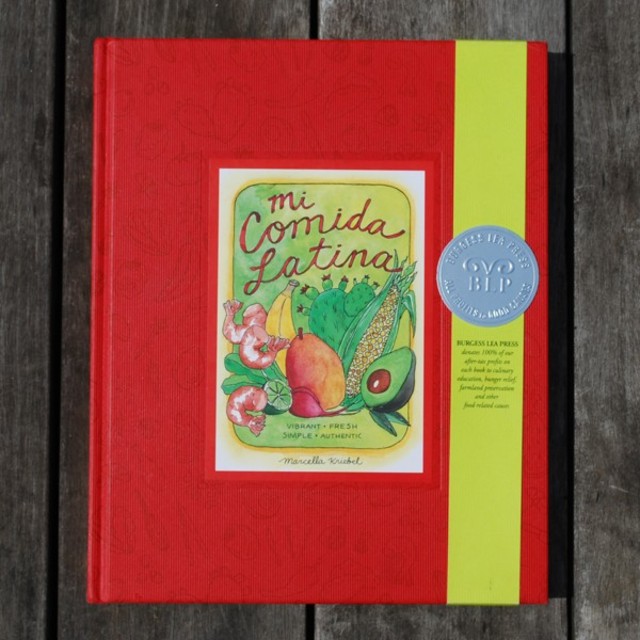
Kriebel: My book, Mi Comida Latina is a book comprised of my hand lettered, illustrated recipes inspired by my travels throughout Latin America. It is comprised of 140 pages, featuring different compositions and hand-lettered recipes based on dishes learned through cooking with home cooks throughout Central America, South America and Mexico. This book is just as much an art piece as it is a functional cookbook.
DCist: You self-published it at first, and you did a Kickstarter that successfully raised $30,000. How was that experience? What didn’t you expect going in?
Kriebel: Oh man, that was easily the craziest month of my life.
DCist: Good crazy?
Kriebel: Yea! It was great, but super stressful too! I was motivated to make the book to share the recipes that I learned abroad with family and friends. I originally only estimated producing 150 copies.
DCist: For some of the more instructional recipes that you draw, like how to cut an onion or break down a whole chicken, how much is based on your experience and how much do you have to research?
Kriebel: I had to do some research—that chicken page is a good example. In many cases though, like the onion page and the fruit spread, this content was learned from people, in markets, in the kitchen one-on-one. The cutting an onion for example, I learned from one of my host dads in Quito. The thing that was cool about learning from people was that it made them open up. There were so many tips that came along with stories, where people learned the knowledge they were sharing with me for example, was very natural to discuss family history and food rituals during cooking time.
DCist: How has having a publisher changed things?
Kriebel: The distribution of the book is happening on a much greater scale now. When I self-published, it was impossible to get the book into large chain stores, or major catalogs like Baker & Taylor and Ingram. This was because I only had one title to offer and the large distributors weren’t interested in doing business with a teeny entity with only one product to wholesale.
DCist: What does it mean to you to support yourself selling your art?
Kriebel: I feel great to wake up every morning and do what I love! And I like being my own boss. It’s definitely a hustle though.
DCist: Tell me about it. Life as an artist can be fragile. Do you worry about saving money or what would happen to your livelihood if there was an emergency like a fire in your storage space (knock on wood)?
Kriebel: Ugh, yea! Well, I do keep my inventory and my originals in different places. But in this day and age it may be more catastrophic to lose my hard drive—always remember to back things up! I do this weekly; I have an alarm on my calendar.
DCist: Smart. Obviously there will always be more food to draw, but are there other things you want to tackle besides food? Do you want to do more books?
Kriebel: Absolutely! I like drawing people, and birds, insects…unusual animals and landscapes too actually. But I have yet to add any of this subject matter into my prints collection. In the beginning I was really conscious of making the collection super cohesive as a whole. But I’m ready to branch out. I wanted to mention the solo show that I’ll be having at Wildhand Workspace (716 Monroe St NE) up for two weeks, opening July 9th. This show will include selected works from the Art Every Day, 365 project.
DCist: Is there a food or food trend that you can’t stand?
Kriebel: Cupcakes. And cakeballs too for that matter.