 Rachel Sadon
 Photo by Ronnie R.
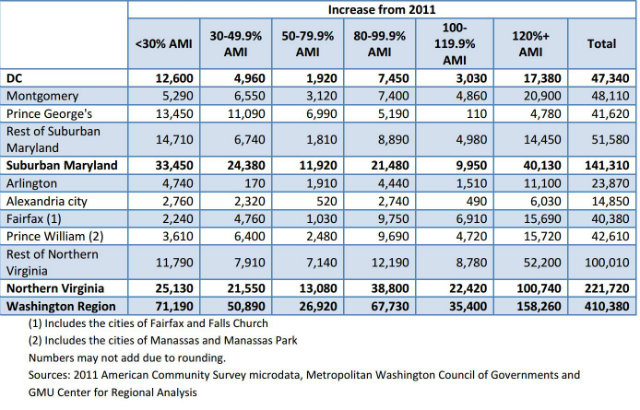
The greater Washington region’s population is estimated to grow by nearly 20 percent in the period between 2011 and 2023, adding 410,380 total households to D.C., suburban Maryland, and Northern Virginia, according to a new report by the George Mason University Center for Regional Analysis. More than 35 percent of those households will earn less than 80 percent of the area median income.
Of the 47,340 households projected to be added to D.C. proper, 41 percent will be making less than 80 percent of AMI. The report estimates that 12,600 extremely low-income households—those making 30 percent or less of AMI—will make up the majority of those new low-income households.
 Courtesy of the George Mason University Center for Regional Analysis.
The figures add clarity to the ongoing affordable housing crisis, and what it will take to accommodate the influx of people slated to move into the region.
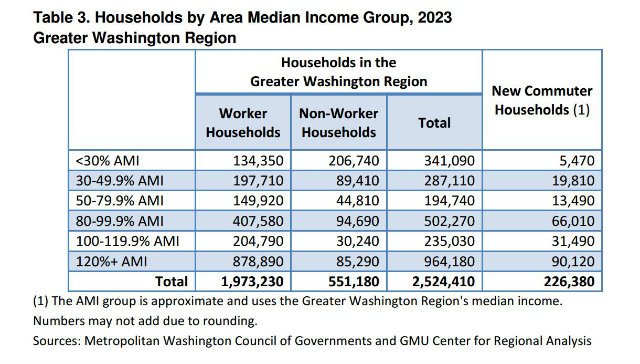
According to the report’s authors, potential demand across the region will be as high as 2,750,790 households, but supply will constrain that growth to 2,524,410. Put another way, the region will have 226,380 fewer units than demanded.
The majority of those choosing to live outside the region are expected to be middle-income households (defined by the authors as those making between 80 percent and 1119.9 percent of AMI). Both supply constraints and personal preferences play into incoming worker’s decisions to commute versus live in the region, the report notes.
 Courtesy of the George Mason University Center for Regional Analysis.