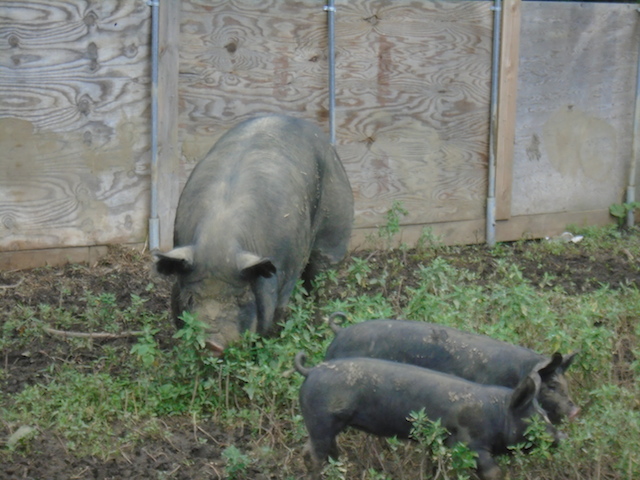
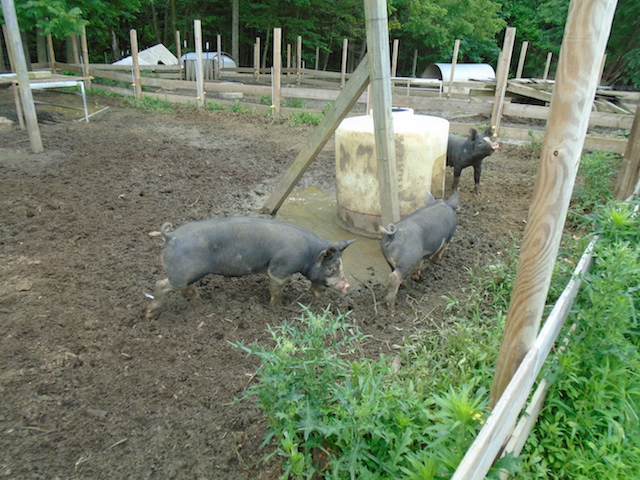
 Pigs roaming at Cabin Creek Heritage Farm in Upper Marlboro, Md. Photo by Bridget Dicosmo.
Each month The Federal Forager explores some of the perks, puzzles, and pitfalls of eating and living more organically, locally, sustainably, and creatively in the D.C. region.
By DCist Contributor Bridget Dicosmo
Jessie Baker remembers a season before her Middleburg, Va. Farm got specially trained dogs to guard its livestock. That year, the farm lost 500 chickens to foxes and raccoon. And at Cabin Creek Heritage Farm in Upper Marlboro, Md., Amanda Kauffmann has used her house dogs to chase off would-be predators prowling near the chickens’ pasture at night.
She also sets traps, and uses decoys that look like scarier predators, such as owls, to keep foxes at bay. “We have a big problem with predators,” Kauffmann said during a recent tour of her parents’ 24-acre farm.
We know we generally pay more for locally raised and grass-fed* meat, but what goes into that higher price tag? I know there are times when I go home from the farmers market without my usual dozen eggs because some wily raccoon got to the chickens that week. But I’ve never given much thought to the fact that without industrial chicken houses to protect against hungry beasties, pastured poultry is pretty much fair game.
Predators are not the only challenge. There’s a time element with raising grass-fed cattle, says Kinley Coulter, of Coulter Farms in Juniata County, Pa. Coulter, who sells certified organic, 100 percent grass-fed beef, lamb, and dairy products at area farmers markets, says that raising pastured beef can take up to eight months longer than raising cows on grain.
And those considerations, not to mention the cost of grazing land for pastured animals, are reflected in the price of locally raised and grass-fed meats. But there are options for conscientious carnivores, especially in the DMV region, to save some money on buying locally and/ or grass-fed. Cow shares, for example, are becoming a thing.
“Most people know about vegetable CSA’s, but we have meat CSAs as well,” Baker says. “It’s like becoming partners with your farmer.”
Which could mean you not only share in the spoils of a bountiful season, but the losses spoilage as well, such as when a fox ravages the henhouse. It also means you have someone to email when you realize you have no idea how to quarter a whole chicken or whether the shoulder steak is good for braising.
A regular share of the Bakers’ Dayspring Farm meat CSA, for example, is $625 for five months, or $125 a month. One share gets you 12-15 pounds per month, which, as Baker says, better aligns with the freezer capacity of an average D.C. apartment, than purchasing half a cow. That works out to between $8.30 and $10.40 per pound.
At Cabin Creek, meat CSAs are offered in four-month increments with small, medium, and large options. And the farm accepts the Special Supplemental Nutrition Program for Women, Infants, and Children (WIC). “We have quite a few customers on a lower income; they’ve found it’s worth it to get better food,” Kauffmann says.
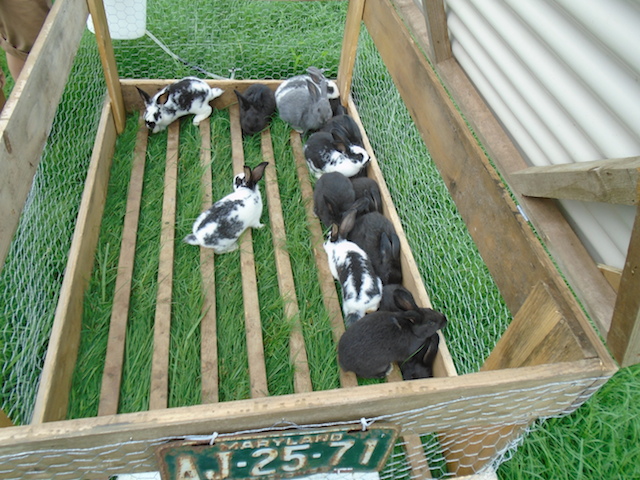 Bunnies at Cabin Creek Heritage Farm. Photo by Bridget Dicosmo.
The cuts can also make a huge difference in affordability, says Matt Ruble, butcher at Let’s Meat on the Avenue (2403 Mt Vernon Avenue) in Del Ray, a butcher’s shop selling pasture-fed, hormone-free meat (and kangaroo!). Most farmers will sell by the cut, and there are often bargains to be had on cuts like “chuck eye,” which refers to meat cut from the shoulder of the steer, one rib off from where you’d slice for a rib-eye steak. “We used to call it poor man’s rib-eye,” Ruble says.
Ruble suggests familiarizing yourself with the various cuts, and institutional numbers, because some of them have their own regional names. Learning the different cuts serves another purpose, especially if you buy a whole animal from a farm.
“There are certain things you want to be able to sell back to the farmer,” Ruble says, because processing those will be tricky.
Buying directly from the farm doesn’t necessarily have to be more inconvenient than regular shopping either. Delivery options are often also available if you choose to “split a cow” or a whole pig with friends. Most farms that offer whole animals as well as half, quarter, and individual cuts. Eatwild lists more than 20 farms in the region. Some of them are more than an hour away, but many deliver to drop-off sites in the area or sell at local markets.
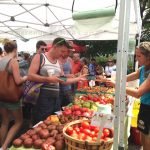
Nora Pouillon, owner of Restaurant Nora, the country’s first certified organic restaurant, advises consumers to check out local farms and the nearly 40 local farmers markets in the Greater Washington area. “The more demand at farmers markets and the more people who buy from farmers, the more reasonably priced their product will be,” Pouillon says. “It’s all connected.”
Pouillon says 36 years of running her business proves “consumers have a steady appetite for food that is both healthy for them and for the environment.” She has been searching for organic local farmers since the late ’70’s, and says she often searches the local farmers’ markets for suppliers.
While grass-fed cows are free of antibiotics and hormones, not every local farm that raises grass-fed animals is organically certified, though many, like Cabin Creek, follow general organic and sustainable practices without the (actual) certification. “I can assure you: there aren’t that many certified organic farmers in this region,” Pouillon says.
For nights when you aren’t up to lighting a grill, the District’s many restaurants give us lots of options. Clyde’s Restaurant Group food and beverage director Bart Farrell says the group’s area establishments use grass-fed, grain-finished beef from Shenandoah Valley Beef Cooperative for burgers, meatloaf, and chili. A major consideration for restaurants in being able to offer grass-fed and local meat is finding steady sources and consistent supplies, Farrell says, “We are working on increasing this to utilize more of this product on our menus,” Farrell says.
The group first began sourcing locally in the ’80s, Farrell says, and back then, resources for restaurants looking for local farmers were non-existent. “It took getting into a vehicle with a map and driving around to find farms that we could talk to,” he says.
* Grass-fed, as defined by the American Grassfed Association, refers to livestock production that is based on pasture, grass, or forage for the animal’s lifetime, with hay and other types of roughage fed in the winter as a supplement. You can learn more about these labels here.