 Photo by
By DCist Contributor Becky Little
Whether you’re talking about its wars, its candy, or its television, the history of America is the history of business. The M&M’S that now line grocery store checkouts were first developed by Mars, Inc. as a snack for U.S. troops during World War II. After soldiers got hooked on these tiny treats, M&M’S transitioned to civilian life, sponsoring children’s TV shows like Howdy Doody.
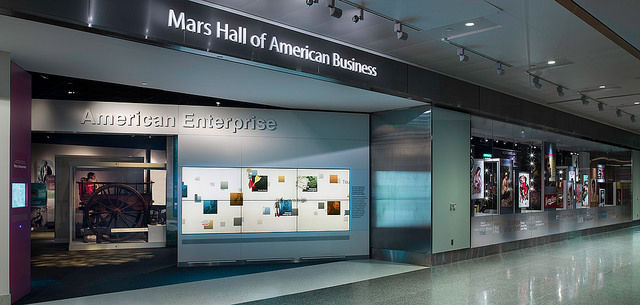
I learned this last week at American Enterprise, the Smithsonian’s National Museum of American History’s new exhibit on the evolution of business. History is the study of simultaneous change and continuity, and the exhibit’s location in the “Mars Hall of American Business” seems to make some meta-point about its subject all by itself. But once you walk past the bizarre video about how “principle-driven” Mars is—and the blurb about how the controversial agricultural giant Monsanto “is honored to support” the exhibit—you’ll find a thoughtful presentation of U.S. business history.
American Enterprise takes an ambitious look at “the tumultuous interaction of capitalism and democracy” between the 1700s and today. This is quite a stretch of time to cover, and its sections jump through decades by using the particular to illustrate larger trends. One of the most powerful examples of this is the “Business of Slavery” interactive, which lets viewers examine what are, horrifically, 19th century business documents. It’s haunting to read that slaves were insured as property by their owners; but to actually see an insurance policy that assessed a slave named William’s life at $900 in 1858 … that is something else.
These particular examples don’t just help viewers understand different historical periods; they also give background to more recent events. Those who know that the Department of Justice broke up AT&T in the 1980s might be interested to learn that, in the early 20th century, the “federal government agreed that this ‘natural monopoly’ benefited the common good.” Or they might be amused, as I was, by a 1921 ad in which AT&T tried to frame itself as a democracy, bragging that “more than half of its owners are women.”
In some places, the exhibit could have drawn more explicit connections across time periods. When I read that IBM CEO Thomas Watson Sr. coined the company motto “Think” in the 1920s, I thought of Steve Jobs and “Think Different,” and what these phrases say about the way American tech companies have historically marketed themselves. The exhibit doesn’t mention that Apple would later develop a motto strikingly similar to IBM’s—but perhaps the curators wanted viewers to make their own connections, and draw their own conclusions.
One of the most mesmerizing parts of the exhibit is a TV in the middle of the advertising section. It plays old commercials, including a 1954 ad that says “doctors look for the same things in cigarettes that we all do …more doctors smoke Camels than any other cigarette.” The commercials are edited with Pop-Up Video-style blurbs, and my favorite pop-up fact was that Marlboro’s public image used to be feminine until advertisers introduced the Marlboro Man in the mid-1950s. These tactics—appealing to consumers’ association of doctors with authority, marketing a product as male or female—resonate because we can recognize them in advertising today. Things change, but they also stay the same, and American Enterprise is most powerful when it prompts viewers to consider how the past has morphed into the present.
Now who wants some M&M’S?
American Enterprise is a new permanent exhibition at the Smithsonian National Museum of American History (14th Street and Constitution Avenue, NW).