 Rachel Sadon
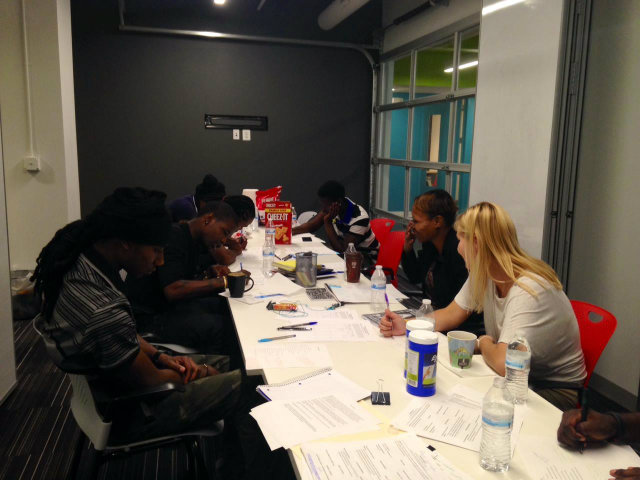 Courtesy of Free Minds, via Facebook.
By DCist contributor Arielle Milkman.
Free Minds Book Club & Writing Workshop has supported hundreds of incarcerated D.C. youth—and now, thanks to a $25,000 grant from the Aspen Institute, the organization is expanding to four new cities.
Youth participating in the program meet for a weekly book club and write poetry. Free Minds staffers then bring those writings to monthly Write Nights where community members and volunteers respond to the inmates’ poetry.
Poetry is a loose term, co-founder Kelli Taylor said, to describe the gamut of free creativity that the participants explore in their work. “It’s just writing—the whole point is that there’s no rules … and to get people to tell their stories,” Taylor said. “If people tell their stories they see how they’re more alike than different”
It is this common ground that produces an effect Taylor describes as magic. For the incarcerated youth with whom the organization works, being heard is the first step.
“The people on the inside are just so desperate to be heard,” she said. “They don’t think that anybody cares.”
Gary Durant, 23, is recently back in D.C. after serving six and a half years in prison for manslaughter. An active participant in Free Minds while he was incarcerated, he hadn’t thought much about writing or reading before Free Minds challenged him to pick up a book.
“They challenged me to grow a little bit,” he said. “I never thought about poetry, and I didn’t like to read, but they encourage you to write more and they help push you.”
Durant’s favorite titles in the book club were ones that featured characters to whom he could relate. He particularly connected with Dwayne Bett’s A Question of Freedom, a memoir of an adolescence spent in prison.
And for those on the outside, the program encourages a more realistic view of incarceration. “People on the outside have seen such a one-dimensional perspective of incarcerated people,” said Taylor, a longtime journalist prior to founding Free Minds in 2002. “The program really does allow two people to see each other.”
Melanie Bates, an attorney, has volunteered in the program since 2011. She said it’s powerful to hear that receiving feedback gives youth who are in prison hope, and that the youth in the program are surprised that there is someone on the other side listening.
In their poetry, Bates notices a common theme: lack of resources and support growing up. “There’s also something called the school to prison pipeline which is at work here—I think all of these factors are combined, especially in D.C., where you see a lot of people who are poor and people of color [experiencing incarceration],” Bates said. About 93 percent of the prison population is male, and 91 percent is black, according to an October 2014 report from the DC Department of Corrections.
And according to a 2010 study by the DC Superior Court and National Center for Juvenile Justice, about 40 percent of incarcerated youth in D.C.’s juvenile system reoffended in 2007 and 2008 (the city doesn’t keep statistics on juvenile offenders in the adult system.)
More than fostering support, Free Minds has data to back their program up. They report that their participants are three times less likely to end up in prison again after they come home.
Free Minds is now looking at sites across the country to host chapters of the new program, called On the Same Page: United (basically localized versions of the Write Nights that the organization hosts in D.C.).
Cities on the table include Los Angeles, Denver, New York, and Baltimore. Taylor has a trip to San Quentin, CA planned, to identify a possible partnership there. She’s looking for folks who are already doing similar work—like a GED program or writing tutoring—so they will already be equipped to shepherd Free Minds’ work in a local context.
The four new sites should come on board in September, Taylor said. Free Minds currently serves 18 youth aged 16 and 17 who are incarcerated in the D.C. Jail and 192 adults in federal prisons across the country.
After coming home, Durant interned with Free Minds, and now does outreach events for the organization between working at a dog day care and coaching football. He is going to college in the fall and plans to study child psychology.
“[At Free Minds] they really hear you and give you a chance to speak,” Durant said. “It just makes you feel like you’re human, and people look at you like you’re human.”