 Rachel Sadon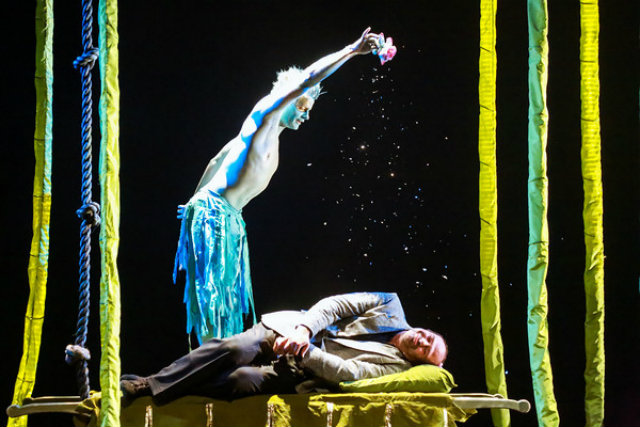
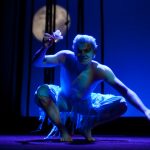
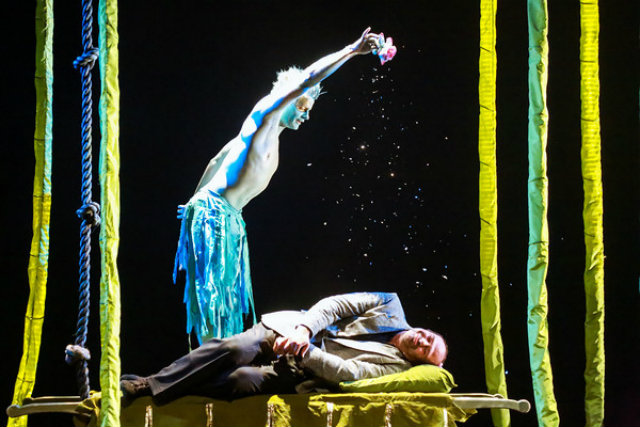 From A Midsummer Night’s Dream (Courtesy of Synetic Theater)
The drama surrounding the Synetic Theater’s series of wordless Shakespeare productions continues, with Fox News (who else were you expecting?) weighing in.
In a rather misleading (what else were you expecting?) report, the hosts of Outnumbered—the show whose premise is four women to one man discuss current events—give their opinions on the production. The conversation was based almost entirely on the Wall Street Journal opinion piece that sparked this whole thing. None of them, it seems, had seen their shows.
In an article published a bit more than a week ago, James Bovard attacked Synetic’s offerings as unenlightened adaptations that willfully pander to the uncultivated masses.
“The latest Shakespeare fashion, at least in the Washington area, is to invite people to a feast of language and serve nothing but grunts, grimaces, and grins—with a few gyrations thrown in for dessert,” he wrote.
The Arlington-based theater company has indeed made a name for themselves through silent productions of multiple Shakespeare plays—A Midsummer Night’s Dream opened shortly after the opinion piece ran—as well as adaptations of other literary works, like The Picture of Dorian Gray. But Synetic employees and fans of the company vehemently dispute Bovard’s categorization.
In a lengthy blog post, Synetic responded:
At Synetic, [Shakespeare’s] words are translated into physical language and visual poetry, just as they have been translated into countless other languages and art forms throughout history. These interpretations simply underscore the success and timelessness of The Bard’s plays. Synetic follows Shakespeare’s example of adapting classical tales in the parlance of his time for his audiences, appealing to both the groundlings and the gentry.
Local news outlets weighed in, including a takedown from the City Paper that noted the wide range of acclaimed and non-traditional Shakespeare productions out there (the four writers also deemed Bovard a twat and a troll). The libertarian author wrote a couple of blog posts in response to his critics, but things seemed to be petering out.
Enter Outnumbered.
The hosts of the Fox show seized on two particular sentences from Bovard’s piece and ran with them:
“Omitting words allows Synetic to finish Shakespeare plays in barely half the time they often require. The company has received numerous grants from the National Endowment for the Arts and its state affiliate, the Virginia Commission for the Arts.”
The first, and more bizarre, accusation is that the wordless plays are simply too short.
“Is the government trying to accommodate the fact that we have no attention spans for the arts anymore?” asks Sandra Smith. “I think that’s ultimately what its about,” responds Lisa ‘Kennedy’ Montgomery, the sneering host who introduced the story.
Right. Definitely, that’s it. The government is choosing which productions to fund based on run time.
But really this comes down to the frequent right-wing complaint that taxpayer money is going toward the arts at all. Montgomery claims the federal government has spent nearly $100,000 on the wordless shows, neglecting to mention several key facts.
According to Synetic, that sum includes combined grants from both the NEA and the Virginia Commission for the Arts—dating all the way back to 2000. It also includes funding for their non-Shakespeare productions like Dante and Faust. And the current production of A Midsummer Night’s Dream is in its fourth remount (which should say something about demand), for which they didn’t receive outside funding at all.
Facts aside, though, this is really what the Fox hosts are taking umbrage at.
“The National Endowment for the Arts should be abolished,” announces commenter and former U.S. ambassador to the United Nations John Bolton. “I just think that it’s wrong for the government to spend money on art, which is purely a matter of taste.”
Bovard agrees. “I’m opposed to any government program that places more of Americans’ life under the sway of politicians and bureaucrats,” he said in an email to DCist. “Thus, I am opposed to federal subsidies for the arts—and most other activities. Addicting the arts to federal handouts will have the same dire consequences that many other forms of dependency produce.”
But, he says, that wasn’t really the point he was trying to make.
“My article was an op-ed primarily about Shakespeare and the intellectual and literary cornucopia he continues to provide after four centuries—and about what is irreplaceably lost when his words are expunged,” Bovard wrote.
After seeing the production last night, he stands by his words.
“Some of their actors, like Scott Brown, are very talented. Some of the comic scenes in the latter part of the play were amusing at times,” he told DCist. He was surprised that the show wasn’t actually silent—”the actors shouted, laughed, sang, grunted, squealed, and cried”—but said the style made “mincemeat” of the plot.
His conclusion:
Synetic offered dry humping in lieu of Shakespearean dialogue. Synetic also rewrote the play to showcase the presumed strengths of its cast—perhaps what director Paata Tsikurishvili means when he says he takes Shakespeare “to the next level.” Maybe Synetic believes that its East European-style pantomime is superior to the words Shakespeare wrote. I disagree.”
As for Synetic, they’re taking this all in stride (even Bovard agrees on that count, saying “they’ve done a great job hyping this piece.”) Their latest marketing materials make mention of the controversy, and they’ve gotten a huge response.
“We’ve seen a lot of support—mainly emails, comments on our Facebook page,” says Alysa Turner, Synetic’s marketing manager. “We’ve done the show four times and it sells really well. Literally our audiences disagree on silent Shakespeare.”
As to the Fox segment, “I think this is a road everyone’s been down before,” Turner says. “Most people realize that [funding for the arts] is important.” A few years ago, Arlington Arts Commission Chair John Seal said that Synetic Theater alone brought $3.75 million in revenue to Crystal City restaurants.
Still, Turner says, “they can keep talking about it, I suppose.” After all, ticket sales are up.