On Friday, first responders treated 14 people near the Columbia Heights Metro station for suspected overdoses of synthetic drugs. It’s just the latest in a series of incidents related to the substances in D.C. over the last few months, including mass overdoses among homeless residents, violence, and possible links to other crimes.
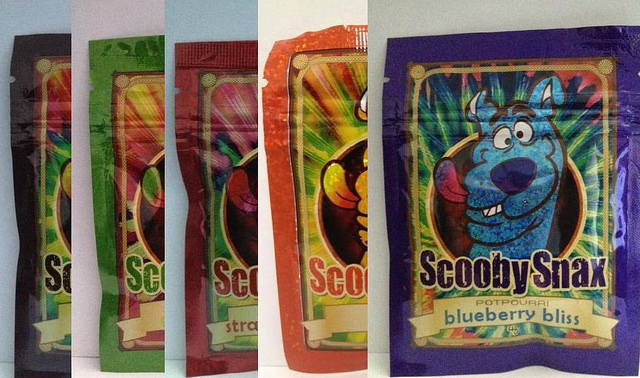
The synthetic drugs in question—known as K2, Spice, Bizarro, Scooby Snax, and Trainwreck—are often referred to as “synthetic marijuana.” In reality, however, it’s a drug that’s far more dangerous than the one it supposedly mimics, and calling it “synthetic marijuana” is grossly inaccurate.
What someone gets when they purchase a bag of, say, Scooby Snax, is potpourri. But it’s not regular potpourri; it’s been sprayed with a chemical compound meant to mimic the effects of marijuana, albeit without using illegal cannabinoids. Dr. Malik Burnett, a former policy organizer for the Drug Policy Alliance says that the reason the moniker “synthetic marijuana” has unfortunately stuck to these particular drugs is because of the way manufacturers engineer a chemical structure meant to be like THC, the active chemical cannabinoid in marijuana.
But the reality is that the cannabinoid-mimicking compound synthesized for these drugs isn’t actually much like a cannabinoid in the slightest. “The only part that’s really marijuana-like is the active part of the chemical compound, because it looks like a cannabinoid,” Burnett says, “but it’s not a cannabinoid at all.”
So what exactly is it that people are consuming when they smoke “synthetic marijuana” and what about it is causing all this violent behavior? Well, it’s complicated, and not because the chemistry is complicated, but because it’s actually a bunch of different synthetic chemical compounds that are constantly being changed.
Every person has cannabinoid receptors in their brain. When you consume THC, those cannabinoids react with your receptors and produce a physical reaction (i.e. getting high). But cannabinoids aren’t perfect fits with your receptors, which keeps the reaction relatively in check. Synthetic cannabinoids, however, are perfect fits for the receptors, which means that it binds at a greater strength than normal cannabinoids, Burnett says. So the reaction is much stronger.
Another factor that makes synthetic marijuana so dangerous is all of the side chains (a chemical group attached to the core part of a synthetic cannabinoid molecule) included in the chemical composition. “Because they change all the side chains in the chemical compound, they ultimately create toxic metabolites and they have an additive negative impact on the body,” Burnettt says.
But what’s most dangerous about “synthetic marijuana” is the uncertainty of what’s in each package, which Burnett says is “almost impossible to say.” He says “there’s no standardization or uniformity to any of these compounds, even within a single package,” which means that one package of K2 could be completely different than another package of it. And that means a person’s reaction to the chemicals can vary wildly, often resulting in erratic, violent, and psychotic behavior.
So how to stop it? Of course, it’d be convenient to just ban all synthetic drugs, but that’s not possible, as many pharmaceuticals that millions of people rely on for treatment are synthetic drugs. Thus, to outlaw certain synthetic drugs, the government has to go after the specific harmful compound.
Right now, synthetic cannabinoids are considered a Schedule I Controlled Substance, yet they are still finding its way on the streets. That’s because as local and federal governments move to ban a certain synthetic compound, manufacturers will just alter it slightly so as to circumvent illegality. Hence why we still see synthetic drugs like K2, Spice, and Scooby Snax still on the streets. And while local governments, like D.C. can ban the sale of it, that’s not the case in every state, making it easy to transport.