 Inong Sungai Ular (Drafthouse Films)
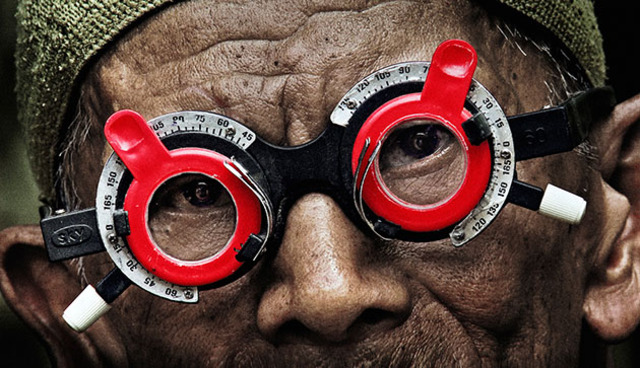
The elderly man having his eyes tested looks like a fragile cross between Charlie Callas and Tony Curtis, but he’s a mass murderer. The Look of Silence opens with exquisitely photographed scenes of village life that could have easily come from an arthouse fiction feature. Multi-camera setups and deft editing create a rhythm that establishes location and intimately brings you into the lives of the film’s subjects. But the film’s harrowing tales of murder, mutilation, and the difficulty of forgiveness, are painfully true.
This is director Joshua Oppenheimer’s return to the scene of his brilliant 2013 documentary The Act of Killing. The word on this companion piece is that it’s “more human” than the first film, which introduced us to the men behind Indonesia’s death squads in 1965s. But what could be more human than murder?
Anwar Congo and the other men of The Act of Killing reenacted their crimes for Oppenheimer’s unflinching, non-judging eye. They weren’t the sheer monsters you might expect, but vivid and even entertaining personalities. All too human. When Oppenheimer was making that film, among the many nameless victims of the death squads, one name stood out: Ramil, who was torn from his family and murdered before witnesses. The Look of Silence powerfully documents Ramil’s family and their attempt to come to terms with his murderers, who were never punished.
It’s a tranquil setting that holds grave torment amid an uneasy quiet. Trucks silently rumble through dirt roads, invoking the kind of horrific journeys made when the villagers were taken by the truckload and massacred. There is a silence born of fear that pervades the film, but as the film’s title and its posters plainly state, all we have to do is look.
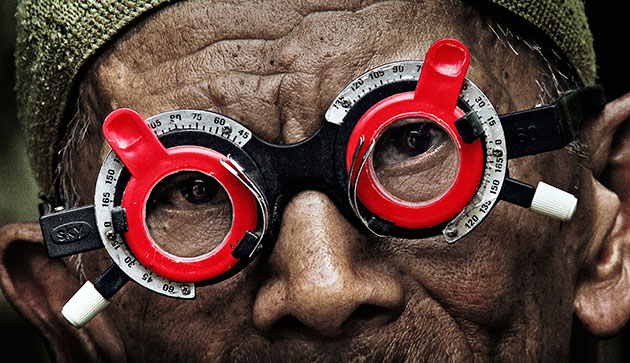
The posters show a stylish portrait of a man getting his eyes tested. This is Inong, one of the death squad leaders responsible for Ramil’s murder, the details of which he describes with glee. Adi, born a few years after the death of the brother he never knew, grew up to be an optometrist, and with the help of Oppenheimer arranged to meet his brother’s tormentors under the pretense of evaluating their eyesight. Their vision is failing, you see, but the eyes don’t fail to show the torment. Cinematographer Lars Skree’s cameras focuses on these subjects so sharply that you can see their eyes turn red and their faces subtly but unmistakably change as the brother of a man they killed comes to them, not out of revenge but as an attempt to come to terms with tragedy.
Throughout the film we see Ramil’s mother Rohani bathe and dress her husband Rokun, who’s over 100 years old, but when asked, he states his age as 16 or 17. Their youngest son Adi was born a few years after Ramil was killed, and it is he who takes it upon himself to confront the men who killed the brother he never knew.
The Look of Silence isn’t a historical documentary with talking heads and charts (though we do see Adi watch newsreel footage). It doesn’t try to explain the ideology of the killers or of the communism that the killers claimed to stamp out; although the film’s tragic story is absolutely political, the director somehow looks past that to immerse us in the basic human condition, whether it’s as a victim or a killer.
I’m not going to try to sell this to you any more; The Act of Killing was my favorite film of 2013, and this will be my favorite of 2015. These are difficult, painful films to watch, but anyone who cares about film or humanity must watch them.
Director Joshua Oppenheimer will appear in person at E Street Landmark Cinema on Friday, July 31 for a Q&A after the 7:15 p.m. show (SOLD OUT) and to introduce the 10 p.m. show.
—
The Look of Silence
Directed by Joshua Oppenheimer
Rated PG – 13 for thematic material involving disturbing graphic descriptions of atrocities and inhumanity
Running time 103 minutes
Opens today at E Street Landmark Cinema.