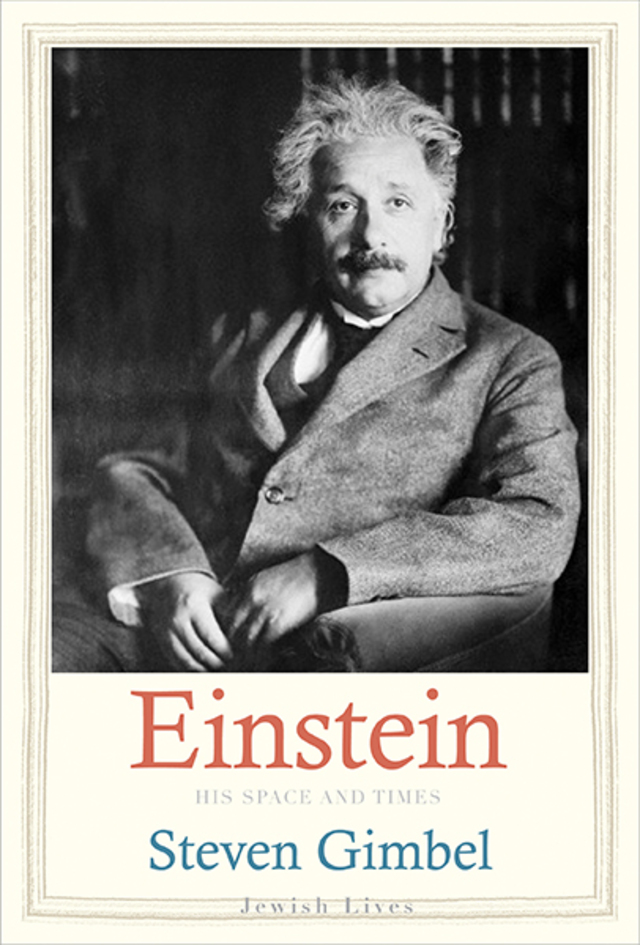
 Albert Einstein is best known for being a genius. But he was also a pacifist, a political rebel, and an all-around badass. That’s the general gist of Steven Gimbel’s Einstein: His Space and Times (Yale Press, $25), which chronicles the scientist’s professional and personal life while leaving you with a better understanding of his work.
He will be discussing the book at the D.C. Jewish Community Center tomorrow, August 4th from 7:30 to 9 p.m.
Einstein grew up in Germany in the late 1800s, just as Otto Von Bismark started a cultural revolution that sought to rid the country of religious influence—namely, Catholicism. Gimbel confirms that Einstein was an outsider, as “the Jewish kid” at his Catholic school, but dispels myths that he didn’t speak as a child, had autism, and failed math. In fact, he was an awesome math and science student.
He also briefly delved into religious tradition, even though his family was largely secular. But by the time Einstein became a teenager, he said “through the reading of popular scientific books I soon reached the conviction that much of the stories in the Bible could not be true.” From this conviction grew a distrust of authority that led him to renounce his German citizenship by age 15, and would follow him thereafter.
Einstein studied math, philosophy, and physics, but resisted doing so in the classroom. He had a series of adventures and travels, and even impregnated his future wife, though he mysteriously never met his first child. After getting a job as a patent clerk in 1905, he had what he called his “happiest thought”: if a person fell off a ladder, he would not feel his weight during his fall.
Over the next ten years, he developed the concept that gravity and acceleration were merely two sides of the same thing, confusing generations to come with the “theory of relativity.” But at the time, Nazis were condemning Einstein’s theories as “Jewish science,” protesting him at forums and sending death threats.
Einstein had mixed reactions to being a newfound celebrity and political figure. Gimbel recounts Einstein’s experience as well as his reconciliation with religion, why he turned down the offer to be president of Israel, and how his dying words were lost in translation. The book explores the less-charted territory in Einstein’s life, while weaving in explanations of Einstein’s brilliance as a scientist and philosopher. And the reader sees how Einstein’s ideas ended up reshaping the world as we know it.
Gimbel chairs the philosophy department at Gettysburg College, and his writing focuses on where history and philosophy of science collide.
Tickets can be purchased online here, and are $12 for general admission or $10 for members, seniors and students.