By DCist Contributor Nathan Wilkinson
When it comes to drinking luxury whisky, I try to take the view of a scotch-drinking anti-snob, if there is such a thing. I’ll mix drinks with single malts, and I try not to make a big deal about pricy blends like Johnnie Walker Blue Label. Such expensive scotches are nice when you can get them, but I have other recommendations that are nearly as good when you can’t. Yet every so often, a scotch comes along that defies my expectations and my ability to keep my cool about it. The Last Drop Distillers, producers of some of the world’s most exclusive whisky, have released several extremely rare and extraordinarily fine blends and a 48-year-old single malt for whisky lovers like myself to covet unabashedly.
I recently got a taste of one of their products at Dram & Grain, the inner sanctum of Jack Rose’s Dining Saloon (2007 18th Street NW). There I met Beanie Espey, PR and communications director for The Last Drop Distillers and daughter of James Espey who’s known for directing several major distilling companies over 50 years.
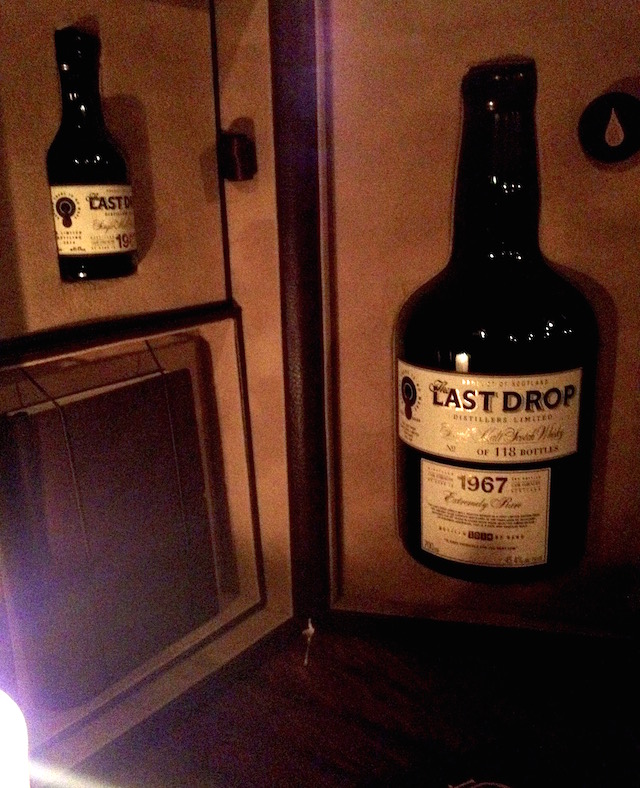
“The idea behind The Last Drop is stated on the label: get it ‘before there is no more,’” says Espey. The 1967 bottling of Glen Garioch single malt that I tasted is a one-off release with only 118 bottles worldwide and only 30 sold in the U.S., which is why I only got to try a half thimble of the scotch. With a price tag of $3,000 per bottle, I’m one of the lucky few to even taste that much. But Espey says the brand tries to eschew the snobby approach to whisky.
“Yes, we are selling whiskies that are extremely old and incredibly rare, which are exacting standards to meet,” she says. “But they are not simply precious because they are old; they are also very good.”
The Glen Garioch 1967 is good, but not in that throaty, peaty roar that American single malt lovers have come to expect. There are a lot of fresh fruits and floral notes on the nose, with some smoke to remind you that it is an old Glen Garioch after all. Tasting reveals rich and smooth honey flavors and something akin to apricot, I thought. There’s saltiness and oak that balances the sweetness, too, and the finish continues for long minutes of clove and cedar spiciness. One thing you can say about The Last Drop is that you get a lot from every drop.
Espey says that her father hopes to “bring to market only the scotches he felt were truly exceptional.” Old whisky doesn’t always translate to good whisky, she explains.
“Having spent so much time in oak, [The Last Drop] retains freshness and not the tannin that can ruin a spirit.” Many of the scotches that comprise the blends are from closed distilleries. They are so old that fifty percent of the barrel has been lost to evaporation, and what remained cannot be reproduced. “For the age, quality, and limited quantity,” Espey says, “it is a good value.”
And at about $3K, The Last Drop 48-year-old blend is cheaper than some extremely rare single malts that sell for ten times as much. But should you just drink something that’s so expensive? Espey says, “the company was started by whisky lovers who ideally want people to enjoy it.”
The box set of 1967 single malt comes with a miniature bottle for tasting because, Espey says, unlike wine, “an unopened bottle of whiskey remains unchanged.” So it is a good value for collectors. (The Last Drop’s 1960 vintage has increased in value by $1,000 dollars in the U.S. since its release last year.) Still, she believes that the price won’t be prohibitive to a group of five or more people who want to go in for a bottle together.
And that means that some people who buy The Last Drop bottlings will probably drink them. Knowing how good they taste, I think I would, too. Having this level of a luxury scotch is a once-in-a-lifetime experience. If anyone is considering buying a bottle, Schneider’s (300 Massachusetts Avenue NE) and Chevy Chase Liquors (5544 Connecticut Avenue NW) will have them in September.