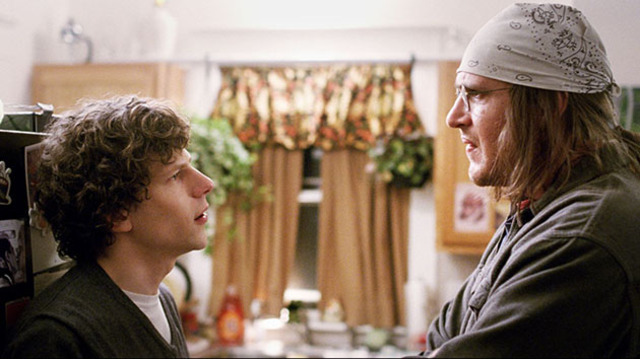
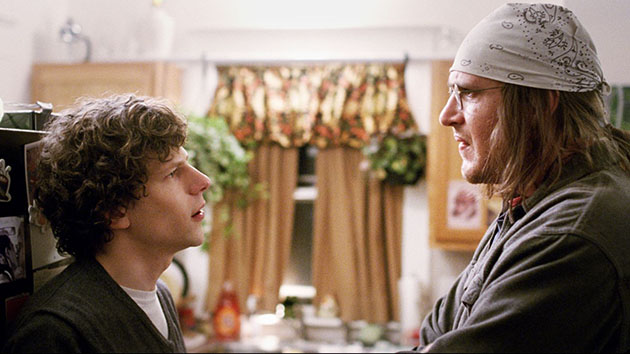
 Jesse Eisenberg and Jason Segal (A24)
Can an interview really capture a human being? Can a conversation? Director James Ponsoldt (The Spectacular Now) gives himself an out in a new film based on interviews conducted by reporter David Lipsky with the late author David Foster Wallace. After accompanying Wallace (Jason Segal) on tour, Lipsky (Jesse Eisenberg) gets ready to say goodbye, but discovers something in Wallace’s house that makes him realize that even though the interview may have been “the best conversation I ever had,” he barely got to know the reclusive author at all. If it’s difficult to really know someone after hours of interviews, then a two-hour biopic doesn’t have a chance.
Biopics ordinarily give me hives, but I was sympathetic to The End of the Tour despite it being potentially even more offensive to actual human achievement than the average biopic. It’s more than just the story of two real-life figures, and about something corny but true, like friendship. It’s about getting the story, and any writer with aspirations to journalism will recognize himself in the smarmy hunter-interviewer character of David Lipsky.
I have no idea if Eisenberg’s portrayal is an accurate impersonation of Lipsky, but he comes off as just another variation of the unlikable but somehow endearing smart-aleck that Eisenberg usually plays. Which suits his role just fine—as much as Lipsky may want to befriend an author he admires, he also has a job to do: he has to get the story, and that might mean being a dick if necessary.
Segal’s Wallace is trickier. The inner life of the writer is particularly difficult to capture on film without resorting to cliches, and Segal’s performance seemed fine as I was watching the movie. But afterwards I started to think of him as just Some Big Guy in a Bandana.
The movie does capture some of the tedium of the road (and with a soundtrack that includes Tracey Ullman and Brian Eno, the excellence of road trip mixtapes), along with the horror of consumerism but also the kind of awesome spectacle of it. If the leads don’t exactly capture their real-life counterparts, they do capture the sad cat-and-mouse game of basic human communication: as much as we might try, more likely than not people are too caught up with their own agenda to be open to what another human being is really about.
David Foster Wallace fans might find that the movie falls short on David Foster Wallace, but The End of the Tour still works, albeit as something considerably less ambitious than his doorstopper novel Infinite Jest: a buddy movie about the difficulty to communicate.
In it’s way, the movie is a corny vision of one of Wallace’s concerns. Early in Infinite Jest (full disclosure: I never finished it), Harold Incandenza, tennis prodigy, is in the middle of an important interview with the admissions board of the University of Arizona when he has some kind of mental episode. Despite this young man’s unmistakable talent, he has serious trouble communicating.
Maybe you don’t read David Foster Wallace for touching themes about the human condition, but this is the touching theme of The End of the Tour. While Lipsky approached Wallace to get a story, Wallace seems to have seen it as a rare opportunity to connect with his audience in a way that he couldn’t even connect with them in a thousand-page novel. Lipsky published his conversations after Wallace’s death, in the book Although of Course You End up Becoming Yourself, which would have been a better title for the movie. It sounds a little corny, but it’s true.
—
The End of the Tour
Directed by James Ponsoldt
Written by Donald Margulies, based on the book by David Lipsky
With Jason Segal, Jesse Eisenberg
Running time 106 miniutes
Rated R for language including some sexual references
Opens today at Landmark E Street Cinema, Landmark Bethesda Row, AMC Shirlington and Angelika Mosaic